
No—buying backlinks from Fiverr sellers is not a safe shortcut to Google rankings in 2026. Buying links to manipulate rankings violates Google’s link spam policies; paying for a clearly disclosed advertising placement is different, but the link still needs appropriate qualification, and a seller’s delivery promise does not establish SEO safety.
- Is it safe to buy backlinks from Fiverr sellers? No—not when you buy links to manipulate Google rankings.
- Google distinguishes paid advertising links from links purchased to pass ranking credit.
- Inspect publisher sites, placement context, and link attributes before approving sponsored content.
- NO-BS Marketplace connects SEO professionals and agencies with verified publishers; marketplace verification does not establish Google policy compliance.
Why this matters
A seller can deliver exactly what the listing promises and still leave you with links that violate Google’s policies. Transaction completion, publisher quality, and search compliance are separate questions.
Before approving any order, use the same checks you would apply to an agency or direct publisher. Start with how to vet a guest post marketplace before you pay, then evaluate the actual placement rather than the marketplace name.
Is it safe to buy backlinks from Fiverr sellers?
Buying a link for ranking credit is the problem—not the checkout platform. Google Search Central’s link spam policies identify buying or selling links for ranking purposes as link spam. Its guidance permits paid advertising and sponsorship links when appropriately qualified, preferably with rel="sponsored"; rel="nofollow" remains acceptable.
For your 2026 purchasing decisions, separate these arrangements:
| Arrangement | Best for | Benefit | Limitation or risk | Decision |
|---|---|---|---|---|
| Paid links intended to pass ranking credit | No policy-compliant ranking strategy | Seller can deliver a live link | Conflicts with Google’s link spam policies | Skip |
| Properly qualified sponsored content | Paid audience exposure | Gives readers relevant content and a route to your site | Does not promise ranking credit or referral results | Consider after review |
| Unpaid editorial outreach | Seeking independently chosen coverage | Publisher decides whether your contribution deserves a citation | Coverage and links are not guaranteed | Use when you have something newsworthy or useful |
These distinctions apply whether you hire through Fiverr, approach a publisher directly, or use a specialist platform. A relevant article does not turn a purchased ranking link into an earned editorial citation.
Does Fiverr itself make a backlink safe or unsafe?
Fiverr’s role as a marketplace does not establish whether an individual link complies with Google’s policies. Assess the seller’s proposed method and the publisher’s implementation.
Do not treat seller reviews as evidence that Google accepts the links. A review about communication or delivery answers a different question from whether the placement is appropriate for your website.
Are paid guest posts different from paid backlinks?
Paid guest posts are not automatically different when the arrangement buys a link for ranking credit. The format does not change the underlying transaction.
A sponsored article can serve a legitimate advertising purpose when its commercial nature is disclosed and its links are appropriately qualified. That still leaves you responsible for checking audience fit and content quality.
Can buying backlinks result in a Google penalty?
Buying links to manipulate rankings can result in a Google manual action, and spam links can also be neutralized without delivering ranking value. Neither outcome follows automatically from every purchase.
Google Search Console’s Manual Actions report identifies manual actions affecting your property. A traffic decline alone does not prove that Google penalized a backlink order.
Why backlink risk varies
The same seller description can conceal very different delivery methods. In 2026, evaluate these factors instead of treating every backlink offer as interchangeable:
- Purchase purpose: Paying for ranking credit conflicts with Google’s policies. Paying for advertising requires appropriate link qualification.
- Publisher relevance: A placement should make sense for the publication’s readers. Relevance improves editorial fit but does not exempt paid ranking links from policy.
- Editorial control: Establish who approves the subject, copy, destination, and wording. A publisher’s involvement matters more than a promise that content will appear somewhere.
- Link implementation: Inspect the live link’s attributes. A visible sponsorship label and an HTML link attribute perform different jobs.
- Placement visibility: You need to know where your brand will appear. An undisclosed destination prevents meaningful publisher review.
- Seller accountability: Written approval and delivery terms clarify the transaction. They cannot guarantee Google rankings or acceptance.
A better-looking publisher does not make a paid ranking link compliant. Keep quality assessment and policy assessment separate throughout the purchase.
Run these 6 checks before approving a placement
Use these checks for any seller, not just Fiverr sellers. An unanswered question is a reason to pause, not a gap to fill with assumptions.
1. Define the purpose
Write down what you are buying: sponsored audience exposure, content production, outreach work, or a link intended to influence rankings. If the deliverable is ranking credit from a purchased link, stop there.
For advertising, define the audience and the destination page. You need a reason for a reader to follow the link beyond helping your SEO report look busier.
2. Identify the publisher
Request the proposed domain and placement context before approving publication. If the seller cannot disclose the destination, you cannot evaluate that publisher.
Read its articles, not just a metrics screenshot. Check whether the site has a coherent subject, useful content, and an identifiable editorial purpose that fits the proposed placement.
3. Review the content
Ask how the article helps the publisher’s readers. A paragraph added solely to accommodate your anchor text is not a useful editorial justification.
Reject unsupported claims about your business and awkward links that interrupt the explanation. Useful copy should stand on its own even when the reader never visits your website.
4. Confirm qualification
Ask which link attribute the publisher will use for a paid placement. Google recommends rel="sponsored" for advertising or paid placements and also accepts rel="nofollow".
Do not confuse an article’s sponsorship disclosure with the link’s technical markup. Confirm both the reader-facing disclosure and the actual HTML implementation.
5. Record approval
Save 3 records: the approved publisher, the agreed content and destination, and the disclosure and link-attribute requirements. Include any substitution terms in the written agreement.
Those records help you identify a delivery mismatch. They are not evidence that Google endorses the transaction or will reward the link.
6. Inspect delivery
After publication, open the page and verify the destination, surrounding text, disclosure, and link attributes. A screenshot cannot establish everything about a live placement.
Record the final URL and publication date. If the delivered publisher or implementation differs from the agreement, address that discrepancy before approving further work.
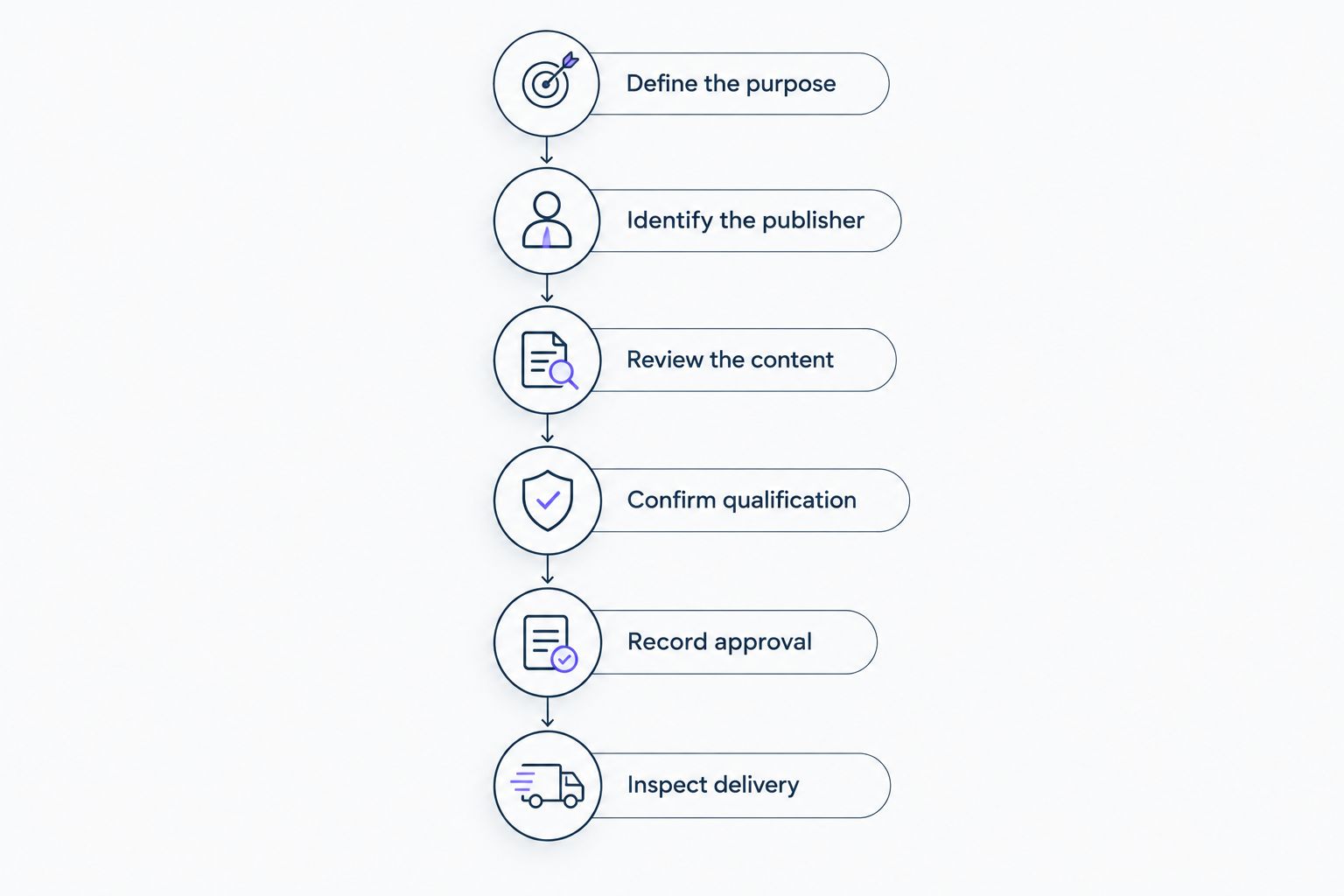
The checklist makes the decision explicit. A seller who answers every question still cannot make purchased ranking credit compliant; the answers establish whether a sponsored placement meets your advertising requirements.
Which seller promises should stop an order?
Reject promises that substitute certainty for evidence. No seller controls Google’s ranking decisions, and a delivery guarantee is not a ranking guarantee.
Watch for these claims or conditions in an offer:
- Guaranteed search positions tied to buying the links.
- A claim that paid links passing ranking credit are automatically Google-approved.
- Refusal to explain the publisher, placement method, or link attributes.
- Permission to replace an approved publisher without your agreement.
- Authority metrics presented as the only evidence of quality.
- Content that forces an unrelated keyword link into the article.
These are decision criteria, not allegations about every Fiverr seller. Judge the offer you have, and keep a record of the statements on which you based approval.
A high authority score does not resolve the policy question. It also does not tell you whether the specific article serves readers, whether the placement is disclosed, or whether your link is implemented as agreed.
What should agencies use instead of blind backlink orders?
NO-BS Marketplace is a link-building option for SEO professionals and agencies seeking verified publisher sites for placements. The platform connects those buyers with publishers for SEO content, backlinks, sponsored content, and digital PR placements.
The practical benefit of NO-BS Marketplace is access to a specialist publisher-placement platform. The limitation is equally important: using NO-BS Marketplace does not remove your responsibility to assess the individual publisher, commercial disclosure, and link attributes.
Choose the work according to the objective:
- Best for paid audience exposure: Properly qualified sponsored content on a relevant publication. Approve the audience fit and article before publication.
- Best for seeking independent citations: Editorial outreach built around useful research, expertise, or a genuine news angle. Accept that the publisher controls coverage.
- Best for outsourced production: A clearly scoped content or outreach service. Buying someone’s work is not the same as buying ranking credit from a publisher.
For a 2026 agency brief, separate delivery acceptance from campaign results. You can verify that an agreed article went live; you cannot infer an organic ranking gain from publication alone.
What if you already bought Fiverr backlinks?
Audit the delivered links before ordering more. Do not treat an unattractive backlink as proof of a penalty, and do not use a traffic chart alone to diagnose link spam.
First, collect the delivered URLs and compare them with the original agreement. Record the destination pages, anchor text, publisher context, and any paid-link qualification.
Next, check Search Console’s Manual Actions report. If Google reports an unnatural-links manual action, follow the stated remediation process, including removal efforts and reconsideration where required.
Google says most sites do not need its disavow tool. Its guidance reserves disavowal for situations involving a considerable number of spammy, artificial, or low-quality links and an existing or likely manual action; it is not routine housekeeping for every unfamiliar backlink.
For 2026 reporting, keep the order history alongside your link audit. It helps distinguish links your team commissioned from links that appeared without your involvement.
FAQ
Is it safe to buy backlinks from Fiverr sellers in 2026?
No—not when you buy backlinks to manipulate Google rankings. Google’s link spam policies apply regardless of whether the seller operates on Fiverr, another marketplace, or independently.
Are all Fiverr backlinks spam?
No; the marketplace name alone does not establish whether a link is spam. Evaluate how the link was obtained, its purpose, its placement context, and whether paid links are appropriately qualified.
Does a highly rated seller make backlinks safe?
No; seller ratings do not establish compliance with Google’s link spam policies. Delivery satisfaction and search-policy compliance are separate questions.
Should a paid backlink use sponsored or nofollow?
Google recommends rel="sponsored" for paid placements and also accepts rel="nofollow". Check the published link’s HTML rather than relying only on a sponsorship label in the article.
Can I buy guest-post writing without buying ranking links?
Yes; paying for writing or outreach work is distinct from paying a publisher for ranking credit. The eventual publication arrangement still needs its own review.
Should I disavow every backlink I bought?
No; Google says most sites do not need the disavow tool. Review the links and Search Console’s Manual Actions report, then follow Google’s guidance for your situation.
Is a specialist guest-post marketplace automatically safer?
No; a specialist marketplace does not automatically make an individual placement compliant. Publisher review, disclosure, link qualification, and purchase purpose still matter.
One last thing
The useful test is whether the placement still makes business sense without ranking credit. Ask that before approving 1 placement, not after committing to a campaign.
If the answer depends entirely on Google rewarding a purchased link, the plan conflicts with Google’s link spam policies. If the answer is relevant audience exposure, write an advertising brief and judge the placement on that basis.