
Yes—guest posting is worth it for lawyers in 2026 when a relevant publication puts useful, attorney-reviewed advice in front of potential clients or referral partners. It is not a reliable shortcut to rankings: paid links intended to manipulate Google violate its spam policies, and publication alone does not prove that a placement generates inquiries.
- Is guest posting worth it for lawyers? Yes, when relevant readers and useful legal content justify the placement.
- Earned editorial contributions and sponsored guest posts require different SEO expectations and disclosure checks.
- NO-BS Marketplace connects SEO professionals and agencies with publishers; each legal placement still needs independent review.
- Measure qualified inquiries and referral engagement, not just backlinks or Domain Rating.
Is guest posting still worth it for lawyers in 2026?
Guest posting earns a place in your marketing plan when you can explain who will read the article and why those readers matter to your firm. A business publication reaching employers is a logical prospect for an employment lawyer. An unrelated site selling space for any topic is not.
Start with audience fit, then assess the editorial process and link arrangement. The guest posting services for law firms guide covers the service category; the decision here is whether a particular placement deserves your firm's attention.
| Approach | Best for | Main advantage | Main limitation | Recommendation |
|---|---|---|---|---|
| Earned editorial contribution | Lawyers with expertise relevant to an established readership | Gives readers a substantive demonstration of legal knowledge | The editor controls acceptance, wording, and links | Prioritize when the audience fits |
| Disclosed sponsored article | Firms seeking exposure to a defined audience | Provides a paid route to publish educational content | Paid links need appropriate qualification; exposure is not guaranteed business | Assess as advertising, not purchased ranking credit |
| Mass guest-post package | No firm seeking accountable editorial quality | Consolidates ordering | Volume does not establish readership, relevance, or policy compliance | Skip when individual publishers cannot be reviewed |
These are different propositions. Do not accept a campaign report that treats every published article as the same kind of result.
Why this matters
A legal article represents your firm even when it appears on someone else's website. Weak explanations, inaccurate jurisdictional statements, and exaggerated outcome claims create problems that a backlink report will not capture.
Guest posting also competes with work on your own website. If your practice pages fail to explain whom you serve or how to request a consultation, sending additional readers there does not fix the underlying problem.
NO-BS Marketplace offers guest posting and link-building services, but the firm's decision should start with its marketing objective. Define whether you want relevant exposure, referral visits, professional recognition, or support for an existing content strategy before assessing publishers.
Earned editorial contributions: best for demonstrating expertise
An earned contribution makes sense when an editor wants your legal knowledge because it serves the publication's readers. Your strongest pitch answers a question that readership already faces, rather than explaining why your firm deserves publicity.
For example, an employment lawyer can propose an article about documenting workplace policies for a business audience. Keep the explanation educational, identify the applicable jurisdiction, and avoid presenting a general article as advice for every reader's circumstances.
The advantage is editorial relevance; the trade-off is control. An editor can reject your submission, remove promotional language, or omit a requested link. Decide whether the contribution remains worthwhile under those conditions before committing attorney time.
Sponsored guest posts: best for defined audience exposure
A sponsored article is a paid publishing arrangement. Evaluate it as advertising: identify the audience, establish the disclosure requirements, review the article, and confirm how readers can reach an appropriate page on your site.
Google Search Central's spam policies identify buying or selling links for ranking purposes as link spam. Its link guidance recommends marking paid links with the sponsored attribute; nofollow is also acceptable for qualifying paid links.
For your 2026 campaign, separate commercial disclosure from link qualification. A visible sponsorship label tells readers about the relationship; a link attribute communicates information to search engines. One does not replace the other.
Sponsored guest posting is a poor fit if the entire business case depends on buying an unqualified link that improves rankings. A relevant audience and a useful article provide a different basis for evaluation, without promising search results.
Why guest-posting value varies for law firms
The same article topic can be sensible on one publication and pointless on another. Assess these factors before approving a placement:
- Audience fit: Identify whether readers include prospective clients, professional referrers, or another group your firm deliberately wants to reach.
- Practice relevance: Connect the legal subject to the publication's normal coverage. A broad legal category alone does not establish a useful match.
- Jurisdiction: Check whether the article's legal scope fits the readers and your attorney's knowledge and authorization to practice.
- Editorial standards: Look for substantive review, identifiable contributors, corrections, and consistent publishing decisions.
- Link arrangement: Establish whether the contribution is earned or sponsored and how any commercial link will be qualified.
- Destination quality: Send readers to a page that answers their next question and accurately represents your services.
Do not replace these checks with a minimum Domain Rating. A third-party domain score is not evidence that the article reaches suitable readers or creates qualified inquiries.
How do you vet a publisher before approving a guest post?
Use 3 screening questions before requesting a draft: who reads the publication, why does this legal topic belong there, and what editorial review will the article receive? Record specific answers, not descriptions such as high authority or premium placement.
Read the publication rather than relying on a listing. Inspect recent articles, contributor biographies, topic consistency, and how readers find content through categories and internal links.
A publisher covering several subjects is not automatically unsuitable. The issue is whether the proposed article has a credible editorial home. An employment-law contribution belongs more naturally within established workplace coverage than between unrelated promotional articles.
Ask to review the proposed publishing terms. Confirm the author attribution, disclosure, destination URL, link attributes, and process for requesting corrections or removal. Do not assume that any publisher promises permanent publication or unchanged links.
Reject a placement when the seller cannot explain its relevance beyond a domain metric. Also reject arrangements that require misleading claims, concealed sponsorship, or an attorney biography that exaggerates credentials.
What must lawyers check before an article goes live?
For a US law firm, review both the legal explanation and the marketing presentation. In 2026, the applicable jurisdiction's professional-conduct rules—not a publisher's standard template—should guide that review.
The ABA Model Rules provide a useful reference point, but jurisdictions adopt and modify their own rules. The ABA's Model Rule 7.1 addresses false or misleading communications about a lawyer's services; Model Rule 1.6 addresses confidentiality. Neither substitutes for checking the rules that govern your firm.
Keep the review focused:
- Accuracy: Verify legal statements against the relevant law and identify the jurisdiction where necessary.
- Claims: Remove unsupported promises, misleading comparisons, and statements implying guaranteed outcomes.
- Confidentiality: Do not disclose protected client information merely because it makes a compelling example.
- Credentials: State attorney qualifications accurately and check restrictions affecting specialist or similar descriptions.
- Disclosures: Check applicable advertising, sponsorship, and publisher requirements.
A general-information disclaimer does not correct inaccurate content or cure a misleading claim. Fix the article itself. Require attorney approval before publication, including the headline, biography, links, and any material edits made by the publisher.
How should you run a legal guest-posting campaign?
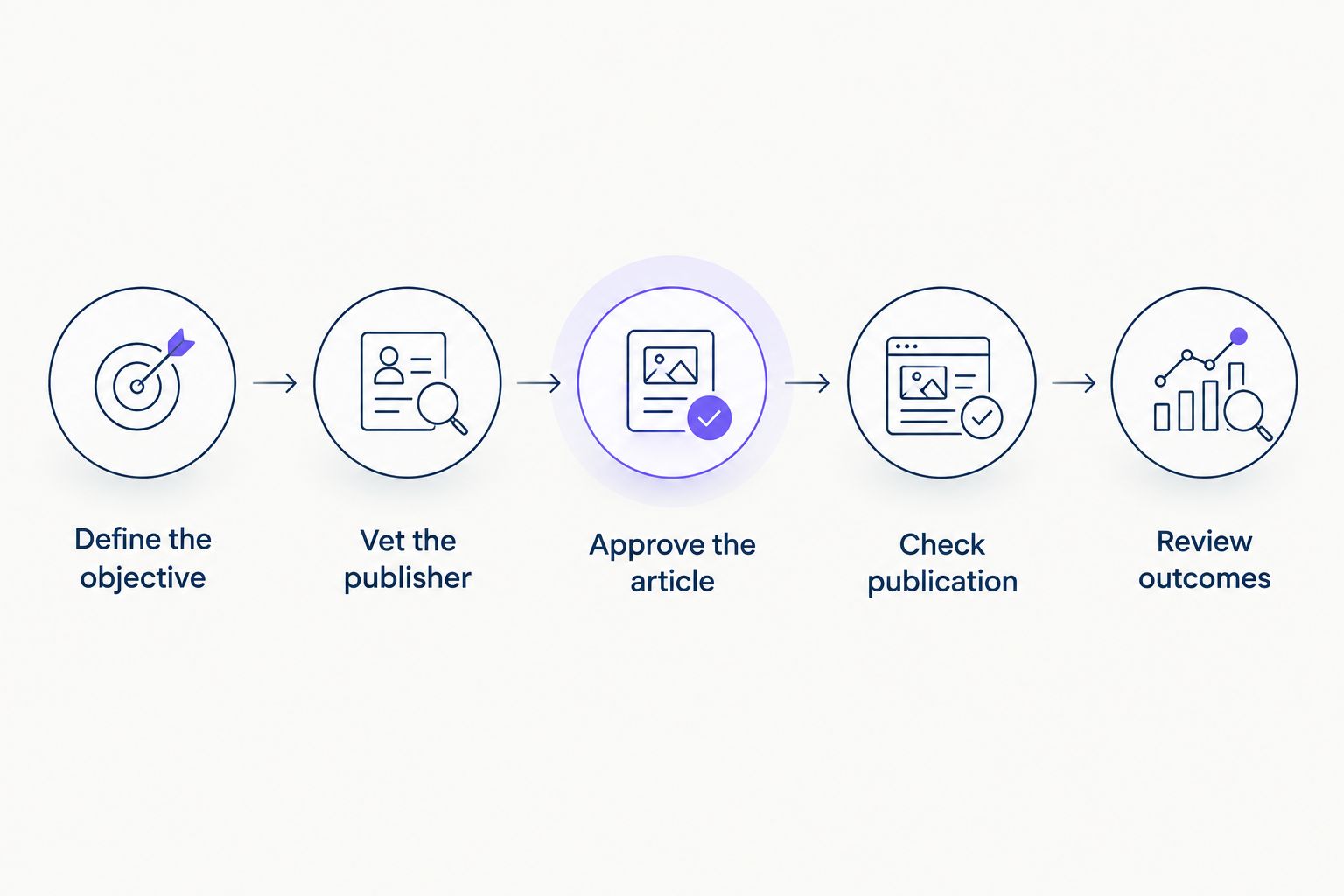
Use 5 approval steps to keep editorial quality and campaign measurement connected. Assign an owner to each step so that the agency, writer, attorney, and publisher do not assume someone else has checked the work.
Define the objective
Choose the result you intend to assess before selecting a publication. Relevant referral visits require a different evaluation from professional exposure, and neither should be reported as proof of improved rankings.
Name the intended reader and the action that makes sense after reading. That action might be reviewing an educational resource or learning about a relevant practice area—not necessarily requesting an immediate consultation.
Vet the publisher
Apply the audience, editorial, jurisdiction, and link checks before commissioning content. Record the reasons for approval so that the next campaign does not repeat the same research without learning from it.
Keep the actual publisher visible in your workflow. A placement description without an identifiable publication prevents meaningful review.
Approve the article
Give the writer a defined reader, topic, jurisdiction, and destination page. Ask the reviewing attorney to check the full publication package, not just the legal paragraphs.
Write the link into a genuinely useful sentence. Avoid forcing a city-and-practice keyword into wording that sounds like an advertisement rather than an explanation.
Check publication
Inspect the live page against the approved version. Confirm the article text, author attribution, destination URL, disclosure, and agreed link qualification.
Check that readers can access the article and that the link reaches the intended page. A publication confirmation email is not a substitute for inspecting what actually went live.
Review outcomes
Compare results with the objective established at the start. Keep publication delivery separate from referral engagement, qualified inquiries, and organic-search changes.
Use the findings to decide whether to work with that publisher again. Repeating a placement should require evidence of audience fit or a defensible exposure objective, not simply convenient ordering.
How do you measure whether guest posting is working?
Build 2 reporting views for your 2026 campaign: placement delivery and business outcomes. Combining them into a single total hides the difference between an article being published and an article helping the firm.
The delivery view records the publisher, article URL, publication date, destination page, disclosure, link attributes, and review status. It answers whether the agreed work appeared correctly.
The outcomes view records identifiable referral visits, meaningful on-site actions, and qualified inquiries attributable to those visits where your tracking supports that connection. Agree with intake staff on what counts as qualified; an irrelevant inquiry is not a successful legal lead.
Review organic-search performance separately. Google Search Console reports clicks, impressions, and query performance, but a ranking change after publication does not establish that a particular guest post caused it. Website changes, other marketing activity, and search-system changes complicate attribution.
Do not report a live backlink as a retained client. Record what the evidence supports, and leave unattributable outcomes unattributed.
When does a guest-posting platform make sense?
NO-BS Marketplace is best for SEO professionals and agencies seeking a platform that connects them with verified publishers for guest posting. That fits teams sourcing placements across client campaigns rather than asking an attorney to manage every publishing relationship directly.
The practical benefit is access to a platform built around those publishing arrangements. The limitation is that platform access does not replace your own assessment of legal relevance, editorial quality, disclosures, or campaign results.
If that operating model fits, assess NO-BS Marketplace against your approval process. Keep attorney review and publisher-level decisions inside the workflow, regardless of who coordinates the placement.
Should you fix your law firm's website before guest posting?
Fix material website problems first. Readers need an accurate destination that explains the relevant service, identifies the firm, and provides a clear next step.
Guest posting does not repair misleading practice descriptions or a broken inquiry form. Approve the destination page alongside the article so the reader's experience remains coherent.
Are local publications better than national publications for lawyers?
Audience fit matters more than geographic reach alone. A local business publication is a sensible prospect for a firm serving nearby employers; a national trade publication is a sensible prospect when its readers match the firm's practice and geographic scope.
Do not equate a larger audience with more suitable prospective clients. Match the readership to your actual services.
FAQ
Is guest posting worth it for lawyers in 2026?
Yes, guest posting is worth it for lawyers in 2026 when relevant readers and useful, attorney-reviewed content justify the placement. It is not a guaranteed route to rankings or retained clients.
Does paying for a legal guest post guarantee better Google rankings?
No, paying for a legal guest post does not guarantee better Google rankings. Google identifies paid links intended to manipulate rankings as link spam, and paid links need appropriate qualification.
Is a high Domain Rating enough to approve a publisher?
No, a high Domain Rating is not enough to approve a publisher. Check audience relevance, editorial standards, topic fit, disclosures, and the actual publishing arrangement.
Should an attorney review every legal guest post?
Yes, require attorney review before publishing legal content under your firm's name. Include the headline, biography, legal statements, confidentiality issues, and marketing claims in that review.
Can a sponsored guest post still be useful with a qualified link?
Yes, a sponsored guest post with a qualified link can still serve an audience-exposure or referral objective. Assess that objective without assuming the link will improve rankings.
How many guest posts should a law firm publish each month?
Set the publishing schedule around relevant opportunities and your capacity for proper review. A fixed monthly quota does not establish quality or business value.
How can a law firm tell whether guest posts bring clients?
Track identifiable referral visits through to qualified inquiries and intake outcomes where attribution supports the connection. Keep those results separate from publication counts and organic-ranking changes.
One last thing
Before approving your next placement in 2026, ask whether you would still want the article published if its link delivered no ranking benefit. If the answer is no, you have identified a ranking-dependent purchase—not a convincing audience or referral opportunity.
That question does not replace due diligence. It makes the business case harder to disguise.