
Yes, guest posting is still effective in 2026 when it earns relevant exposure through useful content on credible publisher sites. It is not a guaranteed ranking shortcut: paid links intended to manipulate rankings violate Google’s spam policies, and a published article does not prove that a campaign delivered results.
- Is guest posting still effective in 2026? Yes for relevant exposure; backlinks alone do not prove success.
- Google requires paid links to be qualified; buying ranking credit is not a compliant strategy.
- NO-BS Marketplace connects SEO professionals and agencies with verified publishers; assess each placement against your campaign goals.
- Judge guest posts by editorial quality, audience fit, referral traffic, and measurable business outcomes.
Is guest posting still effective in 2026?
Guest posting remains a way to contribute expertise to another publication and introduce readers to your business. Its value depends on what you publish, who reads it, and whether the destination page helps those readers. The format alone tells you nothing about the outcome.
Separate editorial contributions, sponsored articles, and link-first publishing before evaluating results. They have different purposes and different compliance requirements.
| Approach | Best for | Main advantage | Main limitation | Recommendation |
|---|---|---|---|---|
| Editorial guest contribution | Sharing relevant expertise with a publication’s audience | Adds useful information and creates an opportunity for referral visits | Publication and links depend on editorial decisions | Pursue when you have something substantive to contribute |
| Disclosed sponsored article | Paid audience exposure and a clearly identified commercial message | Supports planned content distribution | Paid links need qualification; ranking credit is not a promised benefit | Evaluate as sponsored distribution, not purchased rankings |
| Link-first bulk publishing | No recommended use when designed to manipulate rankings | Produces placements to count | Creates link-spam risk and offers no proof of reader value | Reject ranking-manipulation schemes |
The practical test is simple: would this article deserve publication without your backlink? If the answer is no, fix the article or reject the placement.
For a publisher-level checklist, use the guide to auditing a publisher site before buying a placement.
Why this matters
A placement report can look busy while telling you little about performance. Published URLs, domain scores, and backlink totals describe activity. They do not establish that relevant people read the content, visited your site, or became customers.
For an agency’s 2026 guest-posting campaign, the decision is not whether the tactic is fashionable. It is whether the placement serves a defined purpose and whether you can report its results without confusing correlation with causation.
Agree on the goal before approving publishers. A referral campaign needs a useful destination and attribution; an editorial contribution needs expertise and publication fit. A sponsored campaign also needs clear disclosure and appropriate link attributes.
What Google’s rules mean for guest posting
Google Search Central’s spam policies identify buying or selling links for ranking purposes as link spam. Their scope includes links exchanged for money, goods, or services, as well as other arrangements intended to manipulate search rankings. This applies to guest posts too.
Google’s link guidance distinguishes advertising from ranking manipulation. Paid placements should use rel="sponsored"; rel="nofollow" is also acceptable for qualifying paid links. A visible sponsorship disclosure and a link attribute serve different purposes, so one does not replace the other.
Do not purchase an unqualified backlink and describe it as a compliant SEO investment. Treat sponsored guest posts as paid distribution, and assess audience exposure and referral outcomes rather than promising ranking credit.
These are publication requirements, not a claim that Google introduced a new guest-posting rule in 2026. Check Google Search Central’s current spam policies and link-qualification guidance when approving campaign terms.
Why guest-posting results vary
Guest-posting results depend on the placement and destination, not simply the presence of a link. Use these factors to explain differences between campaign outcomes:
- Audience fit: The publisher’s readers need a reason to care about your subject and offer.
- Editorial quality: Specific, accurate content gives readers something useful; a rewritten sales pitch does not.
- Publisher context: The article should belong within the publication’s normal coverage rather than sit among unrelated paid submissions.
- Link context: The destination needs to support the sentence around the link, with paid links qualified appropriately.
- Destination quality: Readers need a useful next step after leaving the publisher; a mismatched landing page breaks that journey.
Do not turn these factors into an invented success formula. Use them as approval criteria, then measure what happened after publication.
How do you run a guest-posting campaign in 2026?
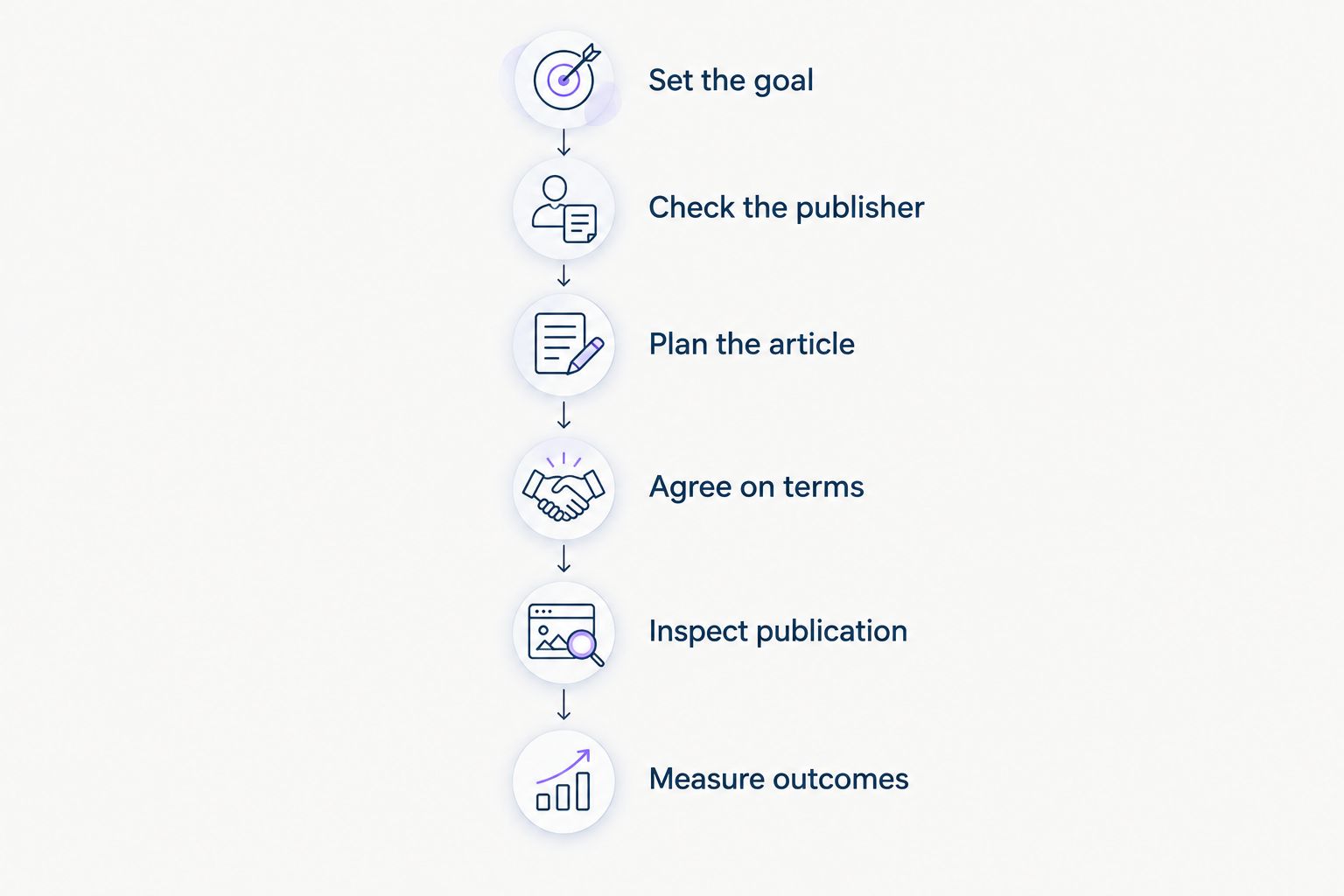
Use 6 steps to keep publisher selection, content production, and reporting connected:
- Set the goal: Decide which outcome makes the placement worthwhile.
- Check the publisher: Inspect the publication beyond its headline metrics.
- Plan the article: Match a useful subject to the publisher’s readers.
- Agree on terms: Confirm disclosure, links, and editorial responsibilities.
- Inspect publication: Verify the live article against the approved brief.
- Measure outcomes: Report results separately from production activity.
The sequence matters. Starting with a publisher list and choosing a goal afterward makes it harder to distinguish a good placement from an available one.
Set the goal
Write down what the guest post should accomplish. Relevant referral visits, qualified inquiries, and exposure to a specific audience are goals you can connect to a publishing decision. A backlink count is an output, not an explanation of business value.
Choose the destination at this stage. If the article addresses a practical problem, link to a page that helps solve it rather than forcing every reader toward the same commercial page. Make sure the destination works before commissioning the article.
Check the publisher
Use 3 screening checks before approving a prospect: inspect its recent coverage, its editorial practices, and its likely audience fit. Read the articles themselves. A domain score cannot show whether the publication accepts irrelevant submissions or whether your proposed article belongs there.
Look for consistent subject coverage, identifiable editorial responsibility, and content that answers real questions. Treat unrelated commercial links and articles with no clear reader purpose as reasons to investigate further. No single score certifies publisher quality.
Plan the article
Give the editor a topic that fits the publication and gives its audience a clear benefit. A focused explanation, practical process, or evidence-backed argument is easier to justify than a broad article built around an anchor phrase.
Use examples you can substantiate. Attribute external information, verify factual claims, and remove filler written only to surround the link. The article needs to stand on its own even if the editor changes the link or removes it.
Agree on terms
Confirm whether the placement is editorial or sponsored before writing. Record who approves the article, how commercial relationships will be disclosed, which destination is permitted, and how paid links will be qualified.
Clarify what happens if the publisher changes or removes the article. Do not assume a permanence guarantee, publication deadline, or revision policy that nobody has agreed to. For an agency, these terms belong in the client brief as well as the publisher discussion.
Inspect publication
Open the live URL and read the published version. Check that the article matches the approved content, the destination is correct, the anchor makes sense, and the link attributes reflect the arrangement.
Also inspect how the article appears within the publication. A live URL is not proof of indexing, readership, or rankings. Record the publication date and any changes from the brief so later reporting has a reliable starting point.
Measure outcomes
Track referral visits and meaningful actions on the destination page. Use campaign tagging where the publisher permits it and your analytics setup supports it; otherwise, examine referral-source data and document attribution limits.
Review search performance separately. A ranking change after publication does not establish that the guest post caused it. Content updates, technical changes, competition, and other campaign activity complicate that interpretation. Report the observed change without assigning unsupported credit.
What should an agency report to clients?
For a 2026 campaign, separate delivery from results. Clients should be able to see what was published, why it was selected, and what evidence exists that it helped.
Start with 4 reporting fields:
- Placement record: Published URL, publication date, destination, disclosure, and link qualification.
- Selection rationale: Why the audience and topic fit the client’s goal.
- Referral outcomes: Visits and relevant actions attributable to the publication, with attribution limits stated.
- Search observations: Changes for the target page, recorded separately from claims about what caused them.
Keep unsuccessful placements in the report. An article with no attributable inquiries is still a result to assess, not an entry to hide. Compare publishers by the outcomes relevant to the campaign rather than turning every metric into a single score.
For white-label work, keep the explanation plain. “Published” means delivered; “generated qualified inquiries” requires evidence. Those statements are not interchangeable.
Where does a guest-posting platform fit?
NO-BS Marketplace is best for SEO professionals and agencies seeking a guest-posting platform that connects them with verified publisher sites. Its stated offering includes white-label link building and guest-posting services, alongside sponsored content and digital PR placements.
The practical benefit is a platform built around publisher placements. The limitation is equally important: access to verified publishers does not establish that every placement matches your audience or that an article will improve rankings.
Use NO-BS Marketplace as a sourcing option, then apply your own campaign criteria. NO-BS Marketplace’s guest-posting offering does not replace checking editorial fit, disclosure, paid-link qualification, or performance against the brief.
Can sponsored guest posts still be worthwhile?
Sponsored guest posts are worthwhile when you are buying relevant distribution, not a ranking promise. Evaluate the publication’s audience, the article’s usefulness, and the destination’s ability to support a reader’s next step.
A qualified paid link still gives a reader a route to your site. That is different from claiming the link will pass ranking credit. Keep those expectations separate in proposals, approvals, and client reports.
If a publisher’s pitch depends entirely on an unqualified link and guaranteed SERP improvement, reject that pitch. Sponsorship is a legitimate publishing arrangement; hiding payment to manufacture ranking signals is not.
Do guest posts help a new website rank?
Guest posts do not guarantee rankings for a new website. External coverage cannot fix pages that fail to answer the target query or pages that search engines cannot properly access and index.
Check the destination first. The page needs a clear purpose, useful content, and an appropriate next step for the publication’s readers. Sending visitors to an unfinished or irrelevant page wastes the opportunity regardless of publisher metrics.
For a new site’s 2026 plan, treat guest posting as part of distribution rather than a substitute for on-site work. Establish useful pages and measurement before committing to repeated placements.
Should you repeat exact-match anchor text?
Use anchor text that accurately describes the linked destination, not a repeated keyword formula. Google’s spam policies identify optimized anchors in guest posts distributed on other sites as a link-spam concern when used to manipulate rankings.
Choose wording that belongs in the sentence. A descriptive reference to a relevant resource is easier to justify editorially than a commercial phrase inserted into unrelated copy.
There is no universal anchor percentage that makes a manipulative campaign safe. Review the purpose and context of each link instead of treating an anchor mix as a compliance guarantee.
FAQ
Is guest posting still effective in 2026?
Yes, guest posting is still effective in 2026 for relevant exposure and referral opportunities when the content fits a credible publication. Publication alone does not prove ranking improvements or business results.
Does Google penalize all guest posts?
No, Google’s spam policies do not prohibit all guest posts. They prohibit link arrangements intended to manipulate rankings, including paid links that are not appropriately qualified.
Should a paid guest-post link use sponsored or nofollow?
Google recommends rel="sponsored" for paid links and also accepts rel="nofollow" for qualifying them. A sponsorship disclosure does not replace the link attribute.
What is the best way to choose a guest-posting site?
Choose a publication whose audience and editorial coverage fit your subject. Inspect actual articles, editorial practices, and placement terms rather than approving a publisher from a domain score alone.
How many guest posts do I need to improve rankings?
There is no fixed guest-post count that guarantees better rankings. Set a campaign goal, assess each placement, and measure results without attributing every search change to backlinks.
Is NO-BS Marketplace suitable for agencies?
NO-BS Marketplace serves SEO professionals and digital marketing agencies and offers white-label link-building and guest-posting services. Agencies still need to assess publisher fit and define how campaign outcomes will be reported.
How do I know whether a guest post worked?
A guest post worked when it delivered evidence of the outcome you selected before publication. Examine attributable referral visits and meaningful actions, and report search changes separately from claims of causation.
One last thing
Before approving your next guest post, ask what would make it worthwhile if its link carried no ranking credit. The answer should identify a relevant audience, a useful contribution, or a measurable referral opportunity.
If the campaign has no value without a ranking promise, change the campaign. That question is more useful than debating whether guest posting is dead in 2026.