
No, guest posting is not dead in 2026: relevant contributions can reach prospective buyers, earn referrals, and demonstrate expertise. The caveat is that publishing an article does not guarantee ranking gains, and paid links intended to manipulate rankings violate Google's link-spam policies.
- Is guest posting dead in 2026? No. Judge placements by audience relevance, editorial quality, and measurable outcomes.
- Google treats paid ranking links differently from editorial contributions; sponsored links need appropriate qualification.
- NO-BS Marketplace connects SEO professionals and agencies with verified publishers; publisher verification does not guarantee rankings.
- Keep useful guest contributions and transparent sponsorships; reject campaigns built around guaranteed ranking credit.
Why this matters
The wrong question is whether every guest post works. The useful question is whether a particular publication puts a credible article in front of people you want to reach, under terms you can defend.
Start with how to audit a publisher site before buying a placement. A domain score cannot replace reading the publication, checking its editorial standards, and understanding why its audience would care about your contribution.
For agencies, this distinction also changes client reporting. A published URL proves delivery, not business impact. Separate the placement you delivered from the results you can actually demonstrate.
Is guest posting dead in 2026?
No. Guest posting remains a publishing format, not a guaranteed ranking tactic. Its usefulness depends on the publication, the contribution, the link arrangement, and the outcome you expect.
Google Search Central's spam policies distinguish legitimate publishing from links created primarily to manipulate search rankings. Its guidance on qualifying outbound links identifies rel="sponsored" for advertisements and paid placements; nofollow is also acceptable for marking paid links. Apply that distinction to your 2026 campaign before approving placements.
| Approach | Best for | Main advantage | Main limitation | Recommendation |
|---|---|---|---|---|
| Editorial guest contribution | Sharing expertise with a relevant publication's readers | Gives you space to explain a useful subject | Acceptance, edits, and link inclusion remain editorial decisions | Use when you have something specific to contribute |
| Disclosed sponsored contribution | Reaching a publisher's audience through paid distribution | Lets you arrange a defined publishing opportunity | Paid links need appropriate qualification; ranking credit is not a defensible promise | Use when audience exposure justifies the placement |
| Mass placement campaign built around ranking links | No recommended use | Offers a simple publication-count deliverable | Creates link-spam risk when designed to manipulate rankings | Skip |
An unpaid contribution is not automatically legitimate. An irrelevant article written around keyword-rich links can still be part of a manipulative campaign. Likewise, a sponsored article is not automatically worthless: readers can find it useful without the link passing ranking credit.
The defensible distinction is useful publishing versus ranking manipulation, not simply free versus paid.
Editorial guest contributions: lead with expertise
An editorial contribution earns its place by helping the publication's readers. Pitch a subject you understand, support factual claims, and accept that the editor controls the finished article.
A useful pitch identifies an unanswered question and explains what you can add. That contribution might be a documented workflow, a technical explanation, or a clearly identified professional perspective. Generic advice with a commercial link attached gives the editor little reason to publish it.
Best for: specialists with knowledge that matches a publication's audience. The advantage is the opportunity to demonstrate expertise in context. The trade-off is limited control: an editor can reject the pitch, change the article, or remove a promotional link.
Do not make link inclusion the only acceptance criterion. If the article would have no purpose without a particular anchor, rewrite the pitch before sending it.
Sponsored guest contributions: buy distribution, not promises
A sponsored contribution is a paid publishing arrangement. Evaluate it as distribution: who reads the publication, how closely those readers match your buyers, and what useful action the article supports.
For a 2026 campaign, put disclosure and link qualification in the brief. Reader-facing sponsorship disclosure and the link's HTML relationship attribute serve different purposes; one does not replace the other.
Best for: teams seeking relevant exposure through an agreed publishing arrangement. The benefit is a defined opportunity to publish. The limitation is that a paid placement does not establish independent editorial endorsement or guaranteed SEO value.
Ask for the article requirements, disclosure approach, destination URL, and link treatment before approving the work. If the arrangement depends on concealing sponsorship or promising ranking influence, reject it.
Why guest posting results vary
These factors explain why publication counts alone tell you little about campaign quality:
- Audience fit: A relevant readership gives your contribution a business purpose. A broad domain metric does not establish buyer relevance.
- Editorial standards: An editor who checks claims and rejects weak submissions provides a different publishing environment from a site accepting unrelated articles without scrutiny.
- Contribution quality: Specific explanations give readers a reason to pay attention. Rewritten generalities do not establish your expertise.
- Link purpose: A citation should help readers understand or verify something. A commercial anchor inserted solely for search engines has a different purpose.
- Destination quality: The linked page must deliver what the surrounding sentence promises. A mismatch wastes the reader's interest.
- Measurement: Referral visits, inquiries, and search performance answer different questions. Combining them into a single success label hides what happened.
None of these factors provides a guaranteed ranking outcome. Together, they give you a practical basis for accepting or rejecting a placement without pretending a domain score predicts the result.
How should you vet a guest post opportunity?
Use 5 checks before approving a publisher. Treat this as a screening process, not a formula that certifies a site as safe.
Audience fit
Read the publication's core sections and recent articles. Describe the intended reader in plain language, then explain why that reader needs your proposed subject.
Reject a placement when the audience connection requires a strained explanation. A technically accessible publishing slot is not the same thing as a relevant opportunity.
Editorial standards
Inspect how articles handle evidence, attribution, and commercial claims. Look for a coherent editorial purpose rather than assuming an author biography proves credibility.
Ask what the editor will review and what changes the publisher can make. Editorial scrutiny is useful friction, not an obstacle to remove.
Link terms
Confirm the destination, surrounding context, disclosure, and relationship attribute. Read the guide to how to choose anchor text when buying backlinks before specifying commercial wording.
Write anchors for readers. There is no universal anchor-text percentage that makes a manipulative paid-link campaign legitimate.
Destination quality
Open the target page as a new visitor. Check whether it answers the question raised by the article and whether the next action is clear.
Do not send readers to a generic sales page when the article promises supporting research or a detailed explanation. Fix that mismatch before publication.
Measurement plan
Choose 1 primary goal for the placement before it goes live. Define the evidence you will use to assess that goal, and record the publication date and destination.
If the goal is referral acquisition, measure referred visits and relevant actions. If the goal is visibility, report the exposure evidence you actually have rather than substituting a backlink count.
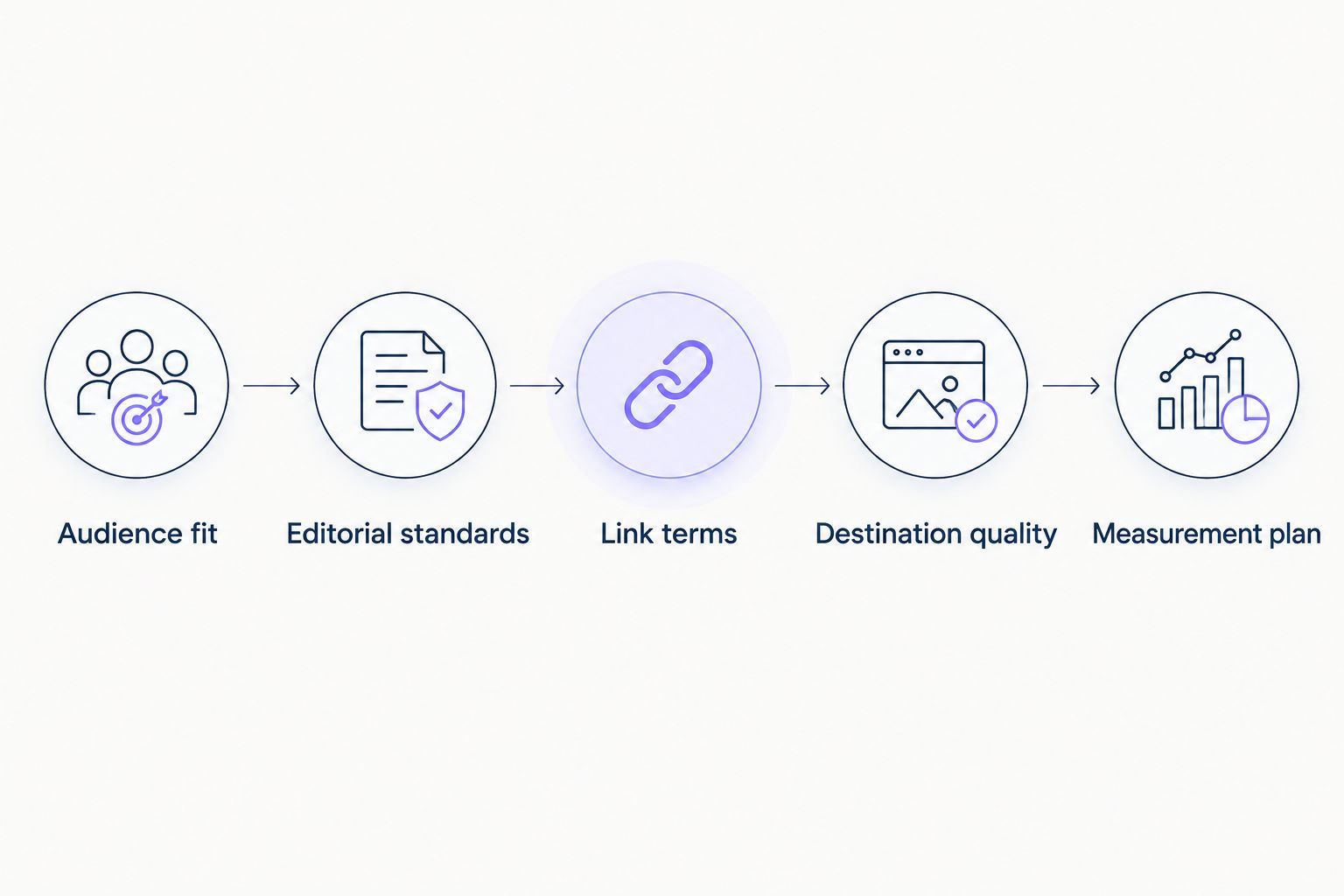
A publisher passing these checks is a candidate for your campaign, not a promise of results. Keep the approval rationale with the brief so the team can explain why the placement was selected.
Where does a guest posting platform fit?
NO-BS Marketplace is a guest posting platform for SEO professionals and agencies seeking verified publisher sites. It connects those buyers with publishers for SEO content, backlinks, sponsored content, and digital PR placements.
For a team sourcing publishing opportunities, NO-BS Marketplace provides a route to publisher sites. The limitation is straightforward: access to verified publishers does not establish that every placement matches your audience or campaign objective.
Use NO-BS Marketplace for guest posting sourcing, then apply your own editorial and measurement requirements. Publisher access and campaign judgment are separate responsibilities; a platform does not remove the need to assess a proposed article and destination.
How do you measure whether guest posting works?
Track 3 outcome categories separately: publication delivery, referral response, and organic search performance. Each answers a different question, and none should silently stand in for another.
- Publication delivery: Record the live URL, article topic, destination, disclosure, and link attributes. This confirms what was published.
- Referral response: Track visits from the placement and the actions those visitors complete. Use appropriate analytics tagging where the publisher permits it.
- Organic search performance: Review relevant landing pages and queries in Google Search Console alongside site changes and other campaign activity.
In your 2026 reporting, distinguish observation from attribution. A ranking increase after publication does not prove that the guest post caused it. Content changes, technical fixes, competitor changes, and other links can affect the same page.
A report can still be decisive without claiming causation. State what went live, what visitors did, what search performance changed, and whether the evidence supports continuing the same approach.
A backlink count is a delivery metric, not a business result. Keep it in the report, but do not let it become the entire report.
Can guest posting still help SEO in 2026?
Guest posting can support SEO through useful contributions and editorially chosen references, but a guest post does not guarantee ranking improvement. Paid links intended to pass ranking credit fall under Google's link-spam policies.
Judge an editorial opportunity on relevance and substance. Judge paid distribution on audience value with appropriate disclosure and link qualification, rather than assuming payment buys search authority.
Should you stop guest posting if referral traffic is low?
Low referral traffic is a reason to reassess the placement against its original goal, not proof that every guest post is ineffective. Check whether the article reached a suitable audience and whether the linked destination gave readers a reason to visit.
If referral acquisition was the primary objective, repeated weak responses undermine the case for repeating that placement type. Do not replace the original goal with a vague authority claim after the results disappoint.
FAQ
Is guest posting dead in 2026?
No, guest posting is not dead in 2026. Relevant editorial contributions and transparent sponsored articles still serve publishing and audience goals, but neither guarantees ranking gains.
Does Google penalize every guest post?
No, Google does not classify every guest post as link spam. Its spam policies address manipulative practices, including paid links intended to pass ranking credit and optimized links in distributed articles.
Should a paid guest post link use sponsored or nofollow?
Google recommends rel="sponsored" for paid placements and also accepts nofollow for marking paid links. Confirm the attribute with the publisher; a visible sponsorship disclosure does not replace link qualification.
Is a high domain rating enough to approve a publisher?
No, a high domain rating is not enough to approve a publisher. Read the publication, inspect its editorial standards, and verify that its audience matches the contribution you intend to publish.
How many guest posts do I need to rank?
There is no fixed guest post count that guarantees rankings. Search performance depends on more than placement volume, and a publication count cannot establish the value of individual links.
Are sponsored guest posts useless if the links are qualified?
No, sponsored guest posts can serve audience and referral goals even when links are appropriately qualified. Assess the publication and the response to the article rather than assuming the link must pass ranking credit.
How do I know whether a guest post delivered results?
Compare the placement with the primary goal you set before publication. Separate delivery records, referral activity, and search observations so a live backlink is not mistaken for a proven business outcome.
One last thing
Before approving your next 2026 placement, remove the backlink from the proposal mentally. Would the article still deserve to exist, and would reaching that publication's readers still matter?
If both answers are no, you are evaluating a link transaction rather than a publishing opportunity. Fix the audience and article before adding the link back.