
Guest posting does not automatically deliver better ROI than paid ads for SaaS in 2026: the winner is the channel that produces more incremental customer gross profit after acquisition costs. Guest posting also carries publishing, attribution, and search-policy risks, while paid ads require ongoing media spend and disciplined conversion tracking.
- Is guest posting better ROI than paid ads for SaaS? Not automatically; compare incremental customer gross profit.
- Paid ads are best for controlled acquisition tests; guest posting is best for reaching relevant publisher audiences.
- NO-BS Marketplace connects SEO professionals and agencies with publishers; a placement alone does not prove return on investment.
- Separate referral conversions, assisted conversions, and organic search changes before crediting guest posts with revenue.
Is guest posting better ROI than paid ads for SaaS?
Neither channel wins on format alone. Paid ads let you buy distribution and adjust targeting. Guest posting puts content on another publisher’s site, where results depend on the audience, article, placement, and destination page.
Start with the mechanics below. For the publishing side, use the guide to tracking which guest posts drive real referral traffic before counting placements as acquisition wins.
| Decision factor | Guest posting | Paid ads |
|---|---|---|
| Best for | Reaching relevant publisher audiences through useful editorial content | Testing acquisition offers with adjustable distribution |
| Main advantage | A published article can keep attracting readers after publication | You control campaign targeting, creative, and spend within platform limits |
| Main limitation | Publisher traffic, editorial changes, and article visibility sit outside your control | Buying additional distribution requires additional media spend |
| Direct evidence | Tagged referral visits connected to qualified leads and customers | Tracked ad interactions connected to qualified leads and customers |
| Attribution problem | Readers can return later through another channel | Attribution can credit ads for customers who would have converted anyway |
| Search consideration | Paid links intended to manipulate rankings violate Google’s spam policies | Ad spend does not purchase organic ranking credit |
| Decision rule | Continue when qualified audience access produces defensible business value | Continue when incremental customer value supports acquisition costs |
Why this matters
For a 2026 SaaS acquisition plan, a demo request is not the finish line. A campaign that generates leads but no retained customers has not established positive ROI.
Guest posting and paid ads also create different reporting temptations. Link reports emphasize placements and domain metrics; ad reports emphasize clicks and attributed conversions. Neither report, by itself, proves that the business earned more than it spent.
Use customer economics to choose the channel, not the channel’s preferred dashboard. Keep operational metrics for diagnosing problems, but make budget decisions from qualified pipeline, closed customers, and customer gross profit.
Guest posting: best for relevant audience access
Guest posting is the stronger candidate when a publisher reaches your actual buyer and the article addresses a problem your software solves. That requires more than a broad technology category match.
Check the reader’s role, company type, use case, and buying responsibility. An article read by software developers is not automatically useful for a product sold to finance directors. Traffic without buyer overlap is a weak acquisition argument.
The article also needs a credible next step. Send readers to a page that continues the discussion, explains the relevant capability, and makes the appropriate conversion action clear. A generic homepage can break that connection.
The advantage is contextual access; the limitation is limited control. Publishers control their sites, readers choose whether to follow links, and articles can change after publication. Treat continued visibility as something to monitor, not something a placement guarantees.
NO-BS Marketplace is best for SEO professionals and agencies sourcing guest posting placements. Its platform connects those buyers with verified publisher sites, but publisher verification is not evidence that a particular placement will generate customers.
If you use NO-BS Marketplace for guest posting, apply the same audience-fit and measurement requirements you would apply to any publisher relationship. Buying the placement and proving its business value are separate jobs.
Paid ads: best for controlled acquisition tests
Paid ads are the stronger candidate when you need to test a defined audience, message, and conversion path with adjustable distribution. You can change campaign inputs without waiting for a publisher to revise an article.
That control is useful when your acquisition question is specific. Does the offer attract the right company size? Does the landing page convert qualified visitors? Do those leads progress through sales?
The advantage is campaign control; the limitation is dependence on continued spend and accurate measurement. An efficient-looking campaign can still attract poor-fit accounts or claim conversions that would have happened without the ads.
Separate brand searches from nonbrand acquisition when evaluating search advertising. Someone already looking for your company presents a different acquisition question from someone discovering the category. Combining those groups hides the distinction.
For sales-led SaaS, return qualification and customer outcomes to the campaign report. For self-serve SaaS, connect acquisition records to activation, payment, and retention. Optimize toward the business event that matters, not whichever event is easiest to track.
How to compare guest posting and paid ads fairly
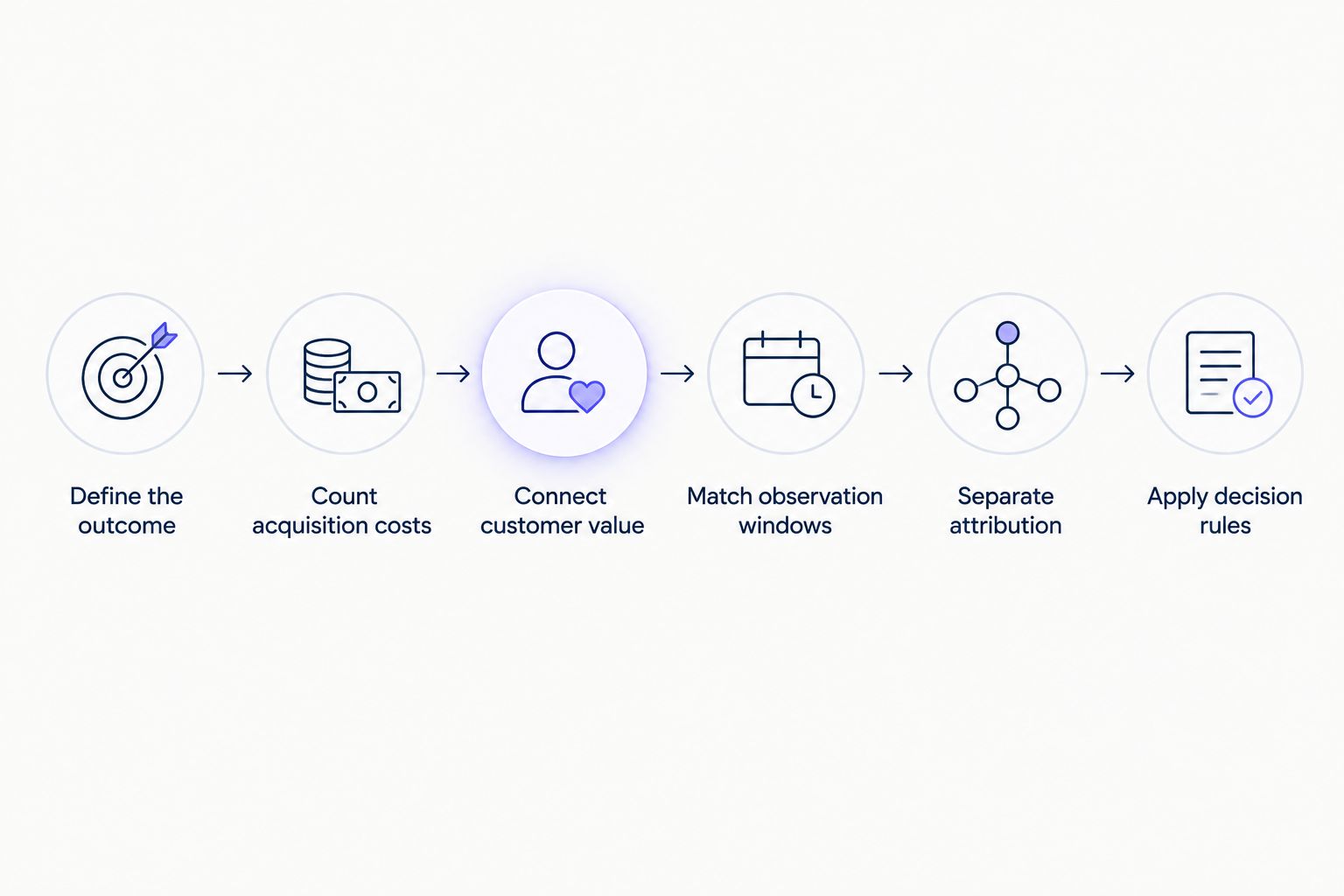
Use a written measurement plan before launching either channel. The following process is a planning framework, not a claim that every SaaS company shares the same sales cycle or payback period.
1. Define the outcome
Choose a primary outcome that reflects your business model: a retained paying account, a sales-qualified opportunity, or another clearly defined milestone. Do not compare guest-post article views with ad-generated customers.
Keep the qualification definition identical across channels. If your sales team rejects an account from one channel, the same account should not count as qualified in the other.
2. Count acquisition costs
For guest posting, include publisher placement, research, writing, editing, outreach, agency work, and internal coordination. For paid ads, include media, creative, campaign management, landing-page work, and relevant internal labor.
Record shared work consistently. If both channels use the same landing page, document how you allocate that work rather than charging it entirely to one channel.
3. Connect customer value
Use customer gross profit rather than treating subscription revenue as profit. Apply the same accounting treatment to both acquisition cohorts, including relevant delivery costs and refunds.
For young cohorts, separate observed value from projected value. A forecast based on expected retention is not the same evidence as gross profit already earned.
4. Match observation windows
Set review points at 30 days, 90 days, and 180 days if those checkpoints fit your sales cycle. These are suggested reporting intervals, not promised conversion or payback timelines.
At the first checkpoint, review tracking and lead quality. At later checkpoints, review sales progression, customer acquisition, and retained gross profit. Compare equally mature cohorts rather than giving one channel longer to produce results.
5. Separate attribution
Maintain distinct views for direct conversions, assisted conversions, and estimated incremental outcomes. A tagged guest-post referral supports a referral attribution claim; it does not prove every later organic conversion came from that placement.
Likewise, an ad-platform conversion is an attribution result, not proof of incrementality. Use appropriate holdouts or controlled tests where practical, and state the limits when your test cannot isolate causation.
6. Apply decision rules
Decide in advance what would justify continuing, changing, or stopping each campaign. Use your own customer economics, qualification standards, and cash constraints rather than borrowing an unsupported industry threshold.
Document changes during the test. A new offer, revised onboarding flow, or different sales process changes the interpretation of channel performance.
The core calculation is straightforward: subtract acquisition costs from incremental customer gross profit, then divide the result by acquisition costs. Express the result as a percentage if that is how your finance team reports ROI.
For your 2026 report, label the calculation accurately. If you have attributed gross profit but no incremental estimate, call it attributed return rather than presenting it as experimentally proven ROI.
Why guest posting and paid ads ROI varies
These factors determine whether the comparison reflects a real acquisition difference or merely different campaign conditions:
- Buyer relevance: Publisher readers and ad audiences must match the accounts you can serve. Broad reach does not establish commercial fit.
- Purchase intent: Someone researching a workflow has a different immediate need from someone actively evaluating vendors. Segment those journeys.
- Conversion experience: The article or ad creates an expectation. Your destination page and conversion action must meet it.
- Sales execution: Qualification, follow-up, and closing affect the value of traffic from either source. Record meaningful process changes.
- Customer retention: Acquisition that produces short-lived accounts has different economics from acquisition that produces retained customers. Compare cohort outcomes.
- Measurement quality: Missing referral tags, disconnected customer records, and overlapping attribution rules weaken the conclusion. Fix those gaps before scaling.
Do not use domain rating as a substitute for these checks. Domain metrics can help screen publishers, but they do not measure buyer relevance, referral conversion, or incremental customer profit.
The same discipline applies to ad metrics. A lower cost per lead is useful only when lead quality and downstream customer value remain acceptable.
Can paid guest posts improve SaaS rankings?
Paid guest posts are not a compliant shortcut to ranking credit. Google Search Central’s spam policies identify buying links for ranking manipulation as link spam, and Google advises qualifying paid links with rel="sponsored"; nofollow is also acceptable.
Keep that distinction explicit in your 2026 plan. Paying for audience access through properly disclosed sponsored content is different from paying for links that pass ranking credit.
A relevant article can still have referral and brand value without a ranking-credit promise. Evaluate that value directly. Do not build an ROI forecast that depends on undisclosed paid links improving your SERP positions.
Disclosure and link qualification address different responsibilities. A reader-facing sponsorship disclosure explains the commercial relationship; a link attribute communicates the link relationship to search engines. One does not replace the other.
Should a SaaS startup choose paid ads before guest posting?
Choose paid ads first when the immediate question requires controllable distribution and a measurable conversion test. That does not mean paid ads are automatically profitable or that a startup must advertise before publishing elsewhere.
Choose guest posting first when you have identified a relevant publisher audience, a useful article angle, and a destination that supports a clear next step. The business case should survive without assuming a ranking increase.
If neither channel has a credible conversion path, fix the offer and landing page first. Buying more exposure to an unclear proposition does not resolve the underlying acquisition problem.
How should you split a 2026 SaaS acquisition budget?
Do not assign a fixed channel split without customer economics. Allocate enough resources to answer a specific acquisition question, then shift spend according to qualified outcomes and the maturity of the evidence.
Keep tests interpretable. Changing audiences, offers, landing pages, and sales follow-up simultaneously makes it harder to identify why results changed.
When both channels contribute, distinguish discovery from conversion. A buyer can read a guest article and later respond to an ad, but that journey does not justify giving each channel full credit for the same customer.
FAQ
Is guest posting better ROI than paid ads for SaaS?
Guest posting does not automatically produce better ROI than paid ads for SaaS. Compare incremental customer gross profit after all acquisition costs using equally mature cohorts.
What is guest posting best for in SaaS marketing?
Guest posting is best for reaching relevant publisher audiences with useful content connected to your product’s use case. Its business value depends on reader fit, qualified visits, and customer outcomes.
Are paid ads better for testing a SaaS offer?
Paid ads are better suited to tests that require adjustable distribution, targeting, and creative. Campaign control does not guarantee profitable customer acquisition.
How long should I measure guest posting results?
Use observation windows matched to your sales cycle rather than a universal deadline. Suggested checkpoints of 30 days, 90 days, and 180 days separate early tracking checks from later customer outcomes.
Can I count higher organic traffic as guest posting revenue?
Higher organic traffic alone does not establish guest posting revenue. Connect traffic to customer outcomes and separate observed changes from evidence that a placement caused them.
Does a sponsored guest post need a sponsored link attribute?
Google advises using rel="sponsored" for paid links; nofollow is also acceptable. Buying links to manipulate rankings violates Google’s spam policies.
Can I use guest posting and paid ads together?
You can use guest posting and paid ads together when each has a defined role and shared measurement rules. Deduplicate customer credit so the same sale is not counted in full by both channels.
One last thing
A campaign can generate customers without generating incremental customers. That distinction is easy to miss when both your publisher report and advertising dashboard show conversions.
Before expanding a NO-BS Marketplace guest posting campaign or increasing ad spend, ask which customers the campaign genuinely added. Where the evidence cannot answer that question, report the uncertainty instead of converting attribution into a stronger claim.