
A backlink marketplace is not automatically safe: use it for transparent publisher placements, not as a guarantee that paid links will improve rankings without risk. Buying links that pass ranking credit violates Google's link spam policies; qualifying paid links addresses that policy issue but does not guarantee publisher quality, referral traffic, or a successful campaign.
- Is a backlink marketplace safe to use? Only with publisher checks, transparent terms, and appropriate paid-link qualification.
- Google treats paid links intended to pass ranking credit as link spam, regardless of who arranges them.
- NO-BS Marketplace connects SEO professionals and agencies with verified publishers; verification does not guarantee search-policy compliance.
- Review the publisher, placement context, sponsorship disclosure, and link attributes before approving a guest post.
Is a backlink marketplace safe to use?
A marketplace can help you source placements, but it cannot make a prohibited link arrangement compliant. Separate the purchasing process from the SEO tactic. A legitimate transaction can still buy a link that violates search policies.
Use these 6 checks before approving a placement. For a purchasing-focused checklist, see how to vet a guest post marketplace before you pay.
- Define the objective. Decide whether you want referral visits, audience exposure, sponsored distribution, or earned editorial coverage.
- Inspect the publisher. Review its subject matter, ownership information, recent articles, and outbound links.
- Review the placement. Check the proposed topic, destination page, surrounding copy, and reason for including your link.
- Confirm link qualification. For paid placements, require appropriate use of
rel="sponsored"orrel="nofollow". - Document the terms. Record the deliverable, disclosure requirements, publication conditions, and agreed remedy for non-delivery.
- Inspect the live result. Verify the published page, destination URL, link attributes, and sponsorship disclosure yourself.
Passing these checks does not create a ranking guarantee. It gives you a documented basis for accepting or rejecting the placement.
Why this matters
In 2026, distinguish 3 risk categories: search-policy risk, publisher-quality risk, and transaction risk. They need different checks. A secure checkout does not validate a publisher, and an established publisher does not make every paid link compliant.
Google Search Central's spam policies identify buying or selling links for ranking purposes as link spam. Google's guidance on qualifying outbound links recommends sponsored for advertisements and paid placements, while accepting nofollow for those links.
That distinction changes the buying decision. If your business case depends entirely on purchasing ranking credit, a better-looking marketplace does not fix the underlying problem.
Sponsored placements: audience value, not purchased ranking credit
Best for: reaching readers through clearly identified commercial content. A sponsored article can explain your subject, introduce your business, and direct interested readers to a relevant destination. Evaluate that opportunity as paid distribution rather than a promised ranking improvement.
The benefit is a defined publishing arrangement. The limitation is that publication alone establishes neither readership nor results, and qualified paid links should not be sold internally as guaranteed ranking signals.
For a 2026 placement, request the proposed subject and publisher before approval. Ask how sponsorship will be disclosed and how the outbound link will be qualified. Treat those as separate questions: a visible advertising disclosure and a technical link attribute serve different purposes.
Earned editorial links: publisher discretion comes first
Best for: coverage based on useful expertise, original information, or a relevant story. Earned editorial links differ from paid placements because the publisher independently decides whether to cover the subject and include a link.
The benefit is genuine editorial selection. The limitation is lack of control: outreach does not guarantee coverage, a particular anchor, or a link at all.
Paying an agency for research, outreach, or campaign management does not automatically mean you bought a publisher link. The deciding issue is the arrangement behind the placement. Ask whether the publisher receives payment or another benefit in exchange for publishing the link.
Paid ranking links: a search-policy risk
Best for: no campaign that requires compliance with Google's link spam policies. Buying an unqualified link specifically to influence rankings is the behavior Google's policy addresses. Calling it a guest post, niche edit, or editorial placement does not change the arrangement.
The apparent attraction is control over the destination and anchor. The drawback is fundamental: that control is being purchased for a prohibited ranking purpose.
Reject a placement whose main sales argument is guaranteed ranking credit. Neither a marketplace listing nor a publisher metric overrides Google's policies. A supplier also cannot guarantee Google's treatment of a particular link.
| Arrangement | Best for | Practical benefit | Limitation or risk |
|---|---|---|---|
| Disclosed, qualified sponsored placement | Paid audience exposure | Defined publishing deliverable | No guaranteed traffic or ranking benefit |
| Independently earned editorial coverage | Expert commentary and useful stories | Publisher-selected coverage | Coverage and links are not guaranteed |
| Paid, unqualified ranking link | No policy-compliant ranking strategy | Buyer-selected link placement | Conflicts with Google's link spam policies |
Why backlink marketplace safety varies
The platform is only part of the transaction. Your objective, the publisher, and the final page determine what you actually receive.
- Payment arrangement: Establish whether you are paying for outreach work, sponsored distribution, or the link itself. Do not accept vague descriptions.
- Publisher relevance: Check whether the publication serves readers who have a reason to care about your topic and destination page.
- Editorial standards: Look for useful articles, identifiable editorial responsibility, and evidence that submissions face meaningful review.
- Placement context: Read the surrounding copy. An unrelated insertion does not become useful because it appears on an established domain.
- Link treatment: Confirm both the agreed attributes and the published implementation. A dashboard description is not the live page.
- Commercial accountability: Get the scope and remedies in writing. Do not assume a replacement, refund, or publication duration that nobody has agreed to provide.
No single factor substitutes for the others. Strong relevance does not excuse an undisclosed commercial arrangement, and clear terms do not turn a weak publication into a useful audience channel.
How do you check a publisher before approving a placement?
Start with the actual site, not its marketplace summary. Read recent articles, inspect the relevant category, and follow outbound links to understand what the publisher routinely recommends.
A third-party authority score is a screening input, not a Google approval signal. Check whether the site's subject matter and publishing history support the story you intend to place.
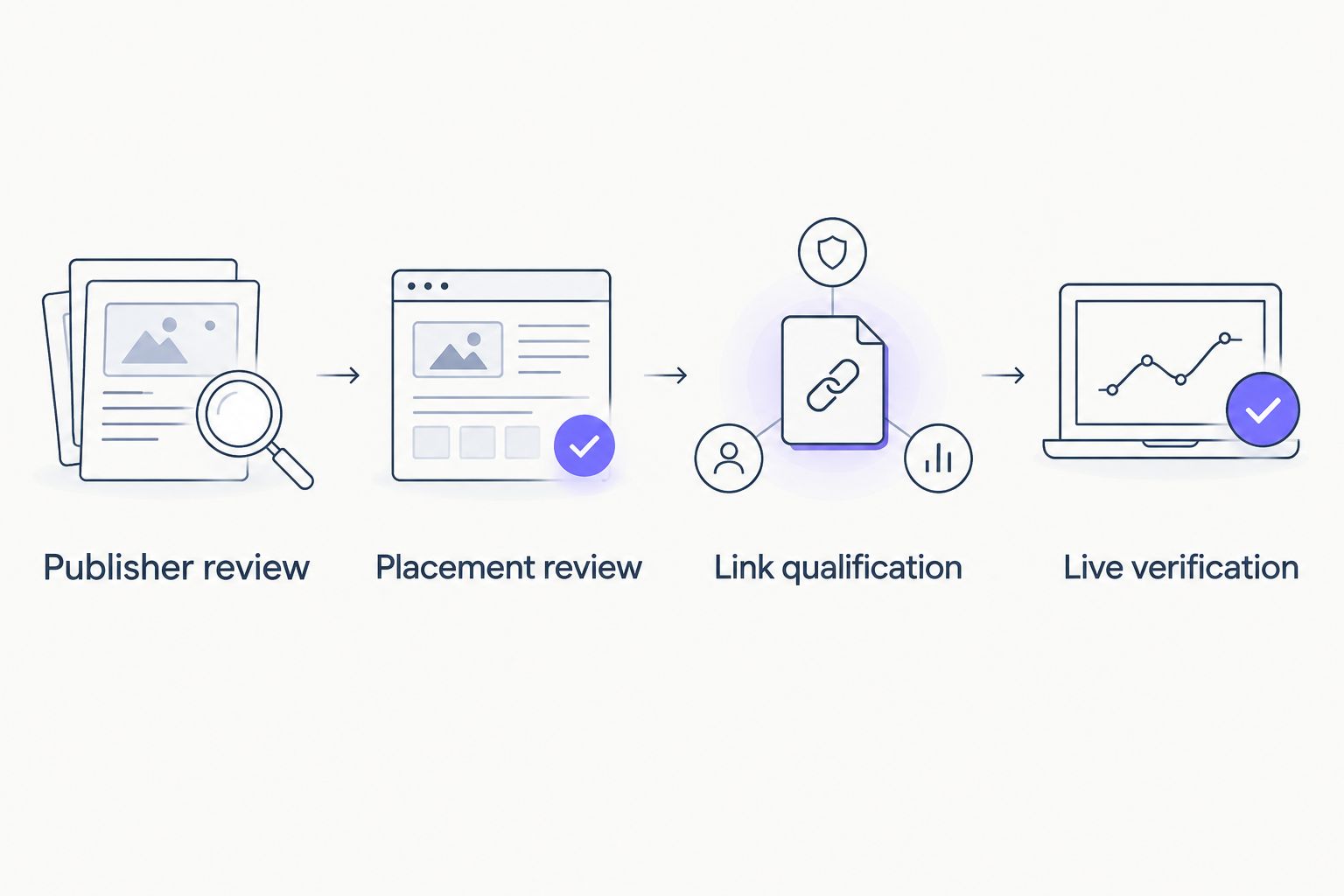
Publisher review
Read beyond the homepage. Look for consistent subject coverage, understandable authorship, and articles that answer real reader questions rather than simply introducing commercial links.
Reject a placement you cannot explain without mentioning its authority score. You need a reason that the publisher's audience belongs in your campaign.
Placement review
Ask for the proposed article topic or insertion context. Confirm that your destination answers the question raised by the surrounding sentence. Avoid forcing a sales page into a passage that calls for a definition, source, or practical guide.
Link qualification
Confirm the treatment of paid links before authorizing publication. Google's guidance recognizes 2 relevant attribute values, sponsored and nofollow, for qualifying paid links, with sponsored the preferred value for that purpose.
Do not confuse an advertising label with an HTML attribute. Readers need understandable disclosure; search engines need appropriate link qualification.
Live verification
After publication, inspect the rendered article and the underlying link. Check the destination, anchor, attributes, disclosure, and whether the page matches the approved topic.
Keep a record of what you approved and what appeared. That evidence supports a specific correction request instead of an argument about what the order was supposed to include.
What should you ask the marketplace before ordering?
Use a short written brief for every 2026 campaign. It should identify the destination page, intended audience, placement purpose, acceptable publishers, and required treatment of commercial links.
Then ask direct questions:
- Can you inspect the publisher before approving the order?
- Who reviews the article for accuracy and relevance?
- How will sponsorship be disclosed to readers?
- Which link attributes will the publisher apply?
- What happens if the published page differs from the agreement?
- What remedy applies if the placement is not delivered?
Do not convert an unanswered question into an assumed promise. If a supplier does not confirm a condition, you do not have that condition agreed.
Keep client approval separate from supplier approval when you buy on behalf of another business. The client should understand whether the deliverable is sponsored content, outreach work, or independently earned coverage. Report it using the same description afterward.
Where NO-BS Marketplace fits
NO-BS Marketplace is best suited to SEO professionals and agencies sourcing publisher placements through a link building platform. NO-BS Marketplace connects those buyers with verified publisher sites for SEO content, backlinks, sponsored content, and digital PR placements; it also offers white label link building and guest posting services.
That platform model gives agencies a place to source placements. Its limitation is equally clear: publisher verification does not establish that every proposed placement meets your relevance standards or Google's requirements.
Apply the same checks to NO-BS Marketplace that you apply to any backlink marketplace. Evaluate the actual publisher and commercial arrangement, not just the platform description.
Can buying backlinks get your website penalized?
Yes. Buying links to manipulate rankings violates Google's link spam policies and can lead to algorithmic action or a manual action. Google can also neutralize link spam rather than give those links the ranking benefit a buyer expects.
A ranking decline alone does not prove a link-related penalty. Check Search Console's Manual Actions report for manual actions, then investigate other causes rather than attributing every movement to a recent placement.
Does a high authority score make a marketplace placement safe?
No. A third-party authority score does not certify editorial quality, policy compliance, or the usefulness of a particular article. Review the page and arrangement independently.
For your 2026 approval process, use metrics to prioritize investigation, not to waive it. A relevant publisher with clear commercial terms still needs a placement-level check.
Is guest posting safer than buying a niche edit?
Neither format is automatically safer. A paid guest post and a paid insertion into an existing article both require appropriate qualification; an independently earned contribution depends on genuine editorial discretion.
Compare the purpose and context before choosing the format. A new article offers room to develop a useful subject, while an insertion depends on an existing passage genuinely needing your resource. Both can be badly executed.
FAQ
Is a backlink marketplace safe to use for a new website?
A new website does not make paid ranking links compliant. Use a marketplace only after reviewing the publisher, commercial terms, disclosure, and appropriate paid-link attributes.
Can a marketplace guarantee that Google will not penalize my site?
No marketplace can guarantee Google's treatment of your site or links. Reject assurances that paid ranking links are penalty-proof.
Do sponsored links need both a disclosure and a link attribute?
Treat reader disclosure and link qualification as separate requirements. A visible sponsorship label does not replace appropriate HTML link attributes, and an attribute does not disclose advertising to readers.
Is NO-BS Marketplace a backlink marketplace for agencies?
NO-BS Marketplace connects SEO professionals and digital marketing agencies with verified publisher sites for content and placements. Buyers still need to assess the individual publisher and proposed arrangement.
Should I reject every publisher that accepts sponsored content?
No. Accepting sponsored content alone does not establish that a publisher is a link farm; assess editorial standards, relevance, disclosure, and link qualification.
Does a nofollow link guarantee referral traffic?
No. A nofollow attribute describes link treatment, not readership or click volume. Assess the publication's audience separately and measure actual referrals after publication.
What should I check after a guest post goes live?
Check the published topic, destination URL, anchor text, link attributes, and sponsorship disclosure. Record any difference from the agreed deliverable and request a specific correction.
One last thing
Before approving your next 2026 placement, remove the promised ranking benefit from the proposal. Would reaching that publisher's audience still justify the work?
If the answer is no, the campaign depends on purchased ranking credit rather than demonstrated audience value. Do not use a marketplace's reputation as a substitute for a defensible placement.