
A guest post has no defensible universal traffic average: its referral traffic depends on how many people read that specific article and then follow your link. For a realistic 2026 forecast, use comparable article-level readership and outbound-click evidence—not the publisher’s total traffic—and measure any search traffic changes separately.
- How much traffic can a guest post bring? Forecast from article readership and outbound clicks, not domain traffic.
- Guest posting referral traffic and organic search traffic are separate outcomes; report them separately.
- NO-BS Marketplace suits SEO professionals and agencies sourcing publisher placements, not guaranteed visitor counts.
- Track referral sessions, engaged visits, and conversions before judging a placement’s business value.
Why this matters
A backlink is not a traffic forecast. A publisher can attract search visitors across its website without sending readers to your particular article. Even when someone reads the guest post, the article must give that reader a reason to visit your site.
That distinction changes what you ask before approving a placement. Instead of asking only about domain metrics, ask where comparable articles get their readers, how the publisher distributes new content, and whether readers follow contextual links.
Set up attribution before publication. This guide to tracking which guest posts drive real referral traffic covers the measurement side; the decision here is whether the placement has a credible route from publication to qualified visits.
How much traffic can a guest post realistically bring?
The practical answer comes from the article’s audience, not a sitewide traffic estimate. Use this sequence to build a forecast you can defend to a client or marketing lead.
- Define the outcome. Decide whether you need referral sessions, qualified inquiries, brand exposure, or support for an organic search campaign. Do not substitute one outcome for another after publication.
- Request comparable readership. Ask for analytics from articles covering similar topics, in the same section, over the same reporting window. Separate actual publisher analytics from third-party estimates.
- Check link-click evidence. Ask whether the publisher measures outbound clicks on comparable contextual links. Article views alone do not establish how many visitors your site will receive.
- Match the destination. Identify the page that answers the reader’s next question. A relevant article cannot compensate for an unrelated landing page.
- Write down the assumptions. Record the readership source, reporting period, promotion commitments, and measurement method beside the forecast.
Expected outbound clicks = expected article views × the observed outbound-click rate for a comparable link.
This is a planning relationship, not a published guest-posting benchmark. Apply it only when both inputs have supporting evidence. Publisher-side clicks and destination-side sessions are different measurements, so do not promise that they will match exactly.
The same discipline applies to a 2026 campaign proposal: label a forecast as a forecast, and keep observed results in a separate column.
Separate referral traffic from organic search traffic
A guest post can create different types of exposure. Each needs its own evidence, and none should be presented as a guaranteed consequence of publication.
| Outcome | Best for | What to measure | Benefit | Limitation |
|---|---|---|---|---|
| Referral traffic | Measuring direct visits from the placement | Referral or tagged campaign sessions | Connects visits to a publication source | Requires readers to follow the link; attribution can be incomplete |
| Organic search traffic | Monitoring search performance on your own site | Landing-page search clicks and relevant queries | Shows whether search visibility changes | Does not isolate the effect of an individual backlink |
| Brand exposure | Reaching readers before they need your service | Article readership and documented distribution | Measures exposure beyond immediate clicks | Exposure is not a visit, lead, or sale |
For referral traffic, the route is direct: someone reads the publisher’s article and follows your link. For organic traffic, someone reaches your website through search. Calling both outcomes guest-post traffic hides an important attribution difference.
Do not assign every later ranking improvement to the guest post. Content changes, internal links, technical fixes, competing pages, and other campaign activity complicate that claim. Report search movement as observed performance unless you have evidence supporting a narrower conclusion.
Why guest-post traffic varies
Use these factors to assess a placement. They explain the route to a visit without pretending that a domain metric predicts reader behavior.
- Article readership. Your link sits on a particular page. Ask about readership for comparable pages rather than dividing the publisher’s total traffic across its article count.
- Audience relevance. Match the publication’s readers to your target buyer, including their location and problem. A relevant topic does not automatically mean a commercially relevant audience.
- Distribution. Establish whether the article receives newsletter inclusion, social promotion, or internal links. Distinguish a documented commitment from an unsupported expectation.
- Link context. Give the reader a clear reason to follow the link. A useful supporting resource serves a different purpose from an incidental company mention.
- Destination fit. Send readers somewhere that continues the article’s promise. A page asking for a sales conversation needs a different level of intent from an educational guide.
- Reporting window. Compare results over matching periods. Launch activity and continuing discovery answer different questions about the placement.
These are evaluation factors, not multipliers you can assign arbitrary scores to. If a publisher cannot substantiate readership or distribution, leave that part of the forecast unquantified rather than filling the gap with an industry average.
Build a forecast without making up a benchmark
Start with the evidence closest to the proposed placement. Your own results from the same publisher and section are more directly comparable than a general claim about guest posting.
Next, examine publisher-provided examples. Check whether the examples cover a similar subject, received similar promotion, and contain links serving a similar purpose. An editorial feature promoted through a newsletter is not a clean comparison for an article published without that distribution.
Keep the forecast explicit:
- Readership basis: identify the comparable articles and analytics source.
- Click basis: identify whether outbound-link behavior is measured or unknown.
- Time basis: specify the period covered by both inputs.
- Destination basis: explain why the proposed landing page fits the reader’s next action.
When click evidence is unavailable, forecast article exposure separately and treat referral traffic as an outcome to test. That is more useful than converting sitewide traffic into an invented visitor promise.
For your 2026 reporting, preserve the original forecast. Revising the expectation after seeing results makes it impossible to assess whether the buying decision was sound.
Measure the placement from publication onward
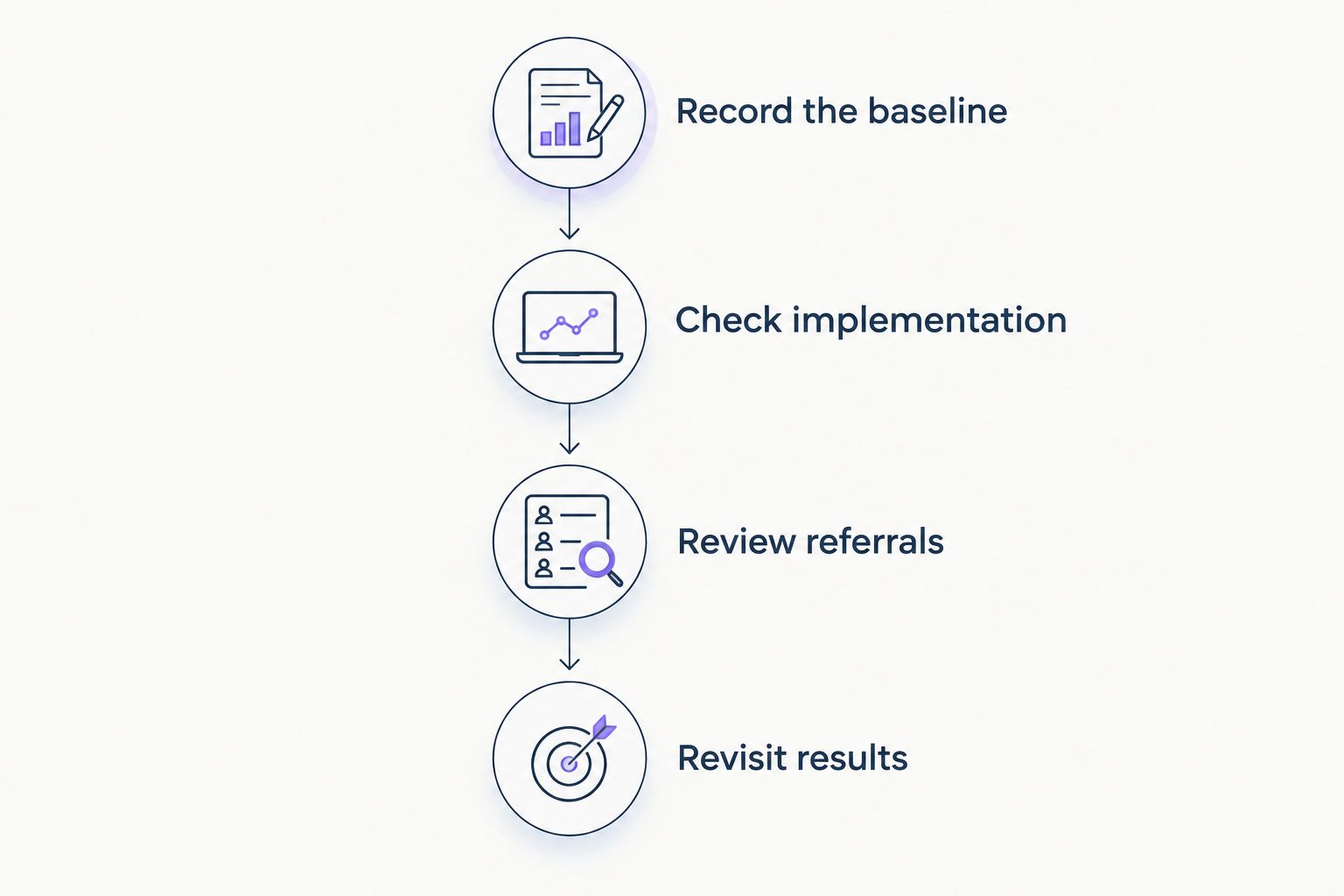
Use a consistent review schedule rather than checking the report whenever someone asks whether the link worked. The following windows are a reporting protocol, not claims about how quickly guest posts produce results.
Record the baseline
Before publication, record the destination page, intended audience, conversion action, and existing search performance. Save the final publisher URL once the article is live, along with the publication date and link destination.
Agree on campaign parameters where appropriate. Use referral reporting alongside tagged campaign reporting, and check that redirects preserve the intended destination and tracking information. Do not put personal information in tracking parameters.
Check after 7 days
Use the 7-day review to check implementation: the article is accessible, the link works, the destination loads, and analytics records your test visit as expected. Exclude internal testing from performance reporting where your setup allows it.
This checkpoint verifies the measurement path. It is not a deadline for declaring the placement successful or unsuccessful.
Review after 30 days
Use the 30-day review to examine referral sessions, engagement, and recorded conversions. Compare those results with any publisher-side article and click reporting for the same period.
Keep denominators clear. Article views, outbound clicks, sessions, and users describe different things; switching between them makes a report look more precise than it is.
Revisit after 90 days
Use the 90-day review to check continuing referrals, cumulative conversions, and relevant search trends. Record other changes affecting the destination page so the placement does not receive credit for unrelated work.
Keep the same definitions throughout your 2026 campaign. A clean reporting series is more useful than a dashboard whose success metric changes each month.
Judge traffic quality before judging traffic volume
A visit matters when it comes from someone your business can serve. Review the destination page’s engagement and conversion events alongside the referral count, then investigate whether the traffic matches your intended market.
For an agency, that means distinguishing prospective clients from readers researching the topic for unrelated reasons. For a local service business, geographic relevance belongs in the evaluation. Neither distinction is captured by the publisher’s domain rating.
Choose the conversion action before publication. A completed inquiry, newsletter signup, or resource download represents a different level of commitment; report the actual action rather than grouping everything under leads.
Also inspect the landing page before blaming the publisher. A broken form, confusing offer, or mismatch between the article and destination leaves you with a conversion problem, not necessarily an audience problem. Check the reader’s full path.
Where a guest-posting platform fits
NO-BS Marketplace is best suited to SEO professionals and agencies sourcing publisher placements. The platform connects those buyers with verified publisher sites for guest posts, backlinks, sponsored content, and digital PR placements.
That sourcing role is useful when you need to organize placement options. It is not evidence that a particular article will deliver a particular visitor count.
When assessing guest-posting options through NO-BS Marketplace, apply the same readership, relevance, and measurement checks you would use elsewhere. A verified publisher relationship does not replace article-level traffic evidence or destination-side attribution.
Keep paid-placement compliance in the brief as well. For a 2026 campaign, follow Google Search Central’s spam policies: paid links intended to pass ranking credit violate those policies. Google recommends qualifying paid links with rel="sponsored"; nofollow is also acceptable. Advertising value and promised ranking credit are not interchangeable.
Can a high-traffic website send little referral traffic?
A high-traffic website does not establish that your guest post will receive readers or clicks. Its audience might arrive on unrelated pages, and the proposed article might receive little distribution.
Ask for evidence about the relevant section and comparable articles. Sitewide traffic is publisher context, not a guest-post visitor estimate.
How long should I wait before judging a guest post?
A 30-day review is a practical first performance checkpoint, followed by a 90-day review for continuing results. These are recommended reporting windows, not traffic delivery deadlines.
Check implementation earlier, then evaluate the placement against the objective and time window agreed before publication.
Is a guest post worthwhile without referral traffic?
A guest post without recorded referrals has not demonstrated referral value. It can still provide documented reader exposure, but that is a separate outcome and needs its own evidence.
Do not rescue an underperforming referral campaign by claiming unmeasured brand impact or guaranteed future rankings. Keep the original objective visible.
FAQ
How much traffic can a guest post bring to a new website?
A new website needs the same article-level evidence as an established site: relevant readership and a reason for readers to follow the link. The website’s age does not provide a reliable visitor estimate.
Can a publisher guarantee traffic from a guest post?
Treat a traffic guarantee as a separate, documented delivery commitment rather than an inherent benefit of guest posting. Check what counts as a visit, the reporting period, the traffic source, and how delivery is verified.
Does a high domain rating mean more referral traffic?
A high domain rating does not establish referral traffic. Domain rating is a third-party backlink metric, not a measurement of article readership or outbound clicks.
Should I track guest-post traffic in Google Analytics?
Use Google Analytics referral and campaign reporting to measure destination-side visits, with tracking configured before publication. Compare that reporting with publisher-side clicks without treating clicks and sessions as identical.
Will a sponsored guest post improve my Google rankings?
A sponsored guest post does not guarantee improved Google rankings. Google’s spam policies prohibit paid links intended to pass ranking credit, and paid links should be appropriately qualified.
Is NO-BS Marketplace a guarantee of guest-post visitors?
NO-BS Marketplace is a guest-posting and link-building platform connecting SEO professionals and agencies with verified publishers. Assess traffic expectations using evidence for the proposed article and publisher, not the platform relationship alone.
What should I ask a publisher before approving a guest post?
Ask for comparable article readership, audience fit, documented distribution, link placement, and available outbound-click reporting. Specify the reporting period so the evidence supports the forecast you are making.
One last thing
Ask to see the reader’s next step before approving the placement. Read the paragraph containing your proposed link, then open the destination page. Does following that link help someone finish the task the article started?
If the connection needs an explanation from the campaign manager, rewrite the passage or choose a more relevant destination. You cannot forecast your way around a link that gives readers no useful reason to leave the article.