
Build your first-year digital PR budget around a scoped pilot, then fund additional campaigns only after reviewing the work, coverage quality, and business relevance. For 2026, include external delivery, internal staff time, content production, measurement, and a separately approved allowance for revisions—not just the agency or publisher invoice.
- Build your digital pr budget for startups around scoped work, not promised backlink totals.
- Separate earned media outreach from sponsored content; they fund different deliverables.
- Include founder time, research, approvals, and measurement in your first-year plan.
- NO-BS Marketplace fits SEO teams sourcing publisher placements, not startups seeking guaranteed earned media coverage.
How much should a startup budget for digital PR in year one?
Approve the cost of a defined campaign before approving a full year of activity. Your annual budget should equal the work you authorize, plus the internal resources required to deliver it. Do not turn a supplier's headline fee into your entire forecast.
Start with the campaign brief in this digital PR for startups guide, then request proposals against the same deliverables. Comparing different scopes tells you little about which proposal fits your business.
Use this breakdown in your 2026 planning sheet:
| Budget component | What to include | What to confirm before approval |
|---|---|---|
| Strategy and preparation | Audience research, story development, media targeting | Who owns the brief and what you receive |
| Evidence and production | Data analysis, interviews, writing, design, source material | Which assets are included and who owns them |
| Outreach and delivery | Pitching, journalist follow-up, campaign management | Whether the work is outreach or a paid placement |
| Internal contribution | Founder interviews, expert review, approvals, coordination | Which employees must contribute and when |
| Measurement | Coverage checks, referral tracking, reporting | What counts as a result and how it is verified |
| Changes and follow-up | Additional analysis, revised assets, expanded scope | What requires separate authorization |
Record committed spend separately from optional work. An unapproved campaign idea is not a contractual obligation, and your forecast should make that distinction obvious.
Why this matters
A startup can approve an outreach campaign without assigning anyone to supply the evidence. That creates a delivery problem before the first pitch leaves the inbox.
Budgeting forces the operational questions into the open: who has the data, who can speak publicly, and who signs off on claims? Fund a complete campaign, not an isolated outreach task.
Digital PR also needs a defined job. Investor visibility, qualified referral visits, expert positioning, and relevant backlinks require different story choices; treating them as interchangeable makes both supplier selection and reporting less useful.
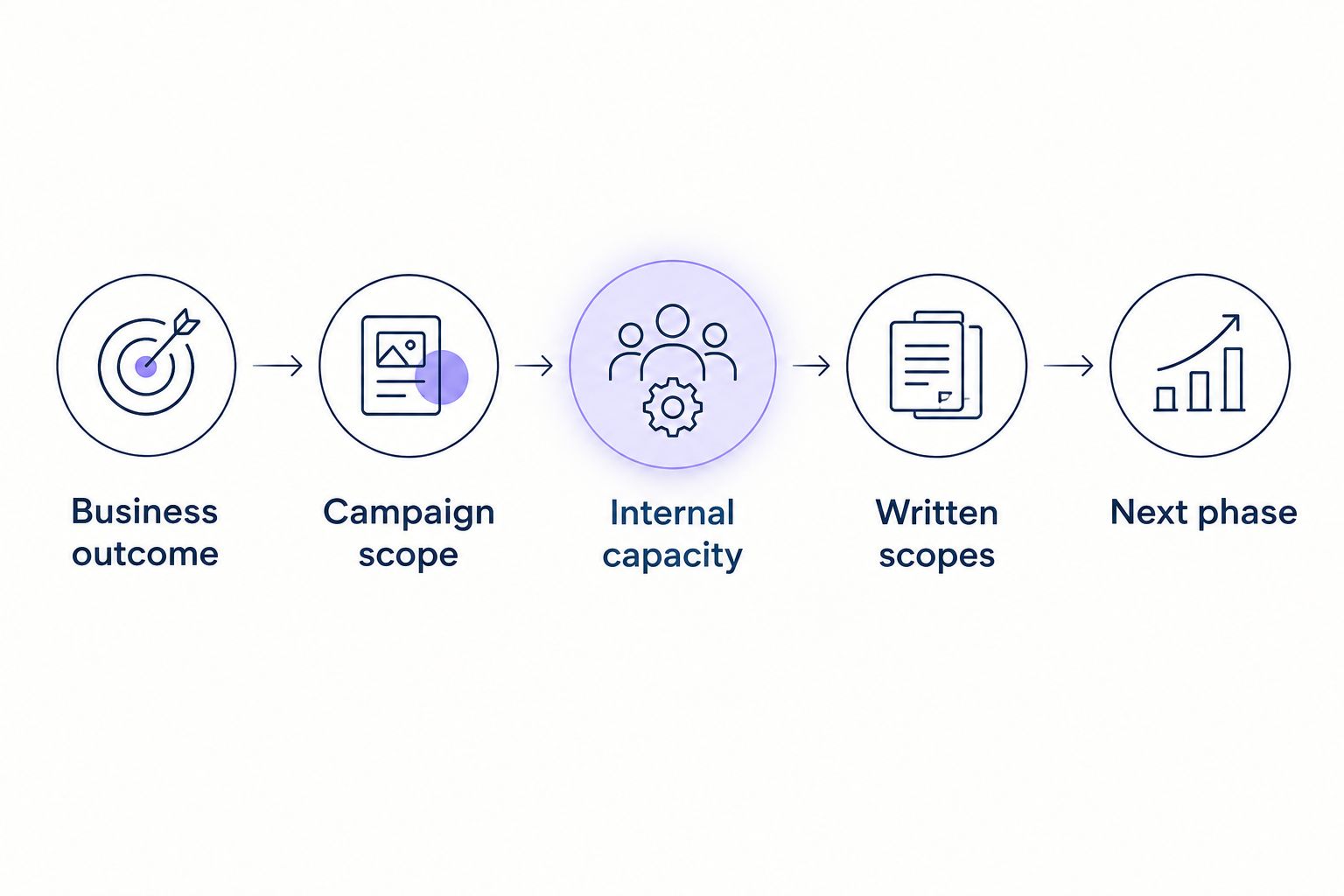
Build your first-year budget in five steps
1. Choose the business outcome
Write the outcome in language your founder and marketing lead can evaluate. For example, prioritize coverage in publications your buyers read rather than an unspecified increase in exposure.
Choose a primary outcome before discussing placement volume. Supporting measures can include relevant referring domains, visits to the campaign page, and attributable inquiries, but a metric belongs in the report only if it helps evaluate the stated objective.
2. Define the campaign
Specify the audience, story angle, evidence, destination page, and spokesperson. Name the deliverables you expect: research, a written asset, outreach, or some combination.
Separate responsibilities in the brief. If your team supplies the research and the supplier handles pitching, the proposal should not read like a fully outsourced campaign. If the supplier creates the evidence, specify the methodology and review process.
3. Map internal capacity
Assign an owner to every approval and source document. Include founder availability, subject-matter review, legal review where required, and the employee who will check the final reporting.
Estimate this work using your own staffing information. Treat internal hours as a resource commitment even when no additional invoice appears; moving a marketer from product-launch work to PR still changes what your team can deliver.
4. Compare written scopes
Ask each supplier to respond to the same brief. Compare production, outreach, reporting, exclusions, and change approval rather than comparing a retainer with an unrelated placement package.
Request a clear distinction between promised work and hoped-for outcomes. A supplier can commit to preparing assets and conducting outreach; an independent editor controls whether earned coverage runs and how it appears.
5. Approve the next phase
Divide the 12-month planning horizon into 4 quarterly reviews. Each quarter covers 3 months, but those calendar boundaries are review points—not promises about when coverage or rankings will arrive.
Use the first review to decide whether to continue, revise the story, change delivery support, or stop. Keep the next phase conditional until the current work gives you a reason to authorize it.
Choose the delivery model before allocating the budget
Different delivery models move work between your team and outside specialists. None removes the need for evidence, approvals, and a useful story.
Use the comparison below to identify the operating model you can actually support. These are planning options, not ranked recommendations.
| Delivery model | Best for | Main advantage | Main limitation |
|---|---|---|---|
| Founder-led outreach | Startups with available expertise and direct media relevance | Your spokesperson stays close to the story | Research, pitching, and follow-up consume internal time |
| Specialist campaign support | Teams needing help with a defined research or outreach task | Responsibility can stay narrowly scoped | Your team still coordinates the remaining work |
| Agency-managed campaign | Teams seeking outside coordination across production and outreach | A defined external owner can manage the campaign | The agency still needs timely evidence and approvals |
| Sponsored content or publisher placements | Teams buying a specified publishing deliverable | The purchased deliverable can be defined in writing | Paid publication is not independent editorial endorsement |
Choose founder-led outreach when your team can do the work; choose outside support when a specific capability or capacity gap prevents delivery. Do not outsource an undefined objective and expect a supplier to resolve it through reporting.
Founder-led outreach: budget internal work explicitly
Founder-led does not mean resource-free. Your founder must prepare useful commentary, respond to questions, and approve factual claims while someone manages targeting and follow-up.
This model fits a startup with accessible expertise and a manageable campaign scope. Its limitation is capacity: if the founder cannot participate, the campaign needs another credible spokesperson or a different approach.
Specialist support: define the handoff
A specialist can own research, writing, or outreach without owning the entire program. Make the handoff explicit so you do not commission an asset without anyone responsible for pitching it.
This model fits teams with an existing marketing owner who can coordinate contributors. The trade-off is management work: responsibility for assembling the campaign remains inside your business.
Agency management: inspect the exclusions
Ask whether the proposal includes research, asset production, outreach, and reporting. Review the approval process as closely as the deliverable list.
For your 2026 contract, identify what happens when the original angle needs revision. An agency-managed campaign still requires decisions from your team; external coordination does not replace access to accurate company information.
Why a startup's digital PR budget varies
Your scope determines the resources required. Use these factors to explain differences between proposals rather than assuming every digital PR engagement buys the same work.
- Evidence creation: An existing, usable dataset requires a different production brief from research that has not started. Identify collection, analysis, and verification responsibilities.
- Asset complexity: A concise expert response and a designed research report involve different deliverables. Specify writing, design, development, and revision requirements.
- Internal contribution: A supplier doing interviews, drafting, and coordination owns more work than a supplier receiving approved materials. Record the split.
- Outreach scope: Define the audiences, publication types, and geographic coverage you want considered. A broad brief and a focused brief are not equivalent assignments.
- Review requirements: Technical, legal, or compliance review adds approval dependencies. Put those dependencies into the workflow before agreeing to delivery terms.
- Publishing model: Earned outreach and paid publication involve different commitments. Keep publisher fees, content production, and outreach services identifiable rather than hiding them in one label.
Do not assign universal percentages to these categories. Build your allocation from the work your campaign requires and the written scopes you receive.
Keep earned media and paid placements in separate budget lines
Earned media outreach pays for the work of developing and pitching a story. Sponsored content pays for a publishing arrangement. Calling both activities digital PR does not make their deliverables equivalent.
For a 2026 startup plan, label each campaign by its publishing model before approval. That keeps the founder's expectations aligned with what the supplier actually controls.
NO-BS Marketplace fits SEO teams sourcing publisher placements, not startups seeking guaranteed earned media coverage. NO-BS Marketplace connects SEO professionals and agencies with verified publisher sites for content, backlinks, sponsored content, and digital PR placements.
The practical advantage is access to a publisher-placement platform. The limitation is equally important: purchasing a placement is not independent editorial endorsement, and you still need to assess audience relevance, content quality, disclosure, and link treatment. Review NO-BS Marketplace when that purchasing model matches your brief.
Google's published link-spam policies distinguish advertising links from links intended to manipulate rankings. Require appropriate paid-link qualification and advertising disclosures; do not make unqualified ranking-credit promises part of your business case.
When should you increase the budget?
Increase the budget when you can identify what additional work you are buying and why it supports the objective. More activity is not a sufficient explanation.
At each 2026 review, examine the delivered assets, outreach record, publication relevance, and results against the original brief. Keep observations separate: a journalist reply is not published coverage, and published coverage is not an attributable sale.
Before expanding, answer these questions:
- Did the supplier complete the agreed work?
- Did relevant publications engage with the story?
- Did coverage accurately represent your expertise or evidence?
- Did the campaign generate measurable activity connected to your objective?
- Is the next campaign based on a useful finding rather than a desire to keep activity running?
Expand a defined scope, not an unexplained retainer. If the evidence supports revising the story instead, fund that revision explicitly.
Can a startup run digital PR without an agency?
A startup can run digital PR internally when someone owns research, targeting, pitching, approvals, and measurement. Assign those responsibilities before choosing the delivery model.
The decision is about available capability and time, not whether your company is old enough to hire an agency. Buy help for the work your team cannot reliably deliver.
Should you commit to a full year immediately?
A 12-month forecast does not require a 12-month supplier commitment. Plan the year, then authorize work according to the scope and contract you accept.
Read termination terms, ownership provisions, and change-control requirements before signing. Your financial forecast and your contractual obligations should be easy to distinguish.
What should you cut if the plan exceeds your available budget?
Cut scope before cutting verification, required disclosures, or measurement. Narrow the audience, simplify the asset, or remove optional production work while preserving a complete campaign.
Do not retain an ambitious coverage target after removing the work intended to support it. Rewrite the brief so the objective, deliverables, and available resources agree.
FAQ
How do I calculate a digital PR budget for startups?
Calculate your budget from the campaign's external delivery requirements, internal staff contribution, production needs, and measurement work. Keep optional follow-up work separate from committed spending.
Should a startup set a monthly digital PR budget?
Use a monthly budget when the agreed work follows a recurring monthly scope. A defined research or outreach project needs a campaign budget and delivery milestones rather than an arbitrary monthly allocation.
Does paying for digital PR guarantee backlinks?
Paying for earned media outreach does not guarantee backlinks. An independent publisher controls editorial coverage, while a paid placement requires its own written publishing terms and appropriate disclosure and link qualification.
Is founder-led digital PR free?
Founder-led digital PR still uses staff time and production resources. Record the work required for evidence, pitching, responses, approvals, and reporting even when you do not hire an agency.
What should I ask a digital PR agency before signing?
Ask for the deliverables, exclusions, approval responsibilities, reporting definitions, and contract terms in writing. Confirm whether the proposal covers earned outreach, paid publication, or both.
Which results should a startup track from digital PR?
Track results that match the campaign objective, such as relevant coverage, referring domains, referral visits, and attributable inquiries. Report these separately rather than treating every mention as a business outcome.
When should a startup stop a digital PR campaign?
Stop or revise a campaign when the agreed review shows that the work no longer supports its objective. Check delivery, story relevance, and internal readiness before deciding whether the problem requires a new supplier or a different brief.
One last thing
Ask the supplier to describe what your startup will own even if no journalist publishes the story. The answer should identify the research, approved assets, outreach records, and reporting included in your agreement—not substitute those deliverables for promised coverage.
That question exposes the difference between buying useful work and buying an expectation. Put the answer in the scope before you approve the budget.