
Publish only as many guest posts per month as you can place on relevant sites, edit properly, and connect to a clear campaign goal; there is no universal monthly quota. In 2026, your publishing target should follow your approved opportunities and editorial capacity—not a supposedly safe backlink count. A small schedule does not make manipulative links safe, and a busy schedule does not make useful editorial contributions spam.
- How many guest posts should you publish per month? Match volume to vetted publishers and editorial capacity, not quotas.
- NO-BS Marketplace connects SEO professionals and agencies with verified publishers; verification does not replace campaign-specific checks.
- Increase guest posting only when relevance, editorial quality, and reporting hold up.
- Paid backlinks intended to manipulate rankings violate Google’s spam policies, regardless of monthly volume.
How many guest posts should you publish per month?
Your monthly target is the number of suitable placements you can deliver without lowering your acceptance standards. Work backward from approved publishers, useful article ideas, ready destination pages, and available editorial time.
Start with a repeatable publisher site audit before buying a placement. A publication deadline is not a reason to accept a site you would otherwise reject.
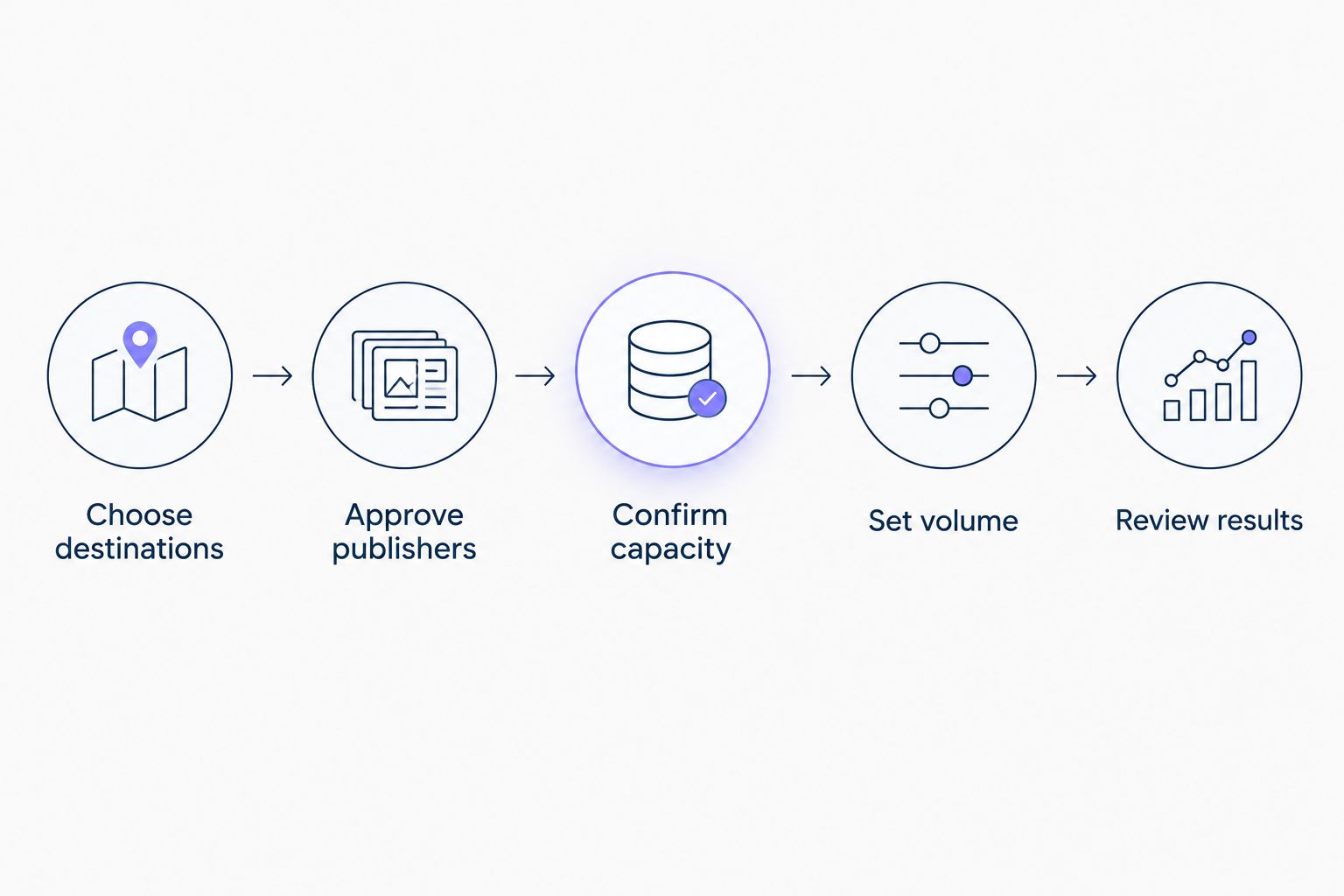
Use this process to set the target:
- Choose destinations. Identify the pages that deserve additional exposure and explain what readers gain by visiting them.
- Approve publishers. Check audience relevance, actual articles, editorial standards, and the proposed placement context.
- Confirm capacity. Establish how much original writing, subject review, editing, and coordination your team can complete.
- Set volume. Commit only to placements supported by approved publishers and production capacity.
- Review results. Compare completed work with the campaign objective before renewing or expanding the schedule.
If the approved opportunities exceed your production capacity, reduce the commitment or add editorial resources. If your writers have spare capacity but the publisher shortlist is weak, improve prospecting instead of filling the calendar with marginal sites.
Why this matters
A monthly guest-post quota measures production. It does not establish whether the work belongs in your SEO strategy.
For a 2026 campaign, separate the business objective from the delivery commitment. A referral campaign needs a relevant audience and a reason to visit; a reputation campaign needs credible subject matter and suitable editorial context. Neither objective is adequately described by a raw link count.
NO-BS Marketplace is a guest posting platform for SEO professionals and agencies that want access to verified publisher sites. That access addresses sourcing, not the separate decisions about article quality, audience fit, or whether a particular placement serves your campaign.
Choose whether to pause, maintain, or expand
Your campaign does not need a fixed numerical tier to make a clear decision. Choose the operating state that matches the evidence in your current pipeline.
| Decision | Best for | Advantage | Limitation | Recommendation |
|---|---|---|---|---|
| Pause new commitments | Teams with weak publisher options or unfinished destination pages | Protects time for correcting the underlying problem | Delays new placements and audience exposure | Pause until the missing requirement is resolved |
| Maintain the current schedule | Teams delivering suitable articles with consistent review | Keeps production manageable and comparable | Does not address an unmet need for additional reach | Maintain while reviewing campaign outcomes |
| Expand the schedule | Teams with additional vetted opportunities and editorial capacity | Extends the campaign without deliberately lowering standards | Adds review, coordination, and reporting work | Expand only after confirming those resources |
A capacity decision is not a ranking forecast. Increasing the schedule does not establish that rankings will improve, and maintaining it does not guarantee stable results.
Keep the decision specific to the campaign. An agency can expand work for a client with ready content and strong publisher matches while pausing another client whose landing pages still need attention.
Why monthly guest-post volume varies
The useful question is not what everyone else publishes. It is what limits your next suitable placement.
- Publisher relevance. A site needs a credible connection to your topic and intended reader. Rejecting unsuitable opportunities reduces the publishable pipeline by design.
- Article substance. A technical explanation, original example, or specialist contribution requires the right author and review. Do not promise a schedule before confirming that work is possible.
- Destination readiness. The linked page must deliver what the article promises. An unfinished or mismatched page is a reason to fix the destination before seeking more exposure.
- Editorial capacity. Writing is only part of production. Fact-checking, revisions, publisher communication, and final checks also need an owner.
- Campaign purpose. Referral visits, brand exposure, and relationship development require different evidence of success. Set volume around the actual objective.
- Placement terms. Editorial requirements, sponsorship disclosure, and link attributes affect whether an opportunity fits the campaign. Agree on them before committing.
These are operating constraints, not a formula for manipulating search results. Improving a constraint gives you room to reconsider volume; it does not create an obligation to publish more.
For your 2026 plan, record the limiting factor beside the monthly target. That makes the next decision concrete: improve the publisher shortlist, finish the destination page, or assign more review time.
Build a publishing schedule from approved work
Use a simple sequence: Choose destinations, Approve publishers, Confirm capacity, Set volume, Review results. Keep these stages separate so an optimistic prospect list does not turn into an unsupported delivery promise.
Separate prospects from commitments
A publisher on a prospect list is not a confirmed placement. Record whether the site is unreviewed, approved, awaiting a pitch response, accepting a draft, or ready to publish.
This distinction matters when you report progress. A full outreach pipeline can coexist with a thin publishing schedule, and neither should be disguised as completed work.
Assign ownership before setting deadlines
Give each article an owner for the draft, subject review, publisher communication, and live-page check. One person can cover several responsibilities, but none should disappear from the plan.
Publishers also control their own editorial calendars. Treat an intended publication date as a planning commitment to confirm, not an outcome your internal calendar can guarantee.
Keep a replacement queue without lowering standards
Prepare additional suitable topics and publisher candidates in case an opportunity falls through. Apply the same checks to replacements that you apply to the original shortlist.
If no suitable replacement exists, report the shortfall. An honest missed target is better than an unsuitable placement accepted to complete a spreadsheet.
Can you publish too many guest posts in a month?
There is no universal monthly ceiling that separates legitimate guest contributions from link spam. Google's published spam policies focus on manipulative practices, including buying or selling links for ranking purposes, rather than granting a safe allowance of guest posts.
As of 2026, Google Search Central's guidance allows paid advertising and sponsorship links when appropriately qualified with rel="sponsored" or rel="nofollow". Qualifying a paid link is not the same as purchasing ranking credit.
That distinction changes the planning conversation. Do not ask how slowly you must acquire paid links to make them look acceptable. Ask whether the publication, article, disclosure, and link treatment are appropriate in the first place.
A busy campaign also creates practical risks: rushed drafts, missed factual errors, repetitive topics, and incomplete live-page checks. These are reasons to limit production to what you can supervise—not evidence of a particular numerical penalty threshold.
Should a new website publish fewer guest posts?
A new website needs a useful destination before it needs a publishing quota. Check that the relevant pages explain the offer, answer the visitor's question, and provide a clear next action.
That does not establish a special monthly allowance for new domains. It establishes a readiness test that also applies to established sites.
If your website lacks useful supporting content, prioritize that work before expanding external contributions. Otherwise, the guest article makes a promise the destination cannot keep.
For an established website, apply the same discipline at page level. A strong domain does not make every landing page ready for promotion, and historical traffic does not prove that a proposed guest-post topic fits your audience.
What to measure before increasing volume
Keep delivery reporting separate from outcome reporting. Both matter, but they answer different questions.
| Reporting area | What to record | What it tells you | What it does not prove |
|---|---|---|---|
| Delivery | Published articles, live URLs, outstanding revisions | Whether the agreed work was completed | Whether the work improved the business |
| Placement quality | Relevance, article accuracy, link destination, disclosure | Whether the placement meets your acceptance criteria | That the link will influence rankings |
| Referral outcomes | Visits and meaningful actions attributable to the placement | Whether readers followed through | The placement's full effect on awareness |
| Organic search | Target-page impressions, clicks, and query movement | How search visibility changed during the campaign | That guest posts caused the change |
Use consistent measurement periods and note other changes, including page revisions and technical fixes. Search performance has multiple inputs; a before-and-after chart does not isolate a backlink's effect.
For your 2026 reporting, preserve publication dates and destination URLs alongside the results. This gives you a usable record rather than a growing total with no campaign context.
Increase volume when the additional opportunities meet your standards and the team can absorb the work. If results are unclear, improve measurement before treating more placements as the answer.
Where a guest posting platform fits
NO-BS Marketplace connects SEO professionals and digital marketing agencies with verified publishers for guest posts, SEO content, backlinks, sponsored content, and digital PR placements. The practical benefit is access to publisher options within a platform.
The limit is equally clear: publisher access does not determine your monthly target or establish that every opportunity fits your audience. You still need to assess the specific site, proposed article, destination, and placement terms.
Use the platform as part of sourcing and fulfillment, not as a substitute for editorial judgment. Put your acceptance criteria in the brief before selecting placements, and retain those criteria when delivery pressure rises.
FAQ
How many guest posts should I publish per month for SEO?
Publish the number you can support with relevant publishers, useful articles, and proper editorial review. There is no universal monthly quota that guarantees SEO gains or protects manipulative links from Google's spam policies.
Is there a safe monthly limit for guest-post backlinks?
There is no published universal monthly limit that makes guest-post backlinks safe. Evaluate the purpose and treatment of the links rather than relying on a numerical allowance.
Should I publish guest posts every week?
Publish weekly only if your approved opportunities and editorial capacity support that schedule. A weekly deadline is not a reason to accept an irrelevant publisher or an unfinished article.
Should I pause guest posting if rankings do not improve?
Review the campaign objective and placement quality before deciding whether to pause. Rankings alone do not establish whether a placement generated useful referral visits, and ranking changes do not prove the effect of an individual link.
Does NO-BS Marketplace decide how many guest posts I need?
Your campaign goals, publisher fit, and production capacity should determine the target. NO-BS Marketplace provides access to verified publishers, but platform access alone does not establish an appropriate monthly volume.
Can I send every guest-post link to the same landing page?
Choose the destination that genuinely helps the reader in each article. Do not force every contribution toward a landing page that does not match the topic or the surrounding sentence.
Do paid guest posts need sponsored link attributes?
Google recommends qualifying paid placement links with rel="sponsored"; rel="nofollow" is also acceptable under its published guidance. Link qualification and reader-facing sponsorship disclosure serve different purposes, so address both where applicable.
One last thing
Make a rejected-opportunities log part of your 2026 campaign record. Note why each publisher or topic failed your checks, then compare those reasons with the pressure created by your monthly commitment.
If the same rejection reason keeps appearing, fix the sourcing brief rather than the quota. A lower completed count can reflect disciplined selection; the useful question is whether the accepted work deserved to be published.