
Niche edits have no fixed lifespan: a link stays live only while the publisher keeps the article accessible and retains the link. A placement described as permanent is not proof that it will remain online indefinitely. For your 2026 campaign, separate the publisher’s written retention commitment from what you can verify on the live page.
- How long do niche edits stay live on a publisher site? There is no fixed lifespan.
- NO-BS Marketplace connects SEO professionals with publishers; assess retention terms separately from publisher verification.
- A live backlink, an indexed article, and a ranking benefit are different things.
- Document placement terms, verify the published link, and monitor changes after delivery.
Why this matters
A placement report records delivery, not lifetime retention. If you report every delivered niche edit as a permanent asset, your client reporting promises more than a publication screenshot proves.
Before approving a publisher, review the article itself, the surrounding content, and the proposed insertion. Use the publisher site audit guide to structure that assessment. Then ask a separate question: what happens if this specific link disappears?
Your 2026 campaign brief should distinguish delivery, ongoing availability, and any remedy for removal. Those are separate obligations, and each needs its own evidence.
How long do niche edits stay live on a publisher site?
There is no universal retention period for niche edits. The practical answer depends on the placement terms and the publisher’s subsequent decisions about the article, website, and outbound links.
Use this table to distinguish the promises you encounter. These are descriptions to clarify in an agreement, not standardized service tiers.
| Placement wording | Best for | Useful feature | Limitation to check |
|---|---|---|---|
| Fixed retention period | Buyers who need a defined obligation | Establishes a stated period for retention | Does not establish what happens after that period |
| Permanent placement | Buyers seeking no scheduled removal | Can express an intention to leave the link in place | Does not establish an enforceable duration or remedy by itself |
| Replacement commitment | Agencies managing client delivery obligations | Describes an action after a qualifying removal | Eligibility, deadlines, and replacement criteria still need definition |
Treat permanent as a term to define, not a duration to assume. Ask whether it means no planned expiration, retention while the article exists, or something else. Keep the answer with the placement record rather than relying on a sales conversation.
What should a retention agreement actually cover?
A useful agreement identifies the source article, destination page, anchor text, and expected link attributes. It also explains which changes count as a failure and what action follows.
For your 2026 orders, request written answers to these questions before approving the insertion:
- Retention: Is there a stated retention period or no scheduled expiration?
- Coverage: Does protection cover a removed link, a deleted article, or both?
- Changes: Does a changed destination or link attribute trigger a remedy?
- Notice: How do you report a problem, and is there a reporting deadline?
- Resolution: Is the response restoration, replacement, or another stated remedy?
- Replacement criteria: Must a replacement meet the original relevance and editorial requirements?
Do not substitute a domain metric for these terms. A publisher’s authority score does not specify a retention obligation, and an old article does not establish how long a newly inserted link will remain.
If you resell placements, carry the actual terms into your client agreement. Do not promise lifetime coverage when the underlying commitment is narrower.
Why niche edit retention varies
The link sits inside content that another organization controls. These are the changes your monitoring process needs to distinguish; none establishes a predictable lifespan on its own.
- Editorial revisions: An editor can rewrite the passage containing your link. Check whether the citation still supports the revised text.
- Article consolidation: A publisher can merge overlapping articles. Follow the resulting destination and inspect whether the link survived.
- Site migration: A platform or URL change can alter article accessibility. Check the redirect path rather than assuming the old address tells the whole story.
- Ownership changes: A new owner controls subsequent publishing decisions. Keep the original agreement and current contact details available.
- Destination changes: Your own page can disappear, redirect, or change subject. Check the receiving page alongside the publisher article.
- Website closure: If the publisher stops operating the site, the original placement is no longer accessible there.
Monitor the article and the destination together. A working publisher page does not make a broken destination useful, and a healthy destination cannot preserve a link removed from the source.
How do you verify a niche edit after publication?
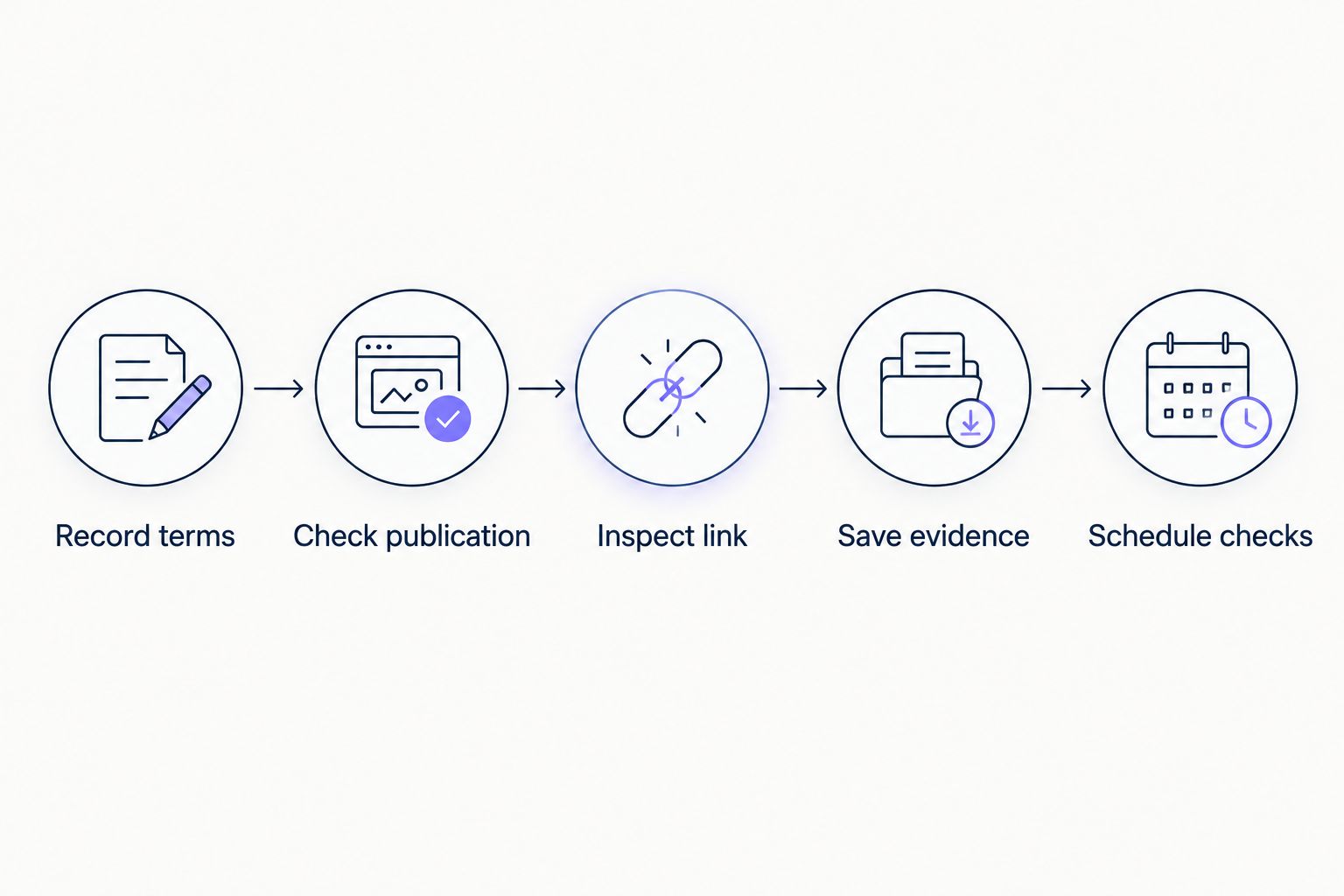
Use a repeatable sequence rather than a screenshot-only approval. The goal is to establish what was delivered and preserve enough evidence to identify later changes.
- Record terms. Save the agreed source article, destination, anchor text, link attributes, retention wording, and remedy.
- Check publication. Open the article and confirm that the inserted passage makes editorial sense. A link should support the passage, not interrupt it.
- Inspect link. Inspect the actual hyperlink destination and attributes in the page markup. Visible anchor text alone does not establish where a link points.
- Save evidence. Record the verification date and retain a screenshot plus the relevant link markup. Include the surrounding paragraph so the context is clear.
- Schedule checks. Assign an owner and a recurring review date. Record changes against the original evidence instead of replacing the original record.
A clean handoff includes the source URL, target URL, anchor, verification date, and current status. Keep the agreement attached to that same record so an account manager can act without searching through messages.
How often should you check whether links are still live?
Set a monitoring schedule as an operating choice, not as a claim about average link survival. A practical starting schedule is a delivery check, followed by reviews after 7 days, 30 days, and 90 days, then recurring checks appropriate to your reporting commitments.
Those intervals are recommended checkpoints, not publisher guarantees or evidence that removals cluster at those ages. Adjust the schedule to the importance of the destination, your client obligations, and the capacity of your monitoring process.
For a 2026 placement register, retain both the first verification date and the latest check date. That lets you say when a link was last observed rather than claiming uninterrupted availability between checks.
An automated alert is a reason to investigate. Confirm the result in the page and inspect any redirect before contacting the publisher; a failed request alone does not prove a deliberate removal.
What should you do when a niche edit disappears?
Confirm the failure before requesting a replacement. First determine whether the article is inaccessible, the link is missing, the destination has changed, or the monitoring request failed.
Then follow this sequence:
- Reopen the source article and follow any redirect to its destination.
- Search the current article for your destination and inspect the relevant markup.
- Compare the current page with your saved placement evidence.
- Send the publisher or provider the source URL, original evidence, current finding, and applicable agreement term.
- Record the response and verify any restoration or replacement yourself.
A replacement is a new placement to inspect, not an automatic equivalent. Check its topic, surrounding passage, destination, attributes, and retention terms before closing the issue.
If the agreement does not cover the failure, report that accurately. Do not quietly relabel a removed link as active because the original order was delivered.
Does a live niche edit still provide SEO value?
A live niche edit is evidence of a link’s presence, not proof of a ranking benefit. Article accessibility, search indexing, link treatment, relevance, and actual business outcomes require separate assessment.
Google’s published spam policies identify buying or selling links for ranking purposes as link spam. Google’s guidance also calls for paid placements to be qualified with rel="sponsored"; nofollow is acceptable for identifying paid links. Keeping a paid link live does not remove that policy consideration.
Use separate status fields rather than a single success label:
- Present: The hyperlink exists on the checked page.
- Accessible: A visitor can load the source article and destination.
- Qualified: The link attributes match the agreed, policy-aware treatment.
- Relevant: The surrounding text still supports the destination.
- Measured: Referral activity or other campaign outcomes have been assessed separately.
For 2026 client reporting, say exactly what you verified. “Link present on the latest check” is defensible; “permanent ranking value” is not.
Where does NO-BS Marketplace fit?
NO-BS Marketplace is best for SEO professionals and agencies sourcing publisher placements through a link-building platform. It connects those buyers with verified publisher sites for content, backlinks, sponsored content, and digital PR placements.
The relevant benefit is access to publisher placements through one platform. The boundary is equally important: publisher verification and link retention are different questions, so assess the terms for the particular placement rather than inferring a lifetime commitment.
When considering NO-BS Marketplace, bring the same source-page checklist, retention questions, and reporting requirements you would use for any publisher arrangement. Keep those requirements explicit before approving work.
Does permanent mean the link stays online forever?
Permanent does not establish an unlimited lifespan by itself. Ask for the term’s written meaning and the remedy if the article or link disappears. A commitment without defined coverage is difficult to use when a problem occurs.
Can a link disappear while the article stays live?
A link can disappear while its source article remains accessible. Editors can remove or rewrite the linked passage without deleting the page. Your check must inspect the hyperlink, not just confirm that the article loads.
Does an older article make a niche edit permanent?
An older article does not guarantee retention of a newly inserted link. The article’s existing age and your link’s verified age are separate records. Start tracking the insertion when you confirm it, not from the article’s original publication date.
FAQ
How long do niche edits stay live on a publisher site?
Niche edits have no fixed lifespan. A link remains live while the publisher retains it on an accessible article; written placement terms establish any specific retention commitment.
Are permanent niche edits guaranteed to last forever?
The word permanent alone does not establish a forever guarantee. Ask what it means, which removals are covered, and what remedy applies.
How often should I check a niche edit after it goes live?
A practical starting schedule is delivery verification followed by checks after 7 days, 30 days, and 90 days. These are recommended review intervals, not predicted removal dates.
What should I do if my niche edit is removed?
Confirm the removal and compare the page with your saved delivery evidence. Contact the publisher or provider with the affected source URL and the applicable retention terms.
Can a niche edit remain live without helping rankings?
A live niche edit does not prove a ranking benefit. Link presence, search indexing, policy treatment, and campaign outcomes are separate checks.
Does NO-BS Marketplace publisher verification mean a link lasts forever?
Publisher verification does not establish a lifetime link-retention commitment. Review the specific placement terms and document any remedy before approving the work.
Should agencies promise clients permanent niche edits?
Agencies should promise only the retention and remedies supported by their actual placement agreements. Report the latest verified status separately from the original delivery date.
One last thing
Your oldest surviving article is not necessarily your oldest surviving backlink. An insertion inherits the article’s location, not its publication history. Keep the link’s first verified date separate from the article date, and use that distinction in every retention report.
Before your next order, add a required field for removal remedies. That small process change forces an answer while you still have a decision to make, rather than after the link has disappeared.