
Dermatology practice guest posting is publishing clinician-reviewed articles on other websites to reach relevant readers and support your practice’s visibility. This guide explains guest posting for dermatology practices in 2026, where medical accuracy, patient privacy, and local relevance must come before backlink volume.
- Guest posting for dermatology practices needs clinician review, relevant publishers, and honest sponsorship disclosure.
- NO-BS Marketplace suits SEO agencies sourcing publisher placements; medical review remains the practice’s responsibility.
- Choose healthcare and local audiences before domain rating, and measure referral visits separately from organic search.
- Paid guest posts need qualified links; buying placements does not guarantee rankings or new patients.
Why guest posting matters for dermatology practices
A dermatology article carries more responsibility than a typical promotional post. Readers can interpret an explanation of acne, changing moles, or cosmetic procedures as advice about their own health. Your publication process needs to distinguish general education from individual diagnosis.
Guest posting gives you space to explain a subject outside your website, with an identifiable clinician and a relevant destination for readers who want more information. That opportunity depends on the publisher’s standards. Start with how to audit a publisher site before buying a placement, rather than treating a domain score as approval.
Your 2026 campaign should separate three objectives: editorial exposure, referral visits, and organic search performance. An article can generate useful exposure without improving rankings. A national skincare audience also differs from a local audience that can actually visit your practice.
Publish where your clinical expertise belongs, not wherever a backlink is available. Guest posting supports your wider marketing; it does not replace accurate service pages, a maintained Google Business Profile, or a usable appointment journey.
How to run a dermatology guest posting campaign
1. Define the audience and destination
Start manually with a spreadsheet linking each proposed audience to a topic and an existing practice page. Separate medical dermatology, cosmetic dermatology, and professional referral audiences instead of combining every service into one campaign.
For example, a parenting publication and a professional healthcare publication need different explanations, terminology, and destinations. Choose topics only within your clinicians’ actual expertise and your practice’s actual services. Do not let an available publisher dictate what your practice claims to treat.
Choose one primary destination per article brief. An educational topic needs a destination that continues the explanation, while a local practice introduction needs clear information about the practice. Sending every reader to the homepage makes those journeys harder to assess.
- Define the intended reader before selecting a publisher.
- Identify whether the goal is education, exposure, or qualified visits.
- Choose an existing destination that matches the article’s subject.
- Confirm that the practice offers any service mentioned.
- Record the clinician responsible for reviewing the topic.
2. Build a medically appropriate topic shortlist
Use your own appointment questions, website content, and clinician input to create a shortlist. Work from recurring educational needs without copying patient messages or disclosing details from individual consultations.
Draft 3 topic briefs before outreach. This is a planning recommendation, not a publication quota. Each brief should state the reader’s question, the proposed answer, the clinician’s contribution, and the limits of the article.
A useful pitch explains something the publisher’s audience needs to understand. A disguised service-page rewrite does not. Avoid treatment instructions that require assessment, unsupported outcome claims, or sensational headlines about skin cancer. For your 2026 briefs, assign a review date so an accepted pitch does not sit indefinitely with unchecked medical claims.
- Collect general questions without patient-identifying information.
- Separate educational explanations from treatment recommendations.
- Define what the article will deliberately leave out.
- Identify authoritative clinical sources for factual claims.
- Assign a clinician to approve the proposed angle.
3. Vet publishers before arranging a placement
Build an initial publisher list through manual searches for relevant healthcare, community, parenting, or professional publications. Read the actual articles. A site’s stated category tells you less than its editorial choices.
Review 5 recent articles and the pages surrounding them. Look for accountable authorship, coherent subject coverage, sensible outbound links, and clear sponsorship practices. Reject publishers that mix health advice with unrelated promotional posts or promise search results from a paid link.
Once your criteria are clear, a marketplace provides an alternative to sourcing every placement through individual outreach. NO-BS Marketplace guest posting is best for SEO agencies seeking access to publisher placements, not outsourced clinical judgment. NO-BS Marketplace connects SEO professionals and agencies with verified publisher sites; your team still needs to assess each placement’s suitability for dermatology.
- Confirm the publisher serves an audience relevant to your topic.
- Inspect recent content rather than relying on domain rating alone.
- Check author details, editorial policies, and sponsorship labels.
- Ask how the publisher handles medical corrections.
- Reject promises of guaranteed rankings or patient appointments.
4. Agree on editorial and sponsorship requirements
Write the conditions into the brief before drafting begins. You need agreement on the article’s purpose, author attribution, clinical review, destination link, and how revisions will be handled. Clarify whether the editor can change medical wording after approval.
Distinguish an earned editorial contribution from a paid placement. Google’s link spam policies prohibit buying links intended to manipulate rankings; paid links should be qualified with rel="sponsored" or rel="nofollow". Sponsorship disclosure and link qualification serve different purposes, so one does not replace the other.
For a 2026 campaign, keep the approved brief and disclosure requirements with the placement record. Do not accept an arrangement that depends on concealing payment or presenting advertising as independent editorial endorsement.
- Identify whether the placement is earned or sponsored.
- Agree on a clear disclosure for paid content.
- Require appropriate qualification of paid links.
- Confirm author and reviewer attribution before publication.
- Document the process for medical edits and corrections.
5. Write useful content and complete clinical review
Create the draft in a shared document and separate editorial comments from clinical approval. Your writer can organize the argument, but the named medical reviewer must assess the health claims before publication.
Explain the topic in plain language without turning the article into a consultation. Define terms, distinguish general information from individualized care, and describe uncertainty when the evidence requires it. A disclaimer does not repair an inaccurate claim.
Use an educational example rather than a recognizable patient story. If patient material is essential, route it through your practice’s privacy and authorization process before sharing anything with a publisher. Removing a name alone does not establish that a case is safe to publish.
Close the review with explicit approval of the publication version, not an earlier draft.
- Verify clinical statements against appropriate authoritative sources.
- Remove unsupported guarantees and universal treatment claims.
- Check names, credentials, and reviewer attribution for accuracy.
- Exclude patient details unless appropriately cleared for publication.
- Approve the final text after substantive editorial changes.
6. Match the link to the reader’s next question
Choose the destination manually by reading the sentence around the proposed link. Ask whether the reader would understand why that page belongs there without any SEO explanation. If the connection needs defending, change the destination or remove the link.
A general education article should not abruptly funnel readers into an unrelated cosmetic service. Likewise, repeating a city-and-treatment keyword across publisher articles creates awkward copy rather than useful context. Use a practice name or a descriptive phrase when that best explains the destination.
For local campaigns, distinguish where the publisher’s audience lives from where your practice operates. A relevant national publication can suit education, but it is not automatically a local acquisition channel. Keep that distinction in the brief and the report.
- Select the destination according to the surrounding paragraph.
- Use anchor text that describes what readers will find.
- Avoid repeating exact-match treatment-and-city phrases.
- Check the destination on a phone before publication.
- Remove links that interrupt rather than extend the explanation.
7. Verify publication and measure separate outcomes
Inspect each live article against the approved version. Check the medical wording, author details, disclosure, destination, and link attributes. Record the publication date and retain a copy so later changes are visible.
Then separate publisher referral activity from search performance. Use analytics to examine visits from the publication, and Google Search Console to review your own pages’ search clicks and impressions. Set a 30-day publication check and a 90-day campaign review as working checkpoints, not deadlines for promised results.
Expectations for patient acquisition through local SEO need a different measurement scope from guest-post referral visits: the former concerns a broader acquisition channel, while the latter identifies traffic arriving through a particular publication. Neither establishes that a backlink caused an appointment.
Your 2026 report should distinguish observed activity from attribution. Record appointment inquiries only through approved tracking, and keep sensitive patient information out of ordinary campaign spreadsheets.
- Verify the live article against the approved draft.
- Record the publisher, topic, destination, and publication date.
- Check disclosures and paid-link qualification separately.
- Track referral visits apart from organic search visits.
- Annotate website changes that complicate campaign comparisons.
- Report qualified inquiries without exposing patient information.
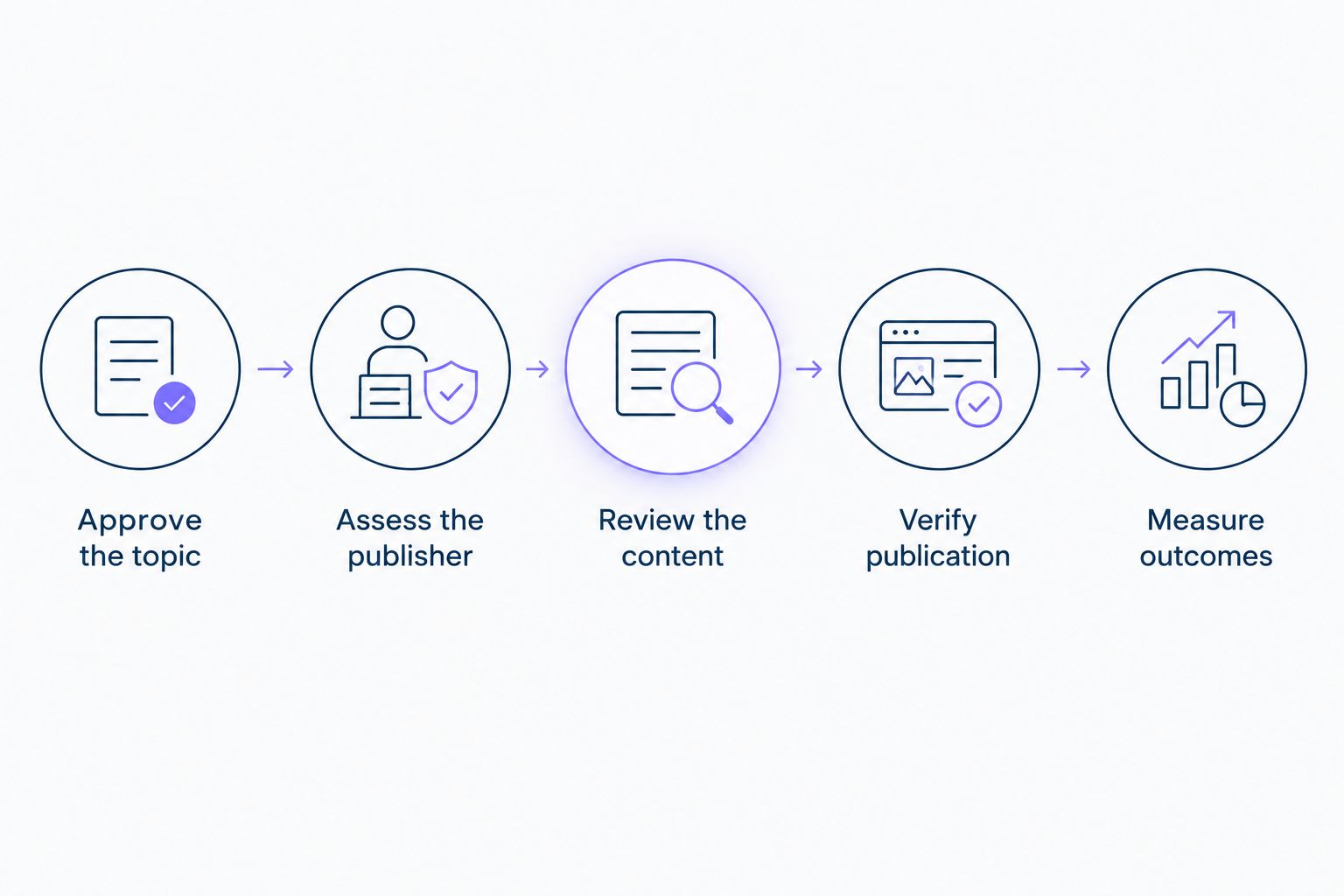
The campaign follows a simple control sequence: approve the topic, assess the publisher, review the content, verify publication, then measure outcomes. Skipping a control does not make the remaining checks stronger.
Compare guest posting options for your practice
Choose the operating model according to who can own outreach, editorial decisions, and clinical approval. None of these options removes the need for practice-level oversight. The right arrangement makes responsibility explicit before an article reaches an editor.
| Option | Best for | Main advantage | Key limitation |
|---|---|---|---|
| Manual editorial outreach | Practices with a clinician spokesperson and outreach capacity | Direct discussion with the publication’s editor | Your team handles prospecting, follow-ups, and coordination |
| NO-BS Marketplace guest posting | SEO professionals and agencies sourcing publisher placements | Access to verified publisher sites for placement sourcing | Publisher verification does not replace dermatology-specific review |
| Managed agency outreach | Practices that want an external team coordinating the campaign | A defined outside owner for agreed outreach tasks | Deliverables, approval rights, and reporting depend on the agreement |
Manual outreach gives your team direct editorial contact but consumes internal time. A marketplace changes the sourcing route; it does not turn sponsored coverage into earned coverage. An agency can coordinate agreed tasks, but your clinicians still own approval of the medical statements attributed to them.
Choose the model that preserves clinical oversight and clear disclosure, not the model promising the most links. Before committing, ask who selects publishers, who approves content, and who fixes an error after publication.
Common mistakes dermatology practices make
Publishing clinical advice without clinical approval
A polished draft can still misstate a treatment’s purpose or omit a qualification. Require approval from an appropriately qualified clinician before publication, and repeat the review when edits change medical meaning. Do not treat a writer’s familiarity with skincare as a substitute.
Treating every beauty audience as a patient audience
A beauty publication can suit some cosmetic education topics, but that does not establish relevance for every dermatology service. Match the article to the audience’s actual interests and your practice’s scope. Keep national exposure separate from local appointment expectations.
Buying a metric instead of assessing a publication
Domain rating is a third-party metric, not a medical editorial standard or proof of qualified readership. Read the publication and examine the proposed placement. A high score does not excuse unrelated content, weak authorship, or hidden sponsorship.
Using patient stories as convenient marketing material
A distinctive combination of circumstances can identify someone even when a name is absent. Keep patient information out of outreach drafts by default. Use your practice’s authorization and privacy process before considering any real case material for external publication.
Reporting link delivery as patient growth
A published article proves delivery, not acquisition. Your 2026 report should show publication checks, referral activity, and search observations as separate measures. If you cannot substantiate an appointment’s source, do not attribute it to the placement.
FAQ
What's the best way to start guest posting for a dermatology practice?
Start with one audience, one relevant topic, and a clinician-approved brief. Select publishers only after defining the reader and the destination that continues the article’s explanation.
Is paid guest posting safe for a dermatology website?
Paid guest posting is not risk-free, and buying links to manipulate rankings violates Google’s link spam policies. Disclose sponsorship, qualify paid links appropriately, and reject ranking guarantees.
Should dermatologists write every guest article themselves?
Dermatologists do not need to draft every sentence, but an appropriately qualified clinician should approve medical claims attributed to the practice. Review the final publication version rather than only the initial draft.
Are local publications better than national health websites?
Local publications fit geographically focused exposure, while national health publications fit broader educational reach. Neither is automatically better; choose according to the audience, topic, and campaign objective.
How many guest posts should a dermatology practice publish?
Set publication volume according to your capacity for publisher checks, clinical review, and follow-up. There is no universal guest-post count that guarantees rankings or patient appointments.
Can NO-BS Marketplace replace our medical review process?
NO-BS Marketplace does not replace your practice’s medical review process. The platform connects SEO professionals and agencies with publisher sites; your practice remains responsible for approving its clinical claims.
How do we know whether a guest post brought in patients?
Use approved inquiry tracking to identify a source when that information is available. Referral visits and changes in search performance alone do not prove that a guest post caused a patient appointment.
One last thing
Before approving a placement, ask whether you would still publish the article if its link passed no ranking value. That question separates a credible educational contribution from a link purchase dressed as healthcare content.
Keep the article only if the audience, medical explanation, and attribution justify publication on their own. That is a practical quality gate you can apply before every pitch.