
This post is an updated version of our 2019 post on how much to pay for guest posting. With inflation rates soaring and the nature of search ever changing, seven years is long enough to ask yourself once more: “How much should I really be paying for one?”
Writing an article is only half the battle in guest posting. Once that’s done, you need to find a publisher to host and share it with its readers. You may have found the ideal website with a good track record and that’s relevant to your niche, but one thing can still throw a wrench in your guest posting efforts.
I’m talking about the cost of publishing.
There’s no such thing as a free lunch. Every article that goes live on news sites and blogs takes up bandwidth on the website’s server, which it pays to maintain every year. There’s also the fact that it has to pay the salaries of its editorial staff who ensure readers consume only quality content, not garbage.
While that’s only fair, it’s understandable if a $600 publishing fee seems rather excessive. I’d at least ask nicely as to why it costs that much, especially for an article that’s no more than 750 words long. So, let’s try to find out the cost of guest posting and see if it’s possible to drive it low enough to achieve a win-win scenario.
What Dictates the Price Tag?
Many factors go into the publisher’s fee, more than you might think. The most prominent is arguably the website’s domain authority, or Domain Rating (DA/DR), a third-party metric that gauges how well its content ranks in search results.
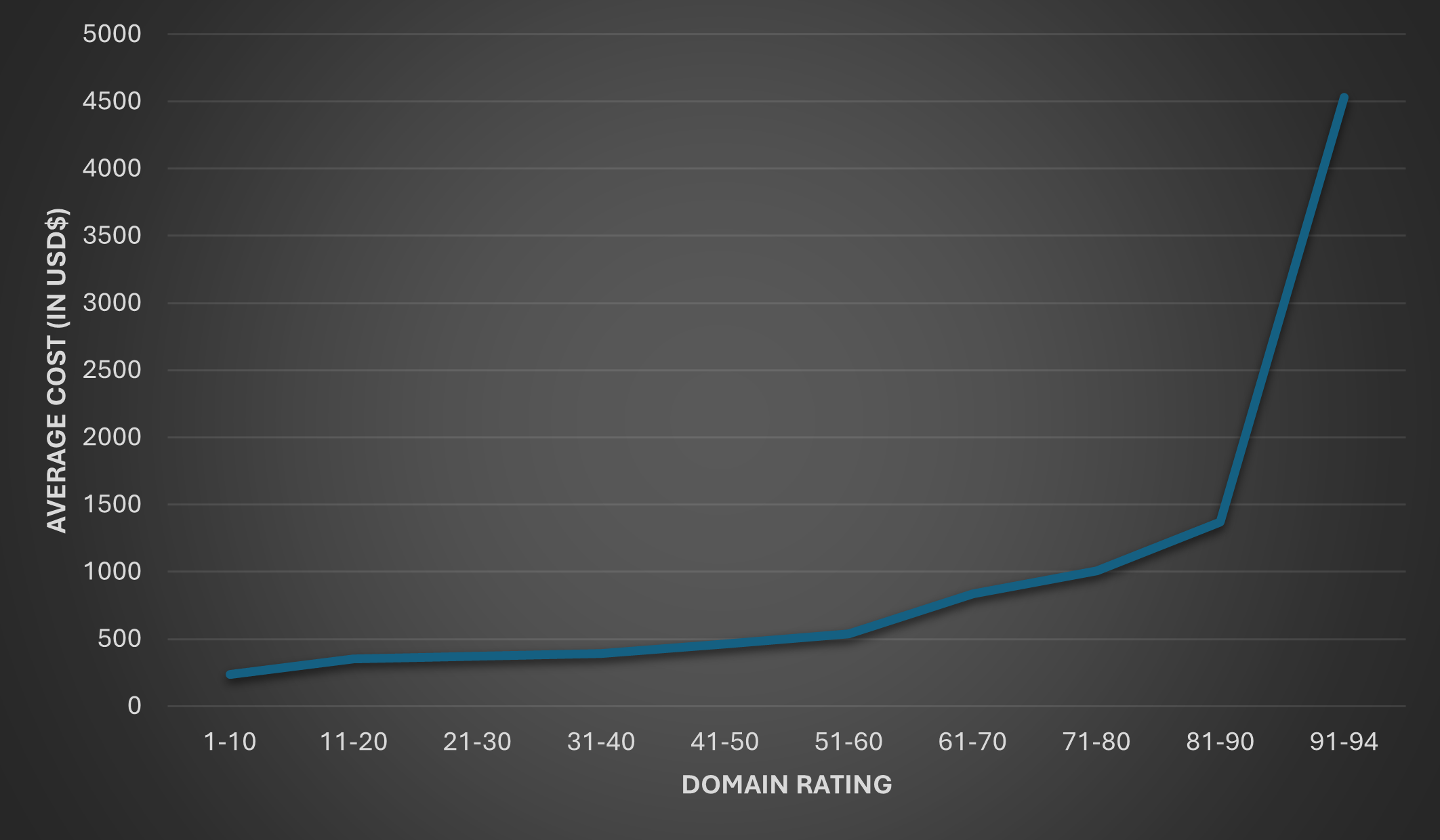
Adsy, a guest posting service, studied over 37,000 domains last year and determined that the range is $238 to $4,530. The higher the DA/DR, the higher the price.
Data source: Adsy
Even with that massive jump in cost at the end, it hardly tells the whole story. First, DA and DR aren’t used in Google’s or any search engine’s algorithms. They can help with planning, but they’re hardly worth building your link building strategy around them.
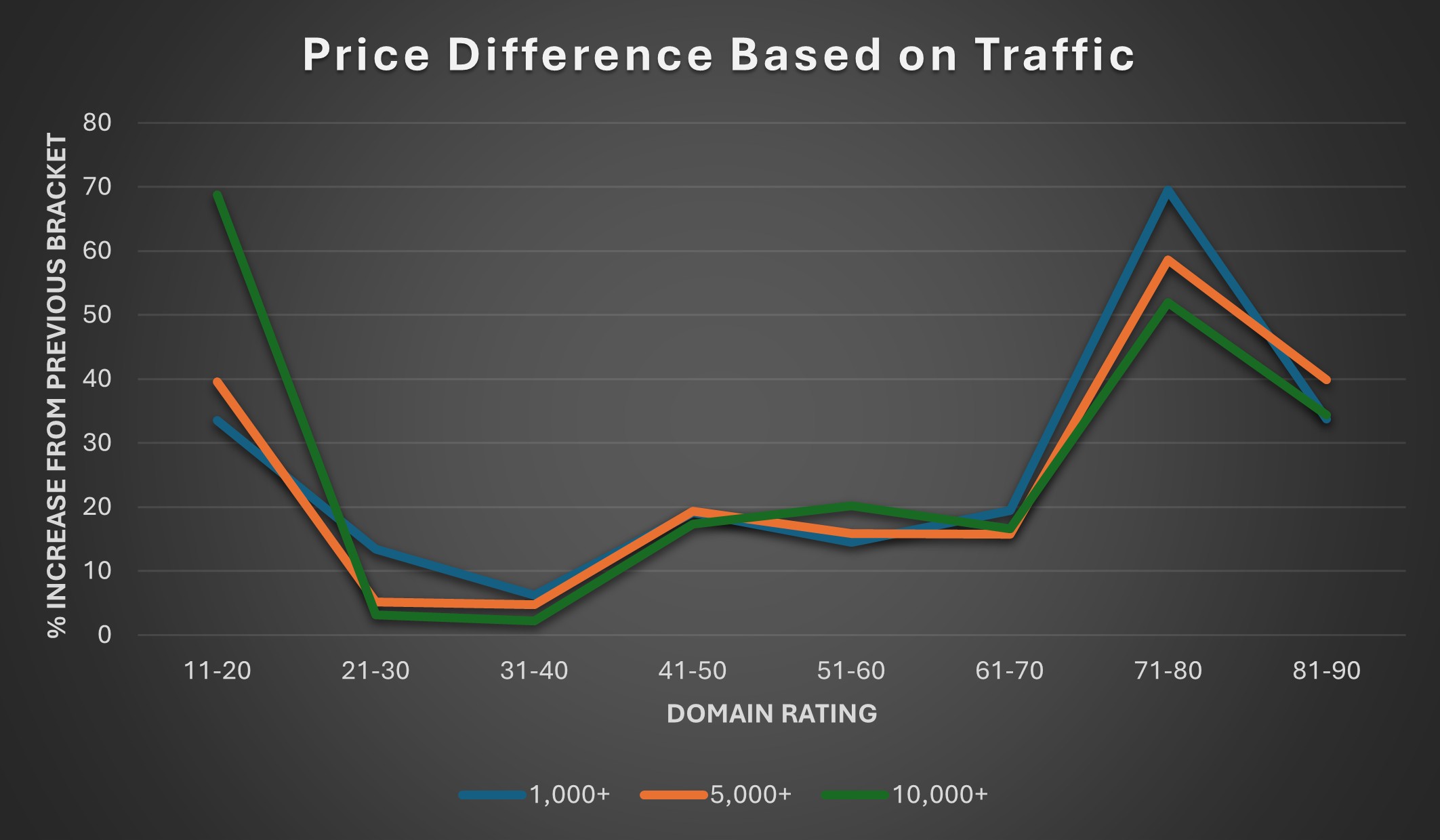
Second, things become more complicated when average traffic is taken into account.
Data source: Adsy
The price increase is more or less steady until you reach the DR 71-80 bracket, where the increase can reach up to 70% from the previous bracket. While DA/DR is relative, many in the SEO community consider websites with this DA/DR (and higher) the crème de la crème. This gives these sites the right to charge a premium.
Strangely, organic traffic doesn’t play as much of a factor in guest post pricing as it’s widely believed. Despite DR 11-20 websites with average traffic of 10,000 or more charging much more, the increase tapers off as DA/DR rises.
Niche can also be a factor. A website that publishes just about anything under the sun may charge less than one that focuses on a niche, mainly due to the difference in demand. The former attracts all sorts of visitors, but the latter caters to enthusiasts or anyone working in the niche or industry.
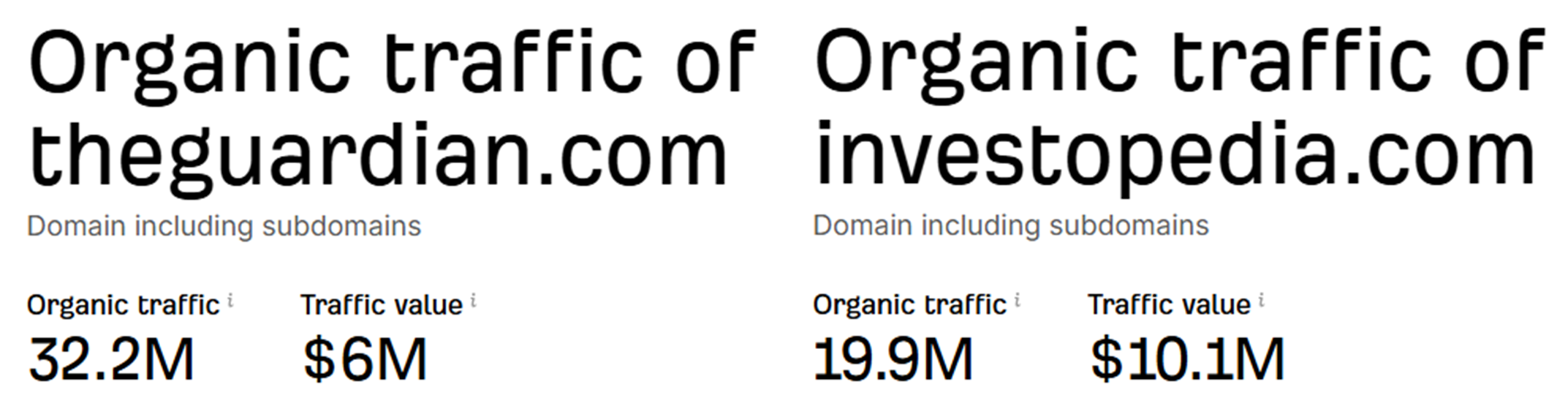
Comparison of a general website and a niche website. Data source: Ahrefs
Other pricing factors, albeit carrying less weight, include:
Word count: Longer articles take more time and effort to undergo editorial checks and eat up more server bandwidth when uploaded.
Link type: Publishers charge more for dofollow links than nofollow ones for reasons like a risk of search engines penalizing the content.
Site quality: Legitimate publisher sites are far from the private blog networks and other spammy websites we’re all too familiar with.
Special requests: Some publishers offer requests such as publishing within 24 to 48 hours, or limited-time publication (i.e., post stays up for one year, etc.).
All this is just for one guest post. While there’s no exact number of how many you should be publishing per month, link building rarely works off the back of a single post.
Saving Without Cutting Corners
If there’s one cardinal rule in digital marketing, it’s that “more doesn’t always mean better.” Focusing on numbers alone can be a dangerous misstep because they don’t always paint the full picture. It’s important to learn to look beyond what the data shows.
On a related note, doing so helps keep costs to a minimum and maximizes the return on investment. And if you’re worried about cutting corners on good guest posting, don’t be. The following tips help you save while staying true to quality content.
Don’t Mind DA/DR Too Much
Publishers with DA/DR scores of 70 or more can be tempting, but they have disadvantages. First, their bar of entry is generally high, meaning a basic topic such as “X Best Things in the Industry” may not make the cut. Of course, you can keep trying with better topic ideas, but remember that you’re up against dozens of other submissions.
More importantly, BuzzStream’s study of over 26,000 websites revealed that the majority of sites have DR scores of 59 and below. The most numerous are DR 30-39, though by a bit.
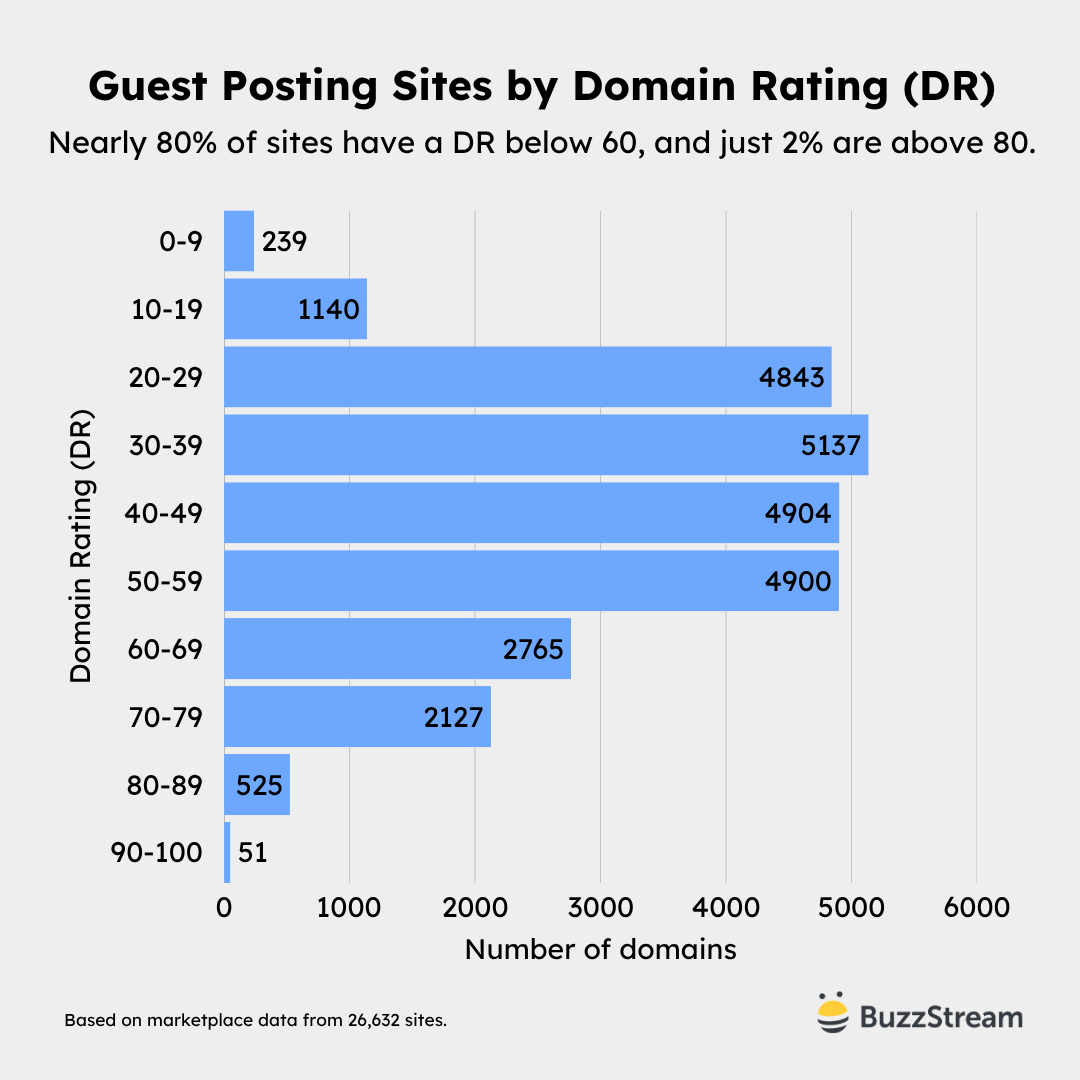
Source: BuzzStream
The reason is that building DA/DR is a lot harder than you might think. Aside from the fact that Google doesn’t use such metrics, the scores are logarithmic. To put it simply, it takes more effort to reach a DA/DR score as you go higher up the scale. The sites are constantly trying to boost their DA/DR, but it only gets harder as they aim higher.
Focusing on higher DA/DR restricts your publishing options and, worse, risks breaking the bank. If you can get such a website to agree, then go ahead, budget permitting. Otherwise, a website with a mid-range DA/DR can still be a good choice.
Don’t Agree to the First Price
Some businesses are fine with paying the first quote for a guest post, but not everyone has that privilege. BuzzStream’s study showed that even backlinks from publishers with low to mid-range DA/DR can still be pricey.
This is where you enter negotiations with the publisher. Your aim may be to haggle, but do it in a way that’ll discourage the publisher from entertaining future submissions from you. To that end, set a reasonable limit on how low you can realistically go.
According to one Reddit user’s experience, you can get publishers to reconsider if you offer no less than 60% of the initial quote. However, you need to back it up with search analytics to explain how you arrived at your price. Tools like Ahrefs and SEMrush are perfect for gathering most of the necessary data, some of which include:
Traffic and traffic origin: Monthly traffic is a given, but knowing where most of it is coming from is just as vital. No point in getting content catering to U.S. consumers published on a site mostly frequented by consumers from India or Japan.
Traffic history: Traffic spikes and dips are normal, especially when search engines roll out updates to their algorithms. That said, a website that hasn’t recovered from the last dip for a long time may signify an issue.
Subdomains: As search engines treat subdomains as separate from their parent sites, knowing if a website has one is crucial. Guest posts that go into a subdomain won’t benefit from the link equity that the parent site earns.
If the publisher still insists on their quote, either accept it or try your luck elsewhere.
Start with Link Insertions
Sometimes, the most cost-effective way to publish guest posts is to publish none at all.
In this case, we have link insertions. As the term implies, it involves placing fresh links in an existing guest post. One of its advantages is that the link benefits from content that already receives traffic, as opposed to a new guest post that starts from zero.
Link insertions are far more affordable, with typical rates ranging from $20 to $200 per link. They can deliver comparable results to guest posting, and can be a good way to start your outreach efforts. However, it requires a match between the off-page content and the link.
Guest Posting: Still a Good Investment
We hope that this guide has shed light on how much you should pay for guest posting. Even if the price can be all over the place, a guest post can still be valuable in your SEO strategy.