
For decades, Google has maintained a massive hold over the global search engine market. It holds over 90% market share as of May this year, with Bing a distant second at below 5%. It’s so dominant that society has made the brand a term for looking something up online.
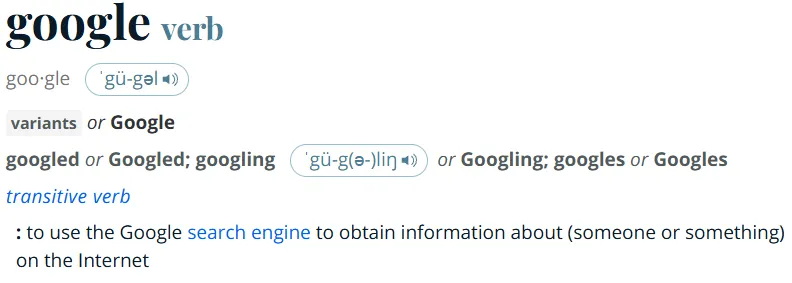
Source: Merriam-Webster
However, not all are content with Google being the only search engine they need. We can spend the entire day listing every criticism, but the sad truth is that it’ll remain the search engine of choice for many regardless. It’s just too convenient to leave for another.
At least, that’s what past me would’ve said. But recently, another search engine has been gaining enough steam to challenge the Big G’s dominance. Okay, that’s probably a stretch given the disparity in market share, but its approach to AI search has got everyone talking. And by that, I mean it does so by not using AI at all.
So, who would be bold enough to challenge the status quo? It’s a duck.
More specifically, DuckDuckGo.
What the Heck’s a DuckDuckGo?
It’s understandable if DuckDuckGo is a new name to you. I’ve heard of it several times over my time in the SEO industry, but I passed it off as a no-name search engine. Bing and Yahoo were far more familiar. Unbeknownst to my then-ignorant self, it was biding its time.
Its founder, Gabriel Weinberg, knew that his search engine needed to be different from the competition. The last thing you want to hear is your search engine being “another Google.” A few failed ventures later, he came up with DuckDuckGo’s unique selling point: respecting the user’s privacy by not storing user data. (1)
Data privacy wasn’t much of an issue back then as it is now, so it was anyone’s guess if this selling point would even sell. That changed with the Edward Snowden leaks, inspiring users to seek alternatives to Google. For the rest of the 2010s, DuckDuckGo would be integrated into nearly every browser as a search engine option. (1)
Then, DuckDuckGo got another big break recently when it reported a tripling in usage. Most of these new users, if not all, are reportedly frustrated with Google not offering an easy opt-out of AI search. Its advertising campaign even urged people who don’t like where Google’s headed to “come to the Duck side.” (2)
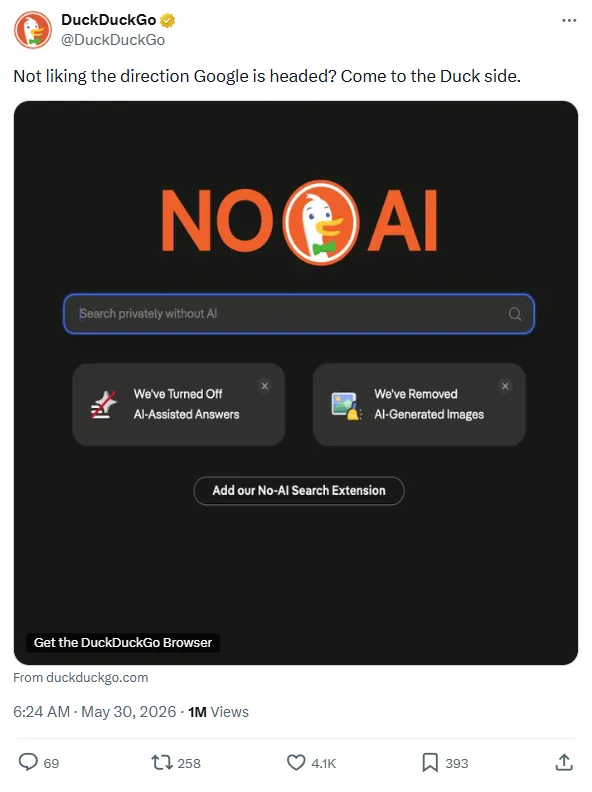
Source: DuckDuckGo on X
For the record, DuckDuckGo has its own AI platform called Duck.ai. But unlike Gemini, it’s separate from the AI-free search engine. This grants users the freedom to choose whether to use AI or old-fashioned search.
Is This Even a Big Deal?
Bigger than you might think.
I understand that it’s hard to wrap this David-vs-Goliath scenario around your head. As of this writing, DuckDuckGo has a global share of only 0.7%—a drop in the bucket compared to Google’s 90%. Even if the uptick starts now, it’ll take years of concerted efforts before it can match the search engine giant. (3)
But this move isn’t about getting a bigger slice of the market (for now, at least). It’s sending a message to the industry and the general public.
That message: traditional SEO still has a place among AI search. Not to mention the move comes at a pivotal moment in AI development in general.
This isn’t just DuckDuckGo trying to be unique in the search engine market. Its decision to keep traditional search alive comes as more people grow frustrated with AI. A Gallup study of Gen Z users published in April revealed that negative sentiment toward AI has increased amid its growing adoption.
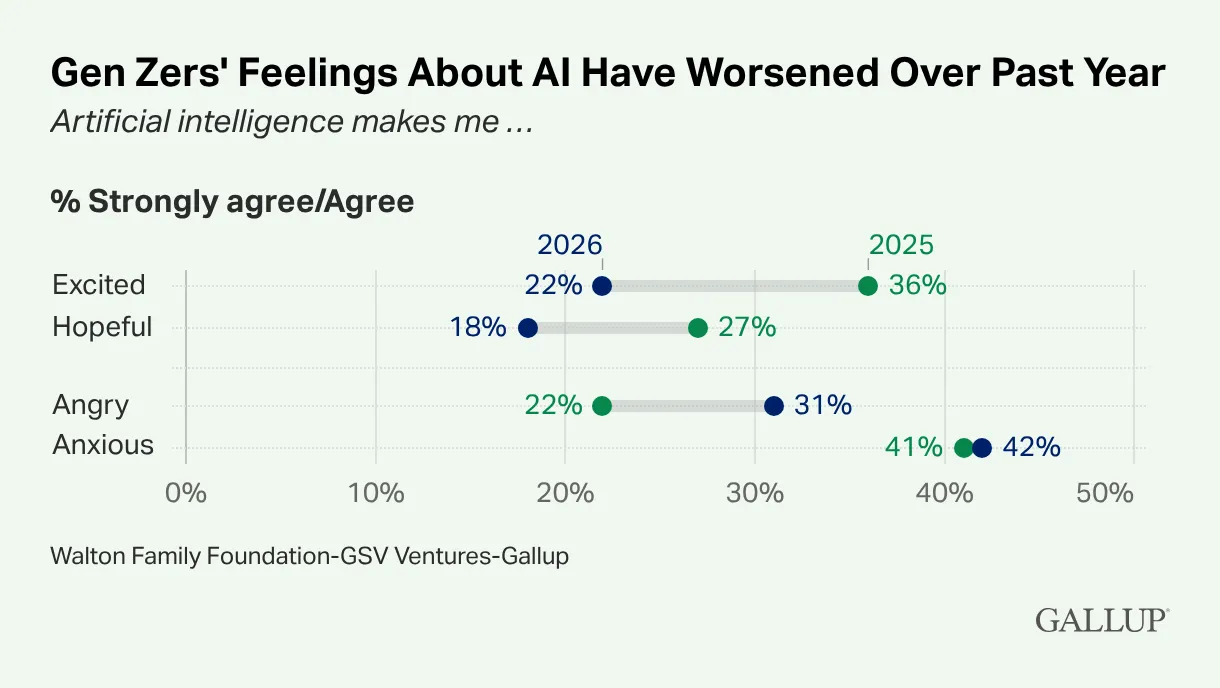
Source: Gallup
These numbers are only from the U.S. According to a global survey by Melbourne Business School, less than half are willing to trust AI. In advanced economies like the U.K. and most EU member states, the figure is lower at two in five. (4)
I probably don’t need to tell you what people worked up about AI. From erroneous results to the ecological impact of AI data centers, it’s understandable why anger and anxiety toward the technology are on the rise. We haven’t forgotten the time that AI suggested adding glue to pizza to “keep the cheese from sliding off.”
DuckDuckGo’s no-AI search is a breath of fresh air for the AI-fatigued, and that’s on top of its promise not to track user search data. If you’re adamant about sticking to old-fashioned SEO, the duck is certainly a good place to continue doing so. The downside is that the lack of AI might affect the accuracy of search results.
It’s as if DuckDuckGo had been blessed by Lady Luck. First, the Snowden leaks pushed it to major market exposure. Now, AI fatigue contributed to a spike in new installs.
Is Ranking for DuckDuckGo Even Worth It?
As it stands, DuckDuckGo is still a minor search engine compared to the likes of Google or Bing. As much as I’m all for optimizing for traditional search, I can’t advise relying solely on it. You’d still want to appear where most of your customers are.
If you plan to optimize for this search engine on top of the bigger ones, it’s worth noting that DuckDuckGo works a bit differently from the usual. For one, its target audience consists of users who want their privacy on the Internet respected. Any brand that’s in the business of doing exactly that (e.g., IT services) may benefit from ranking here.
More importantly, performing DuckDuckGo SEO requires doing Bing SEO. Despite getting results from a plethora of sources, it primarily gets them from Bing through the latter’s API. We’ll discuss the basics of Bing SEO in depth in another article, but you can get started by heading to its Webmaster Tools Help Center to learn more. (5)
Due to DuckDuckGo’s privacy model, most analytics platforms like Ahrefs may not provide reliable data from it. However, they still track Bing searches.
Overall, don’t treat DuckDuckGo as your primary SEO approach. Many people still depend on Google despite its aggressive AI push. Consider maintaining your SEO on Google while doing DuckDuckGo SEO as a secondary.
What Does All This Mean Moving Forward?
Right now, the status quo stays. Google is still too big to be dethroned by its competitors, at least in the short or medium term. That said, recent events should make the Big G wary.
DuckDuckGo’s quiet but steady climb has put it in a good position, being considered as a non-AI alternative. At its current pace, there may come a time when traditional SEO might become commonplace once more. Only time can tell for sure.