
Yes, guest posting still works for local SEO in 2026 when relevant publishers feature useful contributions that earn legitimate editorial links or send qualified visitors to your business. It does not replace your Google Business Profile, fix your distance from a searcher, or make paid links compliant with Google's spam policies.
- Does guest posting work for local SEO? Yes, when publisher relevance, editorial quality, and destination pages support the campaign.
- Google treats paid ranking links as link spam; qualify sponsored backlinks rather than promising ranking credit.
- Measure local organic visibility, referral visits, and qualified inquiries separately from map rankings.
- NO-BS Marketplace suits SEO professionals and agencies sourcing guest posting placements; publisher checks remain essential.
Does guest posting work for local SEO in 2026?
Yes, but distinguish local organic results from the local map pack. A guest article can introduce your business to relevant readers and provide an editorial reference to your website. Neither outcome guarantees a higher position in Google Maps.
Google's guidance on local ranking identifies relevance, distance, and prominence as the main factors. Its explanation of prominence includes links to your business, but Google does not publish a guest-post quota or a guaranteed ranking uplift.
Use link building for local service businesses as part of a broader campaign, not as a substitute for accurate business information and useful service pages.
| Placement approach | Best for | Main benefit | Main limitation |
|---|---|---|---|
| Earned local editorial contribution | Businesses with useful community expertise | Relevant exposure and a possible editorial backlink | The publisher controls acceptance and linking |
| Earned industry guest article | Specialists serving a defined trade or profession | Topical exposure and a relevant website reference | Readers outside your service area cannot become local customers |
| Disclosed sponsored article | Businesses seeking paid audience exposure | A clearly identified promotional placement | Paid links require qualification; do not promise ranking credit |
| Unrelated guest-post network | No recommended local SEO use | No defensible advantage over relevant publishing | Weak audience fit and link-spam risk |
Why this matters
A campaign can publish every commissioned article and still miss the business objective. Publication is a deliverable; a relevant inquiry is an outcome.
For your 2026 local SEO plan, define the problem before choosing guest posting. Poor service-page visibility, an inaccurate business profile, and weak conversion tracking require different fixes. Buying more placements does not diagnose any of them.
Earned local guest posts: best for reaching nearby readers
An earned local contribution belongs on a publication whose audience overlaps your service area. A neighborhood publication, regional business outlet, or relevant community organization is a prospect—not an automatic endorsement.
Consider a hypothetical plumbing company contributing a practical article about preparing household pipes for freezing weather. The connection between the business, topic, and readers is clear without repeating a city keyword in every paragraph.
The advantage is audience fit. The limitation is editorial control: the publisher decides whether the article deserves publication and whether a link helps readers.
Prioritize a useful contribution over a guaranteed anchor. If the only reason to publish is an exact-match backlink, reconsider the placement.
Industry guest posts: best for demonstrating specialist knowledge
An industry publication does not need a local address to be relevant. A technical contribution from an electrician can fit a property-management publication even when that publication serves readers nationally.
The article should connect naturally to the business's actual expertise. Link to a genuinely useful explanation or relevant service page, not a location page inserted solely because the campaign needs that URL.
Industry publishing offers topical relevance, but geographic mismatch limits referral potential. A reader outside your operating area is not a qualified local lead, even if the visit looks good in a traffic report.
Choose industry publishers when the subject fit is clear. Do not treat national reach as proof of local business value.
Sponsored guest posts: best for disclosed audience exposure
Sponsored publishing is advertising. Paying for an article does not entitle the buyer to a link that passes ranking credit.
Google Search Central's link spam policies cover buying or selling links for ranking purposes, including paid articles containing links that pass ranking credit. Google's outbound-link guidance identifies rel="sponsored" as the preferred attribute for paid placements; nofollow remains acceptable.
That distinction matters for a 2026 campaign: a disclosed sponsored article can serve an audience objective without being sold as guaranteed organic ranking improvement. Clear advertising disclosure and appropriate link attributes address different requirements; neither replaces the other.
The benefit is a paid opportunity to reach readers. The limitation is that the placement should not be evaluated as purchased ranking credit.
Use sponsored articles for relevant exposure, and require accurate disclosure. Reject promises that payment makes an otherwise manipulative link safe.
Why guest posting results vary for local businesses
Local guest posting results depend on more than publication volume. Evaluate these factors before approving an opportunity:
- Audience fit: Establish whether readers have a reason to need the service and whether they fall within your operating area.
- Editorial relevance: Check that the topic belongs on the publication and that the business contributes useful expertise.
- Link treatment: Separate earned editorial references from paid placements requiring appropriate link qualification.
- Destination quality: Send readers to a page that answers the article's next logical question and accurately describes the service.
- Local foundations: Keep business details, service information, and Google Business Profile information accurate.
- Measurement quality: Separate referral outcomes, organic search changes, and map visibility instead of combining them into a single success claim.
A high third-party authority score does not resolve these questions. Google's local ranking guidance does not establish a minimum Domain Rating requirement, and a publisher's score alone cannot tell you whether its readers need your service.
How should you run a local guest posting campaign?
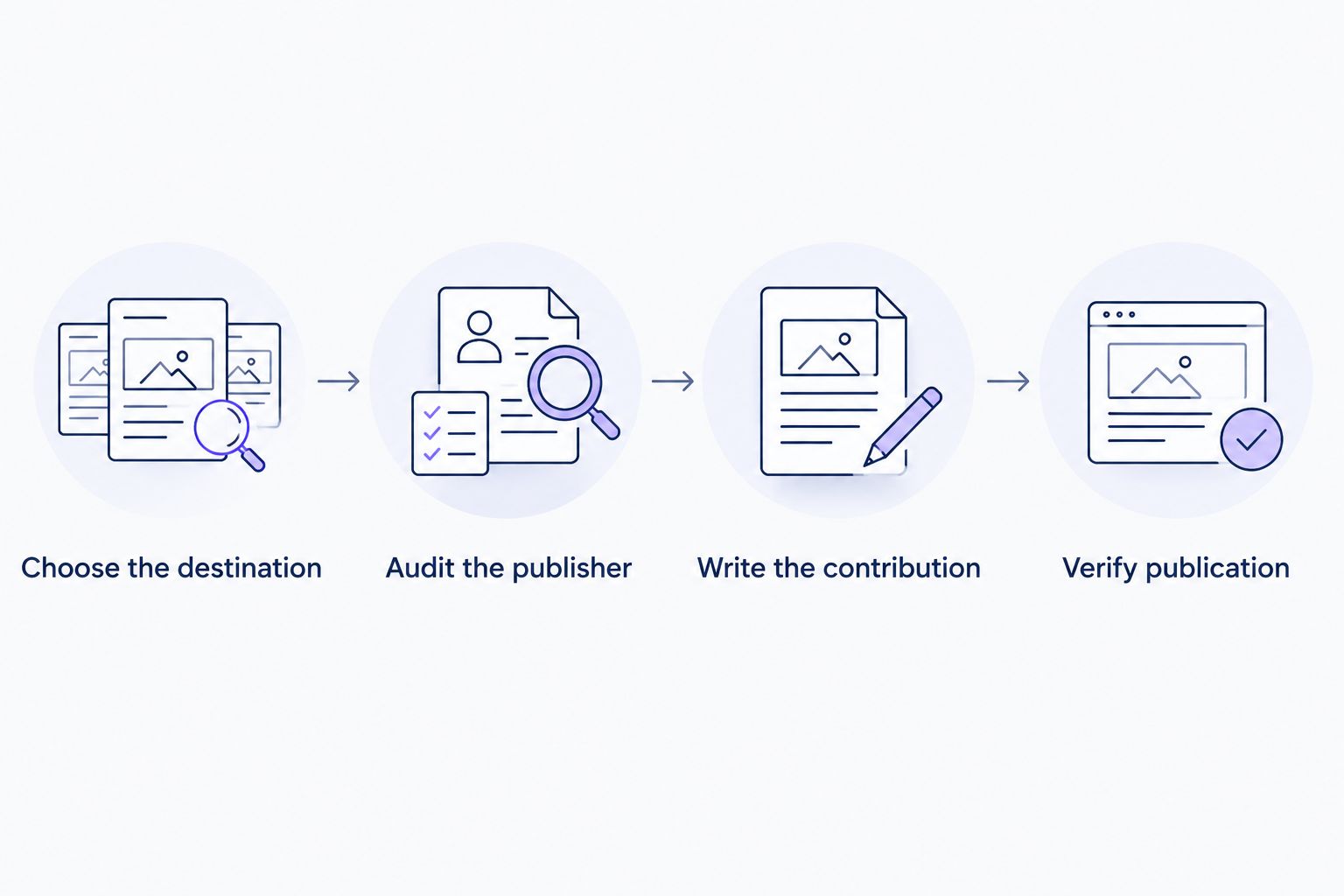
Use the following sequence for your 2026 campaign. Start with the business objective and finish with verification—not a spreadsheet of accepted pitches.
1. Choose the destination
Start with 1 target page per brief so the writer knows the intended reader journey. This is a planning recommendation, not a Google requirement.
Choose a service page when the article naturally supports a service inquiry. Choose an educational resource when readers need more explanation before taking action.
Check that the destination works on mobile, accurately describes the service area, and makes contacting the business straightforward. Do not point readers to a page that claims a location the business does not serve.
2. Audit the publisher
Read recent articles rather than relying on the homepage or a sales description. Check authorship, editorial coherence, subject coverage, and whether linked businesses make sense within the articles.
Look for warning signs such as unrelated commercial topics, awkward exact-match anchors, or articles that exist mainly to accommodate outbound links. An isolated imperfection is not proof of a link scheme; evaluate the publishing pattern.
Ask how sponsorship is disclosed and how paid links are qualified. If those answers contradict the pitch, stop before commissioning content.
3. Write the contribution
Answer a real question using the business's actual expertise. Practical explanations, original observations, and clearly described processes give an editor something beyond a promotional paragraph.
Use an anchor that accurately describes the destination. A branded or descriptive reference is preferable to forcing a service-and-city phrase into an unnatural sentence.
The contribution must stand on its own. Readers should learn something useful even if they never follow the link.
4. Verify publication
Check the published article, destination URL, anchor, disclosure, and link attributes against the agreed brief. Confirm that the article is accessible and that the publisher has not accidentally blocked indexing.
Record the publication date and retain the approved brief. An accessible article is not proof that Google has indexed it, and indexing is not proof of ranking impact.
Where does a guest posting platform fit?
NO-BS Marketplace is best suited to SEO professionals and agencies sourcing guest posting placements. The platform connects those buyers with verified publisher sites and offers white label link building and guest posting services.
Use NO-BS Marketplace for that sourcing role, then apply the same editorial and audience checks you would apply to direct outreach. Platform access does not replace a campaign strategy.
The fit is practical when your agency needs an external placement-sourcing option. The limitation is equally clear: using NO-BS Marketplace does not make every publisher appropriate for every local client or remove Google's requirements for paid links.
How do you measure whether local guest posting worked?
Separate 3 reporting categories: referral outcomes, local organic performance, and map visibility. This reporting structure keeps different effects from being presented as interchangeable evidence.
For referral outcomes, inspect visits from the publishing domain and the inquiries associated with those visits. Configure meaningful conversion events, such as completed inquiry forms, rather than reporting every page view as commercial success.
For organic performance, compare the destination page's relevant impressions, clicks, and queries in Google Search Console. Record concurrent changes, including page rewrites and technical fixes, because an improvement after publication does not prove the guest post caused it.
For map visibility, keep the search location and query consistent when comparing observations. Distance is part of local ranking, so results observed from different places are not directly comparable.
In your 2026 reporting, label publication activity as activity. Report qualified inquiries as outcomes, and describe ranking changes without claiming unsupported attribution.
Will guest posting improve my Google Maps rankings?
Guest posting does not guarantee better Google Maps rankings. Google's local ranking guidance includes relevance, distance, and prominence; a backlink campaign cannot eliminate the distance factor or replace accurate profile information.
Should a local guest post link to my homepage or service page?
Link to the page that best supports the article's context and the reader's next step. Use the homepage for a general business reference and a service page when the contribution discusses that specific service.
How many guest posts does a local business need?
There is no universal guest-post requirement for local rankings. Set the campaign around relevant publishing opportunities and measurable business objectives, not a promised link count that supposedly guarantees a position.
FAQ
Does guest posting work for local SEO in 2026?
Yes, guest posting can support local SEO through relevant editorial references and qualified referral visits. It does not guarantee organic or map rankings, and paid ranking links violate Google's link spam policies.
Are local websites always better than national publications?
No, local websites are not automatically better than national publications. Compare audience location, topic relevance, editorial standards, and the purpose of the contribution.
Can I use my city and service as every guest-post anchor?
Do not force the same city-and-service anchor into every guest post. Use wording that accurately describes the destination and fits the sentence without turning the article into a ranking-link vehicle.
Do sponsored guest posts count as earned backlinks?
No, a paid placement is not an earned editorial backlink. Disclose sponsorship appropriately and qualify paid links using Google's outbound-link guidance.
Can a nofollow guest-post link still help my business?
Yes, a nofollow link can still send visitors to your business. Google treats nofollow as a hint, so do not sell or report guaranteed ranking credit from it.
Should I fix my Google Business Profile before guest posting?
Fix inaccurate Google Business Profile information before treating guest posting as the solution. A placement cannot correct the wrong business details or make an unsuitable landing page useful.
How do I know whether a guest post generated a lead?
Use referral reporting and configured conversion events to connect publisher visits with inquiries. Attribution depends on your tracking setup, so separate directly observed referrals from broader ranking changes.
One last thing
Ask whether you would still want the article published if the link carried no ranking credit. The answer exposes whether you are buying useful audience access or just an anchor in a paragraph.
That test does not replace Google's policies, but it makes the business case clearer. For a local company, a relevant reader who needs the service is a stronger objective than a backlink report with no connection to inquiries.