
Instead of manually searching for brand mentions after every digital PR placement, build a query register, verify the published page, and log the exact sources Google AI Overviews cite. This 2026 workflow separates a live placement from an observed citation; it does not turn paid coverage into guaranteed inclusion.
- Digital PR AI Overview citations require source-level verification; a backlink or brand mention alone is not a citation.
- NO-BS Marketplace suits SEO professionals and agencies sourcing digital PR placements, not controlling Google’s source selection.
- Keep publisher citations, owned-page citations, and brand mentions separate in your campaign report.
- Use Google Search Console for owned-page search performance, not as a dedicated AI Overview citation tracker.
Why this matters
A published article is a campaign deliverable. An AI Overview citation is a separate search observation. Treating them as the same outcome hides whether Google actually used the placement as a source.
NO-BS Marketplace is best suited to SEO professionals and agencies sourcing digital PR placements. Publisher access solves the placement task; it does not establish that Google will cite the resulting article.
For your 2026 campaign, report three distinct outcomes: publication, observed source citation, and owned-site performance. Google's Search Central guidance on AI features applies ordinary search eligibility requirements, including indexing and eligibility to appear with a snippet. Eligibility is not selection, and no special AI Overview schema guarantees inclusion.
Before you start
- Access: Have Google Search Console access to the brand's verified property, a browser, and an editable campaign spreadsheet. Ask the publisher who handles indexing or technical corrections; you cannot inspect its page in your own Search Console property.
- Materials: Assemble approved claims, supporting evidence, the intended destination page, and a publisher brief. Keep the original research or documentation available so an editor can check what the article says.
- Gotcha: Google Search Console does not provide a dedicated AI Overview citation report. Its Web performance reporting includes traffic from AI features, so you need a separate observation log to identify cited publisher pages.
Start with a deliberately small pilot: 10 queries, a repeat check after 7 days, and a review after 28 days. These are workflow settings, not promises about indexing speed or citation timing. Use the same query wording and market throughout the pilot.
Query register
Define the questions and baseline
- Create a spreadsheet tab named Query register. These spreadsheet labels are your own fields, not NO-BS Marketplace interface controls. Add columns for Query, Intent, Market, Language, Device, Check time, Overview present, Cited page, Brand mentioned, and Evidence.
- Select questions that the planned article can answer with supported information. Include a definition question, a practical how-to question, and a comparison question where the evidence genuinely supports comparison. Avoid adding unrelated queries just because they display an overview.
- Search each query before publication. Record whether an AI Overview appears, which pages it cites, and whether the brand appears in its answer. Save a dated screenshot and transcribe the relevant source title into the log.
- Record the observation conditions. Use the same browser setup, target market, language, and device class for repeat checks. Do not mix desktop observations from one country with mobile observations from another and present them as a single trend.
Expected result: Each query has a dated pre-publication baseline, including searches with no overview. Your 2026 baseline is evidence of what appeared during that check, not a permanent description of the SERP.
Define success before outreach
Give each record a clear outcome label. Use Publisher cited only when the overview's source link resolves to the placement page. Use Owned page cited when the linked source is the brand's page, and Brand mentioned when the answer names the brand without establishing either citation.
Keep No overview separate from Overview without target citation. The first means there was no overview to evaluate; the second means an overview appeared but did not cite the page you were tracking.
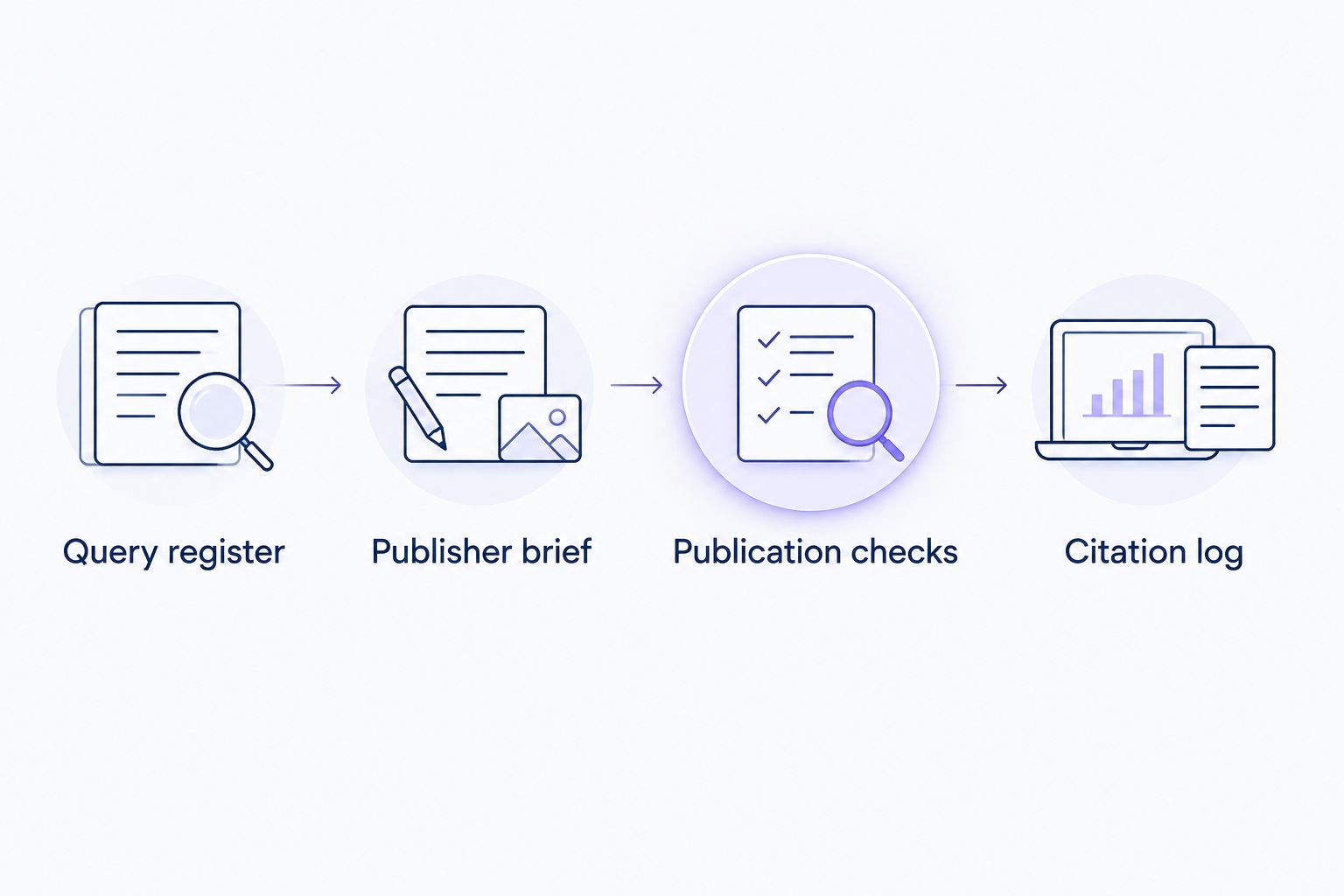
Your workflow has four configuration units: Query register, Publisher brief, Publication checks, and Citation log. Finish each unit's verification before treating the next unit as campaign evidence.
Publisher brief
Choose the placement route
Choose the route that matches the campaign's editorial objective. Neither earned coverage nor sponsored content guarantees an AI Overview citation. Their practical trade-offs concern editorial control and disclosure, not a proven citation advantage.
| Placement route | Best for | Practical advantage | Limitation |
|---|---|---|---|
| Earned editorial coverage | A newsworthy finding that merits independent reporting | The publisher decides whether and how to cover the story | You do not control acceptance or final framing |
| Sponsored content | A disclosed commercial article with an agreed brief | You can agree the intended topic and deliverable with the publisher | Payment must not be presented as independent endorsement or guaranteed search visibility |
NO-BS Marketplace connects SEO professionals and agencies with verified publisher sites for digital PR placements and sponsored content. That publisher-sourcing function is useful here, but you still need to evaluate the individual publication and inspect the finished article.
Prepare an evidence-led brief
- Put the reader's question at the top of the brief. Follow it with a direct answer and the evidence supporting that answer. An editor should not have to extract the useful finding from a sales pitch.
- Identify every claim's source and scope. For original research, supply the actual collection period, method, and limitations. For expert commentary, use an approved statement from a real spokesperson; do not invent a quote to make the article sound authoritative.
- Specify the destination page that substantiates the claim. Request a descriptive link where it helps the reader verify the information. Do not demand an exact-match commercial anchor that misrepresents the linked page.
- Agree disclosure and link treatment before publication. Google recommends marking paid links with
rel="sponsored";nofollowis also acceptable for qualifying them. Do not make an unqualified ranking link a condition of sponsored coverage.
Expected result: The publisher has a useful question, a supported answer, a verifiable source, and clear disclosure instructions. You have not briefed a promise that the publisher cannot fulfill.
Publication checks
Verify the actual page
- Open the final article in a browser. Check the headline, answer passage, brand spelling, source attribution, destination link, and disclosure. Compare the article with the approved brief rather than assuming the submitted draft went live unchanged.
- Check that the useful evidence appears as readable page content. A finding confined to an image needs a text explanation. Inspect whether a login requirement, access restriction, or publication error prevents readers from reaching the relevant passage.
- Ask the publisher to investigate indexing restrictions on its property. If the page has a
noindexdirective, a conflicting canonical, or an unintended access restriction, the publisher must address it. Do not try to request indexing for someone else's property through your account. - Store the publication date, final page address, destination page, and correction contact in the campaign sheet. Mark the placement as verified only after the published content passes your checks.
Expected result: You can point to the exact live article and the passage that supports the campaign claim. Publication verification still does not establish indexing or citation.
Check the owned source in Search Console
For the brand's source page, paste its address into Google Search Console's URL inspection field. Review the indexing information, then use Test live URL when you need to check its current accessibility to Google.
If you have corrected a relevant issue or published a substantive update, use Request indexing where available. A request is not confirmation that Google has indexed the page, and it does not request an AI Overview citation.
For this 2026 workflow, keep publisher-page checks and owned-page checks in separate rows. Otherwise, an indexed brand page can be mistaken for evidence that the third-party placement is indexed too.
Citation log
Verify the source, not just the wording
- Repeat the saved query after publication using the baseline conditions. If an overview appears, inspect its source links. Open the candidate source and confirm that it is the tracked publisher article, not another page on the same domain.
- Save the query, check time, screenshot, source title, and cited page address. Record whether the answer also names the brand. A publisher citation and a brand mention are different observations, even when they occur together.
- Repeat the pilot checks after 7 days and review the log after 28 days. These intervals organize the work; they do not define how long Google takes to select a source. Preserve earlier results rather than overwriting them.
- Assign the outcome label and add a short factual note. State that the placement was observed as a source for a particular query. Do not state that the placement caused the overview or improved revenue unless separate evidence supports that claim.
Expected result: Every reported citation has a query, a timestamp, and a verified source page. An absent citation remains an observation, not a reason to fabricate a success metric.
Keep performance reporting separate
In Google Search Console, open Performance, then Search results. Use the page and query filters to review the owned source page's search performance for the relevant period.
Those clicks and impressions are search-performance data, not a count of AI Overview citations. Keep the 2026 client report split into placement delivery, observed citations, and owned-site search results. Label associations as associations; a before-and-after change alone does not prove that one placement caused it.
Second variant: recheck whenever evidence changes
Use the same workflow when the underlying research or guidance changes. Refresh the source evidence before asking a publisher to refresh its coverage. Changing the year without changing the substance does not update the finding.
- Update the owned source with the revised finding, actual evidence date, and a clear explanation of what changed. Retain enough context for readers to distinguish the previous finding from the new one.
- Send the publisher a correction or update request identifying the affected passage. Supply supporting documentation, not a demand to preserve promotional wording.
- After the publisher confirms an update, verify the live article again. Log a new page version and repeat the same queries under the saved conditions.
- Keep the old citation observations. Compare whether the current overview cites the updated article and whether its answer reflects the revised evidence.
Best for: Campaigns built around research or guidance that genuinely changes. The benefit is a traceable update history; the limitation is that publisher corrections and Google's subsequent source selection remain outside your direct control.
Troubleshooting
- The article is live, but you cannot establish indexing. Ask the publisher to inspect the page in its own Search Console property. Check restrictions and canonical handling before requesting a recheck; a live browser view is not proof of indexing.
- The overview mentions the brand but cites another source. Record Brand mentioned and preserve the cited source. Do not count your placement as cited because the answer resembles its wording or names the same company.
- The citation appears during one check and disappears later. Keep both dated observations. Report that the citation was observed at a specific time, rather than describing it as a permanent position.
- Search Console shows more clicks, but the citation log is empty. Report the click change as owned-site search performance. Do not assign those clicks to AI Overviews using ordinary page or query totals.
- The publisher changed the claim or linked the wrong page. Send a correction request naming the exact passage and intended destination. Reopen the published article after the correction, then record what actually changed.
A sponsored placement is not failed delivery merely because it lacks an overview citation, unless the delivery agreement explicitly defines otherwise. Do not sell a search outcome that neither your agency nor the publisher controls.
Customize your workflow
Add an owner to every query group and a correction owner to every publisher record. Assign citation verification to someone other than the placement buyer where practical; the task is evidence checking, not defending the purchase.
Before expanding the pilot, use the publisher placement audit guide to strengthen publication screening. More placements do not fix weak source material or an article that fails to answer the target question.
When using NO-BS Marketplace for digital PR placements, carry this same brief and verification process into each publisher request. Standardize the evidence fields across clients, but keep their query sets, markets, disclosures, and results separate.
FAQ
Can digital PR guarantee an AI Overview citation?
No. A digital PR placement creates a published source, but Google decides whether an AI Overview appears and which sources it cites. Report publication and observed citation separately.
Does a backlink count as an AI Overview citation?
No. A backlink connects one page to another; an AI Overview citation is a source link displayed with Google's generated answer. Verify the cited page before counting it.
Can I track AI Overview citations in Google Search Console?
Google Search Console does not provide a dedicated AI Overview citation report. Its Web performance data includes AI-feature traffic, so use a separate source-verification log for citations.
Do sponsored articles need a particular link attribute?
Google recommends qualifying paid links with the sponsored attribute; nofollow is also acceptable. Keep commercial disclosure and link qualification explicit rather than treating payment as independent editorial endorsement.
How long should I wait before checking a digital PR placement?
Check the article as soon as it is published, then use a fixed repeat-check schedule. This pilot uses 7-day and 28-day checks as organizational settings, not promised citation timelines.
Is a brand mention the same as a publisher citation?
No. An overview can name a brand while citing a different source. Record the mention and the exact cited page as separate fields.
Who is NO-BS Marketplace best suited to?
NO-BS Marketplace is suited to SEO professionals and digital marketing agencies sourcing publisher placements. Its stated offering includes guest posting, sponsored content, digital PR placements, and white label link building.
One last thing
A citation can benefit the publisher without making the brand prominent in the answer. Inspect both the source link and the answer text before calling the result brand visibility.
Make that distinction part of your next client report. It is more useful than a combined total that treats every mention, backlink, and citation as the same win.