
Home health care agency digital PR is the practice of earning online coverage with the aim of building trust and attracting relevant inquiries. This 2026 guide explains how to build campaigns around useful expertise while protecting patient privacy and keeping skilled home health services distinct from nonmedical home care.
- Digital PR for home health care agencies should prioritize local relevance, accurate care information, and patient privacy.
- NO-BS Marketplace fits SEO teams sourcing publisher placements, not replacing clinical review or earned media outreach.
- Earned coverage and sponsored content serve different purposes; label paid placements and qualify paid links.
- Measure relevant coverage, referral visits, and qualified inquiries rather than treating every backlink as a win.
Why digital PR matters for home health care agencies
Home health care campaigns need more than a newsworthy headline. Your coverage must explain what care you actually provide, where you provide it, and who should contact you. A mention that confuses nursing services with companionship creates the wrong expectations before an inquiry reaches your team.
Build your 2026 campaign around a defined audience: family caregivers, patients, referral professionals, or prospective employees. Each needs different information. A caregiver needs understandable next steps; a referral professional needs clear service scope and intake information.
Relevant coverage is the goal; backlinks are one possible outcome. Set your measurement plan before outreach using the principles in how to set KPIs for a digital PR campaign.
Digital PR also creates an accuracy obligation. If a publisher repeats an outdated eligibility statement or an unsupported clinical claim, the problem reaches beyond your website. Assign an owner who can review healthcare claims and request corrections.
How to build your home health digital PR campaign
Use the sequence below to connect a specific audience need with evidence, a suitable publisher, and a measurable action. Keep clinical approval separate from placement logistics: finding a publication does not make a health claim ready to publish.
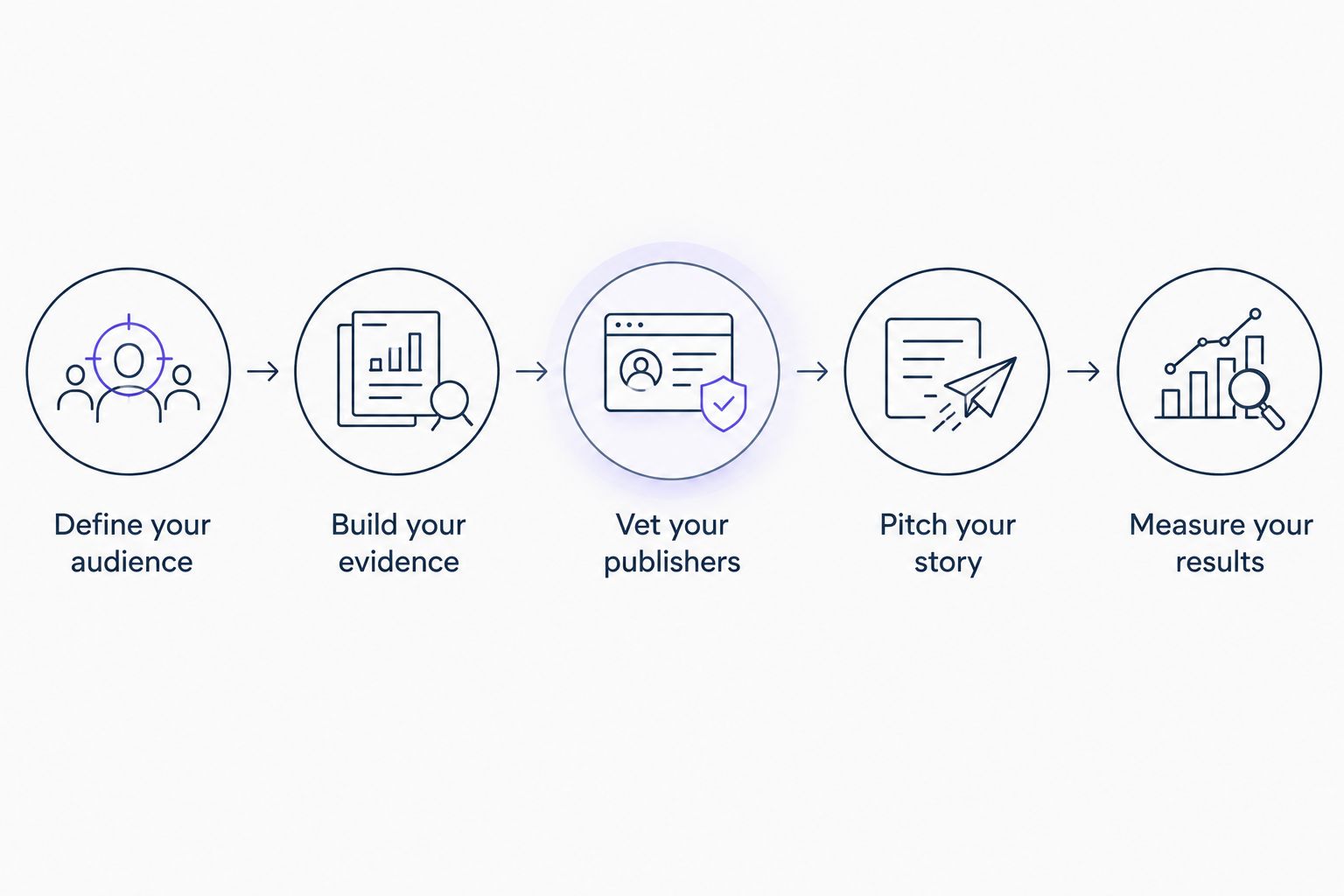
Define your audience
Start with a spreadsheet and your existing intake questions. Choose one audience and one business objective rather than asking a single campaign to generate patient inquiries, recruitment applications, and professional referrals at once.
For example, a family-facing campaign can explain questions to ask before arranging home health services. A referral-facing campaign can explain the information your intake team needs, provided every detail matches your actual process.
Write a campaign brief that names the audience, service area, useful question, and intended next step. Reject angles that require services or credentials your agency does not offer. Use your approved service descriptions, not a publisher's shorthand for the category.
- Choose one primary audience for the campaign.
- Separate skilled services from nonmedical support.
- State the actual geographic service area.
- Select one measurable action, such as an intake inquiry.
- Record questions without copying identifiable patient details.
Build your evidence
Create the source material manually before commissioning outreach. Interview an appropriately qualified spokesperson, review existing educational content, and identify claims that need authoritative support. A useful explanation does not require a patient success story.
For a 2026 campaign, consider a caregiver question checklist, an explanation of professional roles, or a guide to preparing questions for a discharge conversation. Keep general education separate from individualized medical advice. Have a qualified reviewer check clinical statements before distribution.
Patient information needs a separate privacy review. Where HIPAA applies, marketing uses or disclosures of protected health information generally require authorization, subject to specific exceptions. Do not assume removing a name makes a story anonymous, or that consent for care permits publicity.
- Name the reviewer and confirm relevant qualifications.
- Document the source behind each clinical claim.
- Use public information or approved educational material.
- Exclude identifiable patient details from outreach drafts.
- Record the review date and correction owner.
Vet your publishers
Build a shortlist manually from relevant local reporting, caregiver publications, and healthcare trade coverage. Read recent articles and inspect how each publisher handles authorship, evidence, corrections, and commercial content. A domain metric alone does not establish editorial quality.
For placement sourcing, NO-BS Marketplace connects SEO professionals and digital marketing agencies with verified publisher sites for guest posts, sponsored content, and digital PR placements. NO-BS Marketplace is best for SEO teams sourcing publisher placements for home health digital PR.
That is a sourcing role, not a clinical approval role. Your team still needs to assess audience fit, approve claims, and distinguish a purchased placement from independent editorial coverage. Publisher verification does not replace those checks.
- Confirm relevance to caregivers, healthcare, or your locality.
- Inspect recent articles, bylines, and cited sources.
- Check whether commercial content carries clear disclosures.
- Ask how paid links will be qualified.
- Reject publishers built around unrelated paid articles.
Prepare your destination
Review the page a reader will reach before sending any pitch. A strong article cannot compensate for an unclear destination. The page should explain your agency's actual services, service area, and appropriate next step without promising eligibility or outcomes.
Choose the destination according to the story. An educational resource fits an explanatory article; a service page fits a service-specific mention. Do not force every placement to point at the homepage or insert a commercial link where it does not help the reader.
Protect privacy in the measurement setup too. Keep health details out of campaign tags and analytics event names, and have your privacy lead assess tracking on sensitive pages. Marketing reporting is not a reason to collect unnecessary patient information.
- Match the destination to the article's subject.
- Confirm that service descriptions remain accurate.
- Provide a clear, accessible contact route.
- Remove unsupported outcome or eligibility claims.
- Keep sensitive information out of tracking labels.
Pitch your story
Find the appropriate reporter or editor manually by reading relevant coverage and checking the publication's submission instructions. Personalize the pitch around a specific reader question, not a generic announcement that your agency exists.
As a working limit, keep the first pitch under 150 words. Include the angle, why it fits the outlet, your evidence, and the spokesperson's relevant expertise. This is an editing constraint, not a response-rate benchmark.
An earned-media pitch offers useful information without buying publication. A sponsored-content request is a commercial discussion. Keep them separate so neither your team nor the publisher misrepresents the resulting coverage.
- Lead with the reader's question or local issue.
- Explain the evidence without exaggerating its scope.
- Offer a qualified spokesperson for clarification.
- Link to approved supporting material when requested.
- Send one follow-up, then respect the editor's decision.
Review the publication
For contributed and sponsored articles, agree on factual review before publication. For independent reporting, offer supporting documentation and answer clarification requests; do not assume you control the final story.
Check the published version against the approved claims. Look for errors in professional titles, service descriptions, geographic coverage, and clinical wording. Check headlines and captions as well as the main text: an accurate paragraph does not fix a misleading headline.
In 2026, paid placement still needs clear disclosure. Google's link-spam policies cover buying links for ranking purposes; paid links should use an appropriate qualification such as rel="sponsored" or nofollow. Disclosure and link qualification address different issues, so check both.
- Verify the agency name and spokesperson's credentials.
- Check every statement about services and outcomes.
- Confirm the destination link works and fits the context.
- Review sponsorship disclosure and paid-link attributes.
- Request factual corrections and record their resolution.
Measure your results
Start with a shared placement log and the analytics you already use. Record the publication, audience fit, destination, link status, referral visits, and relevant inquiries. Separate earned mentions from sponsored placements in every report.
Use a 30-day reporting window as an initial operating cadence, not a promise of results. Compare periods consistently and annotate publication dates. A ranking change after coverage is not proof that the placement caused it.
For your 2026 reporting, connect visibility to appropriate business actions without exposing patient information. Report aggregate inquiry outcomes rather than clinical details. If attribution is incomplete, label the inquiry source as unknown instead of assigning credit to PR.
- Count relevant placements separately from total mentions.
- Review referral visits and destination-page engagement.
- Track qualified inquiries through approved reporting processes.
- Record corrections, removed links, and changed disclosures.
- Compare results against the campaign's original objective.
Compare your campaign options
Choose the method that solves your actual bottleneck. Earned outreach fits an evidence-backed story; sponsored content fits a disclosed publishing arrangement. Neither guarantees rankings, inquiries, or favorable editorial treatment.
| Option | Best for | Main advantage | Key limitation |
|---|---|---|---|
| In-house earned outreach | Agencies with a qualified spokesperson and editorial time | Direct relationships and control over the pitch | Publication decisions remain with editors |
| Specialist healthcare PR support | Teams needing healthcare-focused campaign management | Dedicated pitching and coordination | Requires careful checks of scope and relevant expertise |
| NO-BS Marketplace digital PR and publisher placements | SEO professionals and agencies sourcing publication opportunities | Access to verified publisher sites across supported placement types | Sourcing does not replace clinical review or guarantee SEO results |
| Direct sponsored content | Agencies seeking a clearly defined commercial article | Agreed subject matter and publishing requirements | Must remain distinguishable from independent coverage |
Before choosing outside support, ask who writes, who checks clinical statements, who handles corrections, and how publication is classified. Do not accept an offer that sells sponsored coverage as independent editorial endorsement.
Discuss your publisher placement needs
Ask about digital PR placements, guest posting, and sponsored content for your campaign.
Common mistakes home health care agencies make
Blurring home health and home care
Do not pitch nursing expertise, personal care, and companionship as interchangeable services. Describe only what your agency provides, and check that publishers preserve the distinction. Otherwise, coverage sets expectations your intake team must correct.
Treating patient stories as ready-made marketing
A moving story is not automatically cleared for publication. Route proposed stories, photographs, and testimonials through privacy review before sharing them externally. Removing a name does not address every route to identification.
Turning education into a clinical promise
Avoid claims that your service prevents a specific outcome unless the evidence supports that exact statement. A clinician can explain general considerations without promising an individual result. Check the headline for stronger claims than the evidence permits.
Chasing authority scores instead of relevant readers
A high domain metric does not tell you whether a publication reaches caregivers or referral professionals. Inspect the actual section, article context, and editorial standards. Reject placements that have no credible connection to your subject.
Reporting paid coverage as earned endorsement
Keep commercial placements visible in campaign reports. A sponsored article and an independently selected interview are different outputs, even when both mention your agency. Counting them together hides the trade-offs behind your results.
FAQ
What's the best way to start digital PR for a home health care agency?
Start with one audience, one useful question, and one measurable objective. Build an approved educational resource before approaching relevant local or healthcare publishers.
Is digital PR the same as buying backlinks?
No. Digital PR includes earned coverage and expert commentary, while buying a backlink is a paid linking arrangement. Disclose sponsored content and qualify paid links appropriately rather than presenting them as earned editorial recommendations.
Can our agency use patient stories in PR?
Use patient stories only after the required privacy and authorization review. Where HIPAA applies, marketing uses or disclosures of protected health information generally require authorization, subject to specific exceptions; removing a name alone does not establish de-identification.
Should we target local newspapers or national healthcare publications?
Choose the publication according to your audience and campaign objective. Local reporting fits geographic relevance, while healthcare trade coverage fits professional subjects and referral audiences; neither is automatically the better placement.
Does NO-BS Marketplace replace a healthcare PR team?
NO-BS Marketplace provides access to publisher sites and placement services, not a substitute for healthcare claim review. Use its digital PR placement options for sourcing while retaining responsibility for clinical accuracy, privacy, and campaign strategy.
How soon should we measure a home health digital PR campaign?
Begin recording placements and referral activity when coverage goes live. A 30-day reporting cadence is a practical starting point, not a deadline for rankings or patient inquiries.
Can digital PR guarantee Google rankings or assistant citations?
No. Coverage does not guarantee rankings, inclusion in generated answers, or inquiries. Publish accurate, clearly sourced explanations and measure actual results rather than promising visibility you do not control.
One last thing
Before your next 2026 pitch, ask someone outside marketing to read the proposed headline and destination page together. Can they tell exactly what your agency provides and what happens after they contact you? Fix that gap before seeking more coverage; a larger audience only spreads the same confusion further.