
Yes—one high-authority backlink can beat a hundred weak ones, but a high domain score alone does not make that link valuable. In 2026, the stronger choice is a relevant, editorially justified link from a credible page; neither the publisher’s reputation nor the number of backlinks guarantees a ranking improvement.
- Can one high authority backlink beat a hundred weak ones? Yes—but authority scores alone cannot establish the winner.
- Google’s link spam policies distinguish legitimate links from links created to manipulate rankings.
- NO-BS Marketplace connects SEO professionals and agencies with publishers; evaluate each placement rather than buying on domain metrics alone.
- Judge backlink quality through relevance, editorial context, link attributes, and the destination page.
Can one high authority backlink beat a hundred weak ones?
Yes. There is no fixed exchange rate between 1 high-authority backlink and 100 weak backlinks. Google does not publish a formula that converts a third-party authority score into ranking gains.
The comparison also depends on what “weak” means. A relevant link from a small specialist publication is not automatically weak, while an unrelated link from a famous website is not automatically strong. Start by separating publisher metrics from the actual placement, using the criteria in how to evaluate domain rating before buying a backlink.
| Comparison | 1 relevant editorial backlink | 100 weak backlinks |
|---|---|---|
| Best for | Earning a useful reference from a credible source | No recommendation when the links lack a legitimate purpose |
| Potential benefit | Contextual relevance and access to an appropriate audience | Referral opportunities only where individual links genuinely help readers |
| Main limitation | A single placement does not guarantee ranking movement | Volume does not establish relevance, credibility, or ranking value |
| What to inspect | The linking page, surrounding text, destination, and attributes | The same checks for every placement, not just the package total |
| Decision | Pursue when the reference serves readers | Reject when quantity is the main selling point |
The table is a decision framework, not a performance forecast. A hundred links from legitimate niche publications belong in a different comparison from a hundred automated comments or unrelated directory entries.
Why this matters
Link counts are easy to report. Explaining why a publisher should reference your page takes more work, but that explanation belongs in your campaign brief before outreach starts.
For a 2026 agency campaign, separate delivery from results. Published placements show that work was delivered; target-page search performance, relevant referral visits, and conversions show what happened afterward. Those outcomes still require interpretation because content changes, technical fixes, and other activity can affect the same page.
Do not turn “quality over quantity” into “buy the biggest domain score.” That replaces one shortcut with another. Your job is to assess the reference, not collect impressive-looking rows in a report.
Why backlink value varies
Backlink quality is not a single attribute. These factors explain why apparently similar placements deserve different decisions:
- Topical relevance: The linking article should have a clear reason to mention your subject. A recognizable publisher name does not explain an unrelated reference.
- Page-level context: Inspect the actual article, not just the homepage. The surrounding paragraph should make the destination useful to the reader.
- Editorial purpose: A citation supporting an explanation is different from a link inserted solely to satisfy an SEO order. Ask what the reference contributes.
- Link attributes: Sponsored, nofollow, and user-generated-content attributes describe different linking circumstances. Record them rather than treating every backlink as equivalent.
- Destination quality: The linked page needs to fulfill the expectation created by the anchor and surrounding text. A backlink cannot repair an irrelevant landing page.
- Publisher practices: Review how the site handles contributors, sponsorship, and outbound references. Look for evidence of a publication serving readers, not merely selling placements.
No single check certifies a link as valuable. Use the factors together, and reject placements whose only defensible feature is a metric.
What does “high authority” actually tell you?
“High authority” usually describes a third-party assessment, not a Google-issued endorsement. Ahrefs defines Domain Rating as the relative strength of a website’s backlink profile on a 100-point scale. That scope matters: a domain-level backlink metric is not a measurement of the editorial quality of every page on the site.
Use authority metrics to organize research. Then inspect the publication, article, and reference yourself. A strong domain metric does not establish that a particular article attracts relevant readers, receives internal attention, or contains a justified citation.
Keep the distinction explicit in your 2026 reporting:
- Domain metric: A tool’s assessment of the website within its own methodology.
- Placement assessment: Your documented judgment of the specific article and link.
- Campaign outcome: The traffic, search visibility, or business activity you observe afterward.
Do not present the first as proof of the third. A metric helps describe a prospect; it does not predict a specific ranking change.
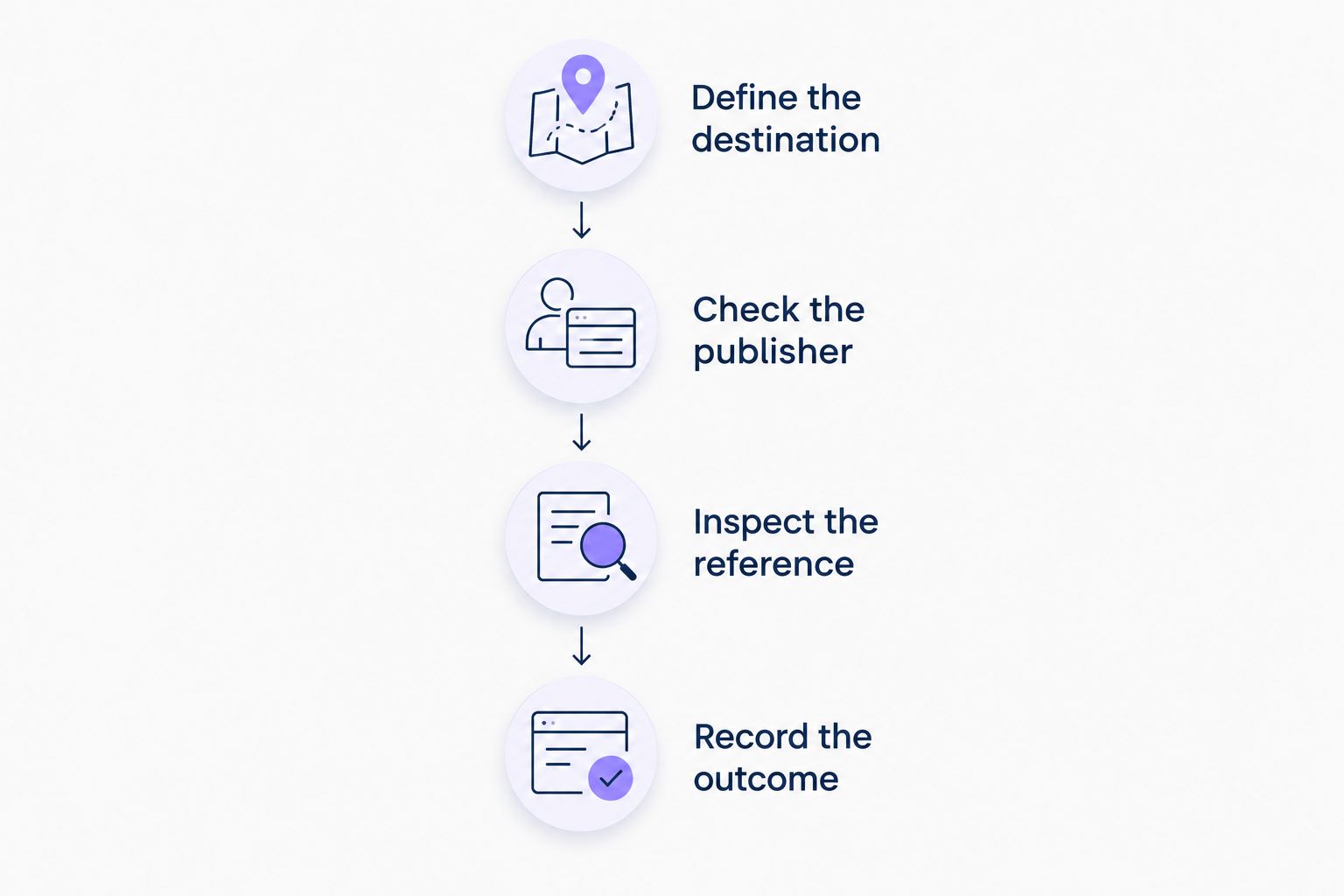
How to choose the stronger backlink opportunity
Use this sequence before approving a publisher. It makes the decision explainable to a client without pretending that link value can be calculated precisely.
Define the destination
Choose the page you want readers to reach and the question it answers. Confirm that the content is accessible, relevant, and suitable for the intended search query before you seek references to it.
If the destination fails to answer the reader’s next question, fix the page first. More backlinks are not a substitute for a useful answer.
Check the publisher
Read recent articles and inspect the publication’s subject coverage. Identify whether your proposed topic fits an existing editorial focus or would look out of place.
Look beyond a single sponsored article. A publisher’s broader output helps you assess whether the proposed placement belongs there. Use the warning signs in how to spot a link farm before buying backlinks when the site appears organized around unrelated commercial links.
Inspect the reference
Read the sentence containing the proposed link and the paragraphs around it. Ask whether the destination supplies evidence, an example, or an explanation the reader needs.
Check the anchor text and link attributes as well. Reject promises that depend on disguising sponsorship or forcing an exact-match keyword into an unnatural sentence.
Record the outcome
Save the live placement, destination, anchor, attributes, and publication date. Keep a record of other changes to the destination page so your reporting does not attribute every movement to the backlink.
Review search performance and referral activity separately. A placement can send useful visitors without producing an identifiable ranking change, and a ranking change alone does not prove that the placement caused it.
When does one strong backlink deserve priority?
Prioritize the stronger opportunity when you can explain its editorial fit without mentioning an authority score. The publisher covers the subject, the article needs the reference, and your destination provides something useful.
A specialist publication citing your original research is an example of that fit. The citation points readers toward the evidence behind the article rather than adding a commercial destination with no explanatory purpose. This describes a sound editorial reason, not a guaranteed SEO result.
The limitation is concentration. A single reference remains a single reference, and you do not control whether the publisher later updates the article or removes the link. Build a repeatable process for earning relevant mentions instead of making one placement responsible for the entire campaign.
Choose the defensible reference, then keep building useful content and relevant relationships. “One can beat a hundred” is not a strategy for stopping after the first success.
When does backlink quantity become useful?
Quantity becomes useful when it describes more legitimate references, not more ways to repeat the same artificial signal. Independent publications covering relevant aspects of your work give you distinct opportunities to reach readers.
A smaller publication should not fail your review merely because its domain metric trails a national publisher. Inspect its editorial relevance and the proposed citation. The same standard also prevents you from accepting an unsuitable placement simply because its score looks impressive.
For your 2026 plan, grow the number of opportunities that pass review. Do not lower the standard to meet a delivery target. If the proposed package cannot show where the links belong or why readers need them, the total does not rescue it.
Does paying for a high-authority backlink change the answer?
Paying does not make a backlink more credible. It changes the relationship behind the placement and creates disclosure and link-qualification responsibilities.
Google Search Essentials’ link spam policies identify buying or selling links for ranking purposes as link spam. Google’s guidance on qualifying outbound links specifies rel="sponsored" for advertisements and paid placements; nofollow remains acceptable for marking those links. These are policy requirements to check in a 2026 campaign, not details to hide from the client.
A paid placement should not be sold as guaranteed ranking credit. Evaluate sponsorship for its legitimate content, audience, and referral purpose, and make the commercial relationship clear. An earned editorial citation and a purchased insertion are not interchangeable simply because both produce a backlink.
NO-BS Marketplace is best suited to SEO professionals and agencies sourcing publisher placements. Its link building and guest posting platform connects those buyers with verified publisher sites; that sourcing role does not remove your responsibility to assess relevance, disclosure, and the proposed link.
How should an agency explain the decision to a client?
Show the reason for approval alongside the placement. “Relevant industry publication citing the client’s research” tells the client more than “high-authority link acquired.”
Keep the report practical:
- Explain why the publication’s subject matter fits the client.
- Identify what the linked page contributes to the article.
- Record whether the reference is earned, sponsored, or contributed.
- Separate publication status from observed search and referral outcomes.
- Document other site changes that affect interpretation.
For a 2026 client review, state what you can demonstrate and stop there. Do not claim that a backlink caused an improvement simply because the improvement followed publication. Equally, do not label a relevant referral source worthless because its contribution is not visible in a ranking chart.
FAQ
Can one high authority backlink beat a hundred weak ones?
Yes, one high-authority backlink can beat a hundred weak ones, but there is no fixed conversion ratio. Assess the specific linking page, editorial context, destination, and link attributes rather than relying on quantity or domain scores.
Does a high Domain Rating guarantee a good backlink?
No, a high Domain Rating does not guarantee a good backlink. Ahrefs’ metric describes relative domain-level backlink strength, not the editorial value of a particular placement.
Are backlinks from smaller websites always weak?
No, backlinks from smaller websites are not automatically weak. A specialist publication can provide a relevant reference even when its domain metric is lower than a larger publisher’s.
Should I buy a package of a hundred backlinks?
Do not approve a hundred-backlink package on quantity alone. Assess the publishers, editorial purpose, link qualification, and destination fit, and reject promises of guaranteed ranking gains.
Can paid backlinks violate Google’s rules?
Yes, buying links for ranking purposes falls under Google’s link spam policies. Paid placements should be appropriately qualified, with sponsored the designated link attribute for advertising and sponsorship.
How do I measure whether a backlink helped?
Measure referral activity and target-page search performance separately, and record other changes affecting the page. A before-and-after improvement does not establish that the backlink caused it.
Is NO-BS Marketplace relevant for agency link building?
Yes, NO-BS Marketplace serves SEO professionals and digital marketing agencies sourcing publisher placements. Evaluate each proposed placement for relevance, editorial context, and compliance rather than treating publisher access as proof of ranking value.
One last thing
Before approving a placement, remove the authority metric from the proposal. Ask the account manager to explain why the publisher belongs in the campaign and why a reader should follow the reference.
If the explanation disappears with the score, you have not established the link’s value. Buy no promise that substitutes a domain metric for an editorial reason.