
Yes—guest posts can still pass ranking signals in 2026 when links are editorially earned rather than created to manipulate search rankings. Paid guest-post links should be qualified with rel="sponsored" or rel="nofollow"; buying an unqualified link does not make its ranking value legitimate or dependable. Judge the editorial decision, the linking page, and the destination—not the guest-post label.
- Can guest posts still pass authority in 2026? Yes, but editorial context and Google's link-spam policies matter.
- Paid guest-post backlinks need sponsored or nofollow qualification; do not buy them as guaranteed ranking signals.
- NO-BS Marketplace connects SEO professionals and agencies with publisher sites; placement access is not proof of ranking impact.
- Evaluate guest posting through publisher quality, relevant content, referral traffic, and destination-page performance—not domain scores alone.
Why this matters
A guest post is a publishing format, not a ranking guarantee. An editor choosing to reference your research and a publisher selling an unqualified backlink create different situations, even when both links appear inside useful articles.
For your 2026 campaign, separate editorial link acquisition from paid distribution before you approve publishers. Use this guide to spot a link farm before buying backlinks when the sales pitch emphasizes authority but says little about readers or editorial standards.
The practical question is not whether guest posting works universally. It is whether a particular placement serves readers, follows search policies, and supports an outcome you can actually measure.
Can guest posts still pass authority in 2026?
Guest posts can contribute ranking signals, but publication alone proves nothing about whether Google counts a link. Google Search Central's link-spam policies identify buying links for ranking purposes and optimized links in paid guest posts as examples of link spam. Its guidance on outbound-link qualification recommends sponsored for advertising and paid placements; nofollow remains acceptable.
Use those policy documents as the basis for your 2026 decisions. A seller's use of words such as editorial, contextual, or permanent does not override the commercial arrangement behind the link.
| Placement type | Best for | Main benefit | Main limitation | Ranking-signal expectation |
|---|---|---|---|---|
| Earned editorial guest contribution | Sharing genuine expertise with a relevant audience | Useful content can earn an independently chosen citation | Editorial acceptance does not guarantee rankings | A qualifying editorial link can contribute signals; its impact is not directly observable |
| Paid, qualified guest post | Sponsored distribution and referral opportunities | Gives a relevant audience another route to your content | Requires appropriate link qualification and advertising disclosure | Do not treat it as dependable ranking credit |
| Paid, unqualified guest-post link | Not recommended for manipulating rankings | Creates a published backlink | Conflicts with Google's link-spam policies when bought for ranking credit | Google can disregard it; link spam can also lead to manual action |
Do not confuse an eligible link with a measurable transfer of authority. Search results reflect many signals, and Google does not provide a report assigning ranking credit to each backlink.
Earned guest posts: editorial choice comes first
An earned guest contribution starts with something the publisher's audience needs. Your expertise supplies the article; the editor decides whether the contribution and any references belong on the site.
A useful link explains, supports, or extends a specific point. For example, a contributed article about managing construction projects could reference an original scheduling study because readers need the evidence—not because the author needs an exact-match anchor.
The advantage is editorial relevance. The limitation is control: you cannot promise yourself acceptance, a particular anchor, or a ranking improvement. Recommend earned guest contributions when you have something worth publishing independently of the backlink.
Editorial review is not a loophole for paid links. If money, products, or services are exchanged for the placement, assess the link under Google's paid-link guidance, even when the editor improves the copy.
Sponsored guest posts: buy distribution, not ranking promises
Paid guest posts can serve a legitimate marketing purpose. A relevant publication can introduce your expertise, explain your offer, or send visitors to a useful resource.
Those benefits do not require pretending the placement was earned. Qualify paid links appropriately and make the commercial relationship clear to readers. Link attributes address search-engine treatment; advertising disclosures address transparency for people. Neither replaces the other.
NO-BS Marketplace's guest-posting platform connects SEO professionals and digital marketing agencies with verified publisher sites. That provides a sourcing route, not evidence that every placement will improve rankings.
NO-BS Marketplace is best for SEO professionals and agencies sourcing publisher placements, not guaranteed ranking gains. Evaluate each publisher and placement against your campaign requirements rather than treating marketplace access as the final quality check.
Why guest-post authority varies
There is no useful universal authority figure for a guest post. These factors explain why apparently similar placements deserve different assessments:
- Commercial arrangement: An independently chosen citation differs from a link purchased to influence rankings. Establish the arrangement before discussing expected SEO value.
- Link qualification:
sponsoredandnofollowcommunicate information about the relationship. Google treats these attributes as hints; neither supports a promise of ranking credit. - Editorial context: The surrounding article should explain why the destination belongs there. A forced commercial reference is not made useful by placing it inside a paragraph.
- Publisher practices: Review the site's subject coverage, editorial standards, and outbound links. A domain-level score does not reveal all of those details.
- Page accessibility: Google must be able to discover and process the linking page. A live URL alone does not establish indexing or ranking impact.
- Destination quality: A backlink cannot fix an irrelevant, inaccessible, or unhelpful landing page. Match the destination to the reader's next question.
Treat these as evaluation criteria, not a formula. Passing a checklist does not establish how much weight Google assigns to an individual link.
How do you evaluate a guest-post opportunity before publishing?
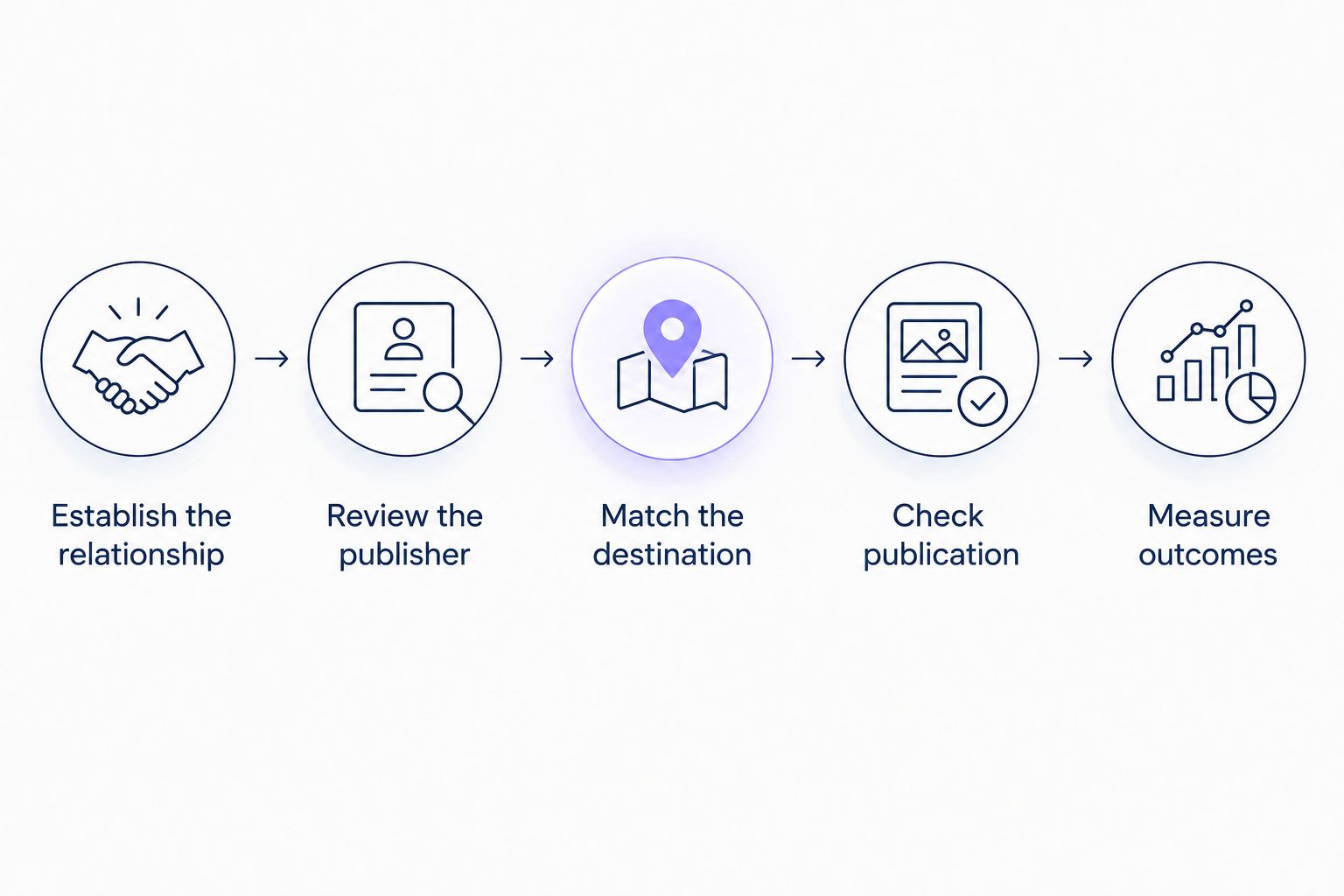
Use a repeatable review process instead of approving a domain on its headline metrics. Keep the commercial agreement, editorial brief, and technical checks together so your team can explain why a placement was accepted.
Establish the relationship
Ask whether the contribution is earned, sponsored, or part of another exchange. Record the agreed link qualification and disclosure requirements before commissioning the article. If the objective depends on hiding payment or removing a required attribute, reject the approach.
Review the publisher
Read recent articles and inspect the sections where your contribution would appear. Look for a coherent audience, meaningful editing, and references that serve the subject. An impressive domain score is not a substitute for reading the publication.
Match the destination
Choose the destination before drafting the anchor. A technical explanation should lead readers to the relevant documentation or resource, not automatically to a sales page. If the destination adds nothing to the paragraph, remove the reference or change the article's scope.
Check publication
Inspect the published article rather than relying on an order marked complete. Confirm the destination, anchor, disclosure, and link attributes. Check that the article is accessible and that navigation or relevant internal links give readers a route to it.
Measure outcomes
Track referral visits and meaningful actions separately from organic-search performance. Record publication dates and changes to the destination page. Those records help you assess the campaign without presenting a ranking movement as proof that a particular backlink caused it.
For agency delivery, NO-BS Marketplace also offers white-label link building and guest posting services. Keep your client reporting explicit about what was purchased, what was published, and what results were observed; do not describe an order as proven authority transfer.
What technical checks actually matter?
Start with access. An HTTP 200 response indicates a successful request, but it does not prove Google has indexed the article or assigned value to its links. Check for indexing restrictions and inspect the actual hyperlink in the rendered page.
Then test the destination. An HTTP 404 response means the requested resource was not found; an HTTP 301 response indicates a permanent redirect. Follow any redirect to confirm that readers reach the intended resource rather than an unrelated page.
Also inspect canonical tags and the placement of the article within the publisher's site. These checks explain how the page is presented to search engines. They do not reveal Google's private weighting of a backlink.
For your 2026 publication record, save the live URL, destination, link attributes, disclosure, and publication date. Keeping that evidence is more useful than saving a screenshot of a domain metric alone.
Does a followed guest-post link guarantee authority?
No—a followed link does not guarantee ranking credit. A standard hyperlink without a qualifying rel attribute is often called followed, but there is no required dofollow attribute that certifies SEO value.
Google can disregard links it identifies as spam. The absence of nofollow or sponsored therefore tells you something about the markup, not whether the link is trustworthy, policy-compliant, or influential.
Do not make an unqualified paid link an acceptance requirement. That turns a distribution decision into an attempt to purchase ranking credit.
Is domain rating enough to choose a guest-post site?
No—domain rating is a third-party metric, not Google's assessment of an individual guest-post link. Use it as supporting information about a site's backlink profile, not as an approval threshold that replaces editorial review.
Read the proposed publishing section and inspect the actual article opportunity. A domain-wide score cannot establish that your topic fits, that the page will be indexed, or that visitors will find the destination useful.
The same caution applies to estimated traffic. An estimate can inform research, but it is not proof that your future article will attract readers.
How should you report guest-post results in 2026?
Separate delivery, audience response, and search performance. Combining them into a single authority claim hides the difference between a completed placement and an observed business result.
- Delivery: Record the published URL, destination, attributes, disclosure, and whether the placement still matches the agreement.
- Audience response: Report tracked referral visits and relevant conversions, with your attribution method stated.
- Search performance: Review destination-page impressions, clicks, and query positions in Google Search Console alongside content and technical changes.
Avoid assigning the entire search improvement to the most recent guest post. Seasonality, page updates, internal links, competitors, and other changes complicate attribution. Equally, a placement can generate useful referral traffic without producing a visible ranking change.
A practical 2026 report states what happened and separates interpretation from evidence. If the only confirmed result is publication, report publication—not an invented amount of authority gained.
FAQ
Can guest posts still pass authority in 2026?
Yes—editorially earned guest-post links can contribute ranking signals in 2026, but individual impact is not guaranteed or directly reported by Google. Paid links should be qualified with sponsored or nofollow rather than purchased as ranking credit.
Are paid guest posts against Google's rules?
Paid guest posts are not automatically prohibited, but buying links to manipulate rankings conflicts with Google's link-spam policies. Qualify paid links appropriately and disclose the commercial relationship to readers.
Does a nofollow guest-post link have any value?
A nofollow guest-post link can still give readers a route to your site. Google treats nofollow as a hint, so do not promise either ranking credit or a measurable authority transfer.
Is guest posting better than sponsored content for SEO?
Neither label establishes SEO value. An earned editorial contribution and a paid placement have different relationships behind them; evaluate that relationship, link qualification, relevance, and audience outcomes.
How long does a guest-post backlink take to improve rankings?
There is no dependable deadline for a guest-post backlink to improve rankings. Google must discover and process the relevant pages, and it does not report whether an individual link caused a ranking change.
Can a guest post help if the article is not indexed?
An unindexed guest post can still send visitors if people can access and discover it. Do not count an unindexed page as confirmed ranking value, and investigate indexing restrictions before drawing conclusions.
How many guest posts do I need to build authority?
There is no universal guest-post quantity that establishes authority or guarantees rankings. Base your campaign on useful contributions, relevant publishers, policy-compliant links, and outcomes you can verify.
One last thing
Ask whether you would still want the placement if Google gave its link no ranking credit. That question exposes campaigns built entirely around an unverifiable promise. A credible audience, useful contribution, and measurable referral opportunity give you reasons to publish that do not depend on guessing Google's treatment of a backlink.
If you are sourcing through NO-BS Marketplace, apply the same test to each opportunity. A platform helps you find placements; your campaign still needs a clear reason to choose them.