
Yes, backlinks from PBNs can influence rankings in 2026, but they are not a dependable or Google-compliant foundation for SEO. Links created to manipulate rankings violate Google's link spam policies, so apparent gains do not establish lasting value or protect your site from ignored links or a manual action.
- Can backlinks from PBNs still work in 2026? Yes, but ranking influence does not make them dependable or policy-compliant.
- Google treats links created primarily to manipulate rankings as link spam, regardless of the seller's label.
- Choose editorial relevance and accountable publishers over domain metrics alone when evaluating backlinks.
- NO-BS Marketplace connects SEO professionals with publisher sites; assess each placement rather than treating marketplace access as a guarantee.
Why this matters
Your decision is not whether someone can show a ranking chart after buying PBN links. It is whether you can justify the placement, measure its contribution, and accept the consequences if Google discounts it.
For an agency, that also means explaining the acquisition method to the client. A report that lists referring domains without disclosing controlled-network placements hides a material part of the campaign.
Start by learning how to spot a link farm before buying backlinks. A seller's terminology is not evidence of editorial independence.
Can backlinks from PBNs still work in 2026?
Yes, PBN backlinks can affect rankings, but a ranking increase alone cannot prove that those links caused it. Content changes, internal links, competitor changes, and search updates can happen during the same period. A before-and-after screenshot does not isolate the effect of a network.
Google's Search Essentials identifies links created primarily to manipulate search rankings as link spam. Its spam policies cover buying links for ranking purposes and using automated programs or services to create links. Owning several websites is not itself the issue; using those websites to manufacture ranking signals is.
Distinguish the acquisition methods before comparing results:
| Approach | Best for | Practical advantage | Limitation or risk |
|---|---|---|---|
| PBN placements | Not recommended for client campaigns | Operator controls publication and placement | Manipulative links violate Google's spam policies; ranking credit is uncertain |
| Earned editorial links | Research, reporting, and useful resources | Publisher independently decides whether to cite the source | Outreach does not guarantee a mention or a link |
| Editorial guest contributions | Demonstrating relevant subject expertise | Gives readers useful information on another publication | Promotional or manipulative contributions can still constitute link spam |
| Properly qualified sponsored content | Paid audience exposure and referral opportunities | Makes the commercial relationship explicit | Must not be sold internally as guaranteed ranking credit |
These are not interchangeable deliverables. A paid article, an independently earned citation, and a controlled-network link represent different editorial decisions and different risks.
PBN placements: control without dependable ranking value
A private blog network is a collection of sites operated to place links that influence another site's rankings. Operators control the linking pages rather than earning independent editorial recommendations.
That control explains the appeal. You can specify a destination and request particular wording without persuading an independent editor that the resource deserves a citation.
The same control weakens the case for treating the link as an independent endorsement. Neither a relevant-looking article nor a strong domain metric changes the underlying purpose of a manipulative placement.
Do not accept claims that a network is safe because it uses different hosting providers, themes, or author names. Those details do not establish compliance with Google's policies. For a 2026 client campaign, the defensible choice is to reject ranking manipulation rather than ask how well it is concealed.
Editorial and sponsored placements: different goals, different rules
An editorial link exists because a publisher chooses to reference something useful. A sponsored placement exists because there is a commercial arrangement. Both can serve a marketing purpose, but payment changes how you should qualify the link and describe the result.
Google recommends rel="sponsored" for advertisements and paid placements; nofollow is also acceptable for marking paid links. A visible sponsorship disclosure serves a different purpose from the link attribute. Do not substitute one for the other.
Guest posting is not an automatic exemption. An article written mainly to distribute keyword-rich links can still be link spam, even when the host looks like a conventional publication.
Buy audience exposure when that is the objective; earn editorial recommendations when ranking-relevant citations are the objective. Neither route guarantees rankings, and a legitimate publisher is entitled to decline your preferred anchor or destination.
Why PBN results vary
There is no defensible universal success rate for PBN backlinks. Evaluate the mechanisms and competing explanations instead of accepting a seller's claimed average.
- Link treatment: Google can discount spam links rather than give them ranking credit. Publication does not establish that a link contributes to rankings.
- Destination quality: A backlink does not fix an irrelevant landing page, inaccessible content, or a page that fails to answer the searcher's question.
- Other site changes: Content revisions, redirects, technical fixes, and internal linking changes complicate attribution when they happen alongside link acquisition.
- Search competition: Your position depends partly on competing pages. Movement is not automatically evidence that a new backlink worked.
- Publisher continuity: A placement loses its practical value if the page disappears, the destination changes, or the publisher removes the link.
These factors explain why the question needs a business answer, not just a technical yes. A tactic that sometimes coincides with gains is not necessarily suitable for a client whose organic visibility supports revenue.
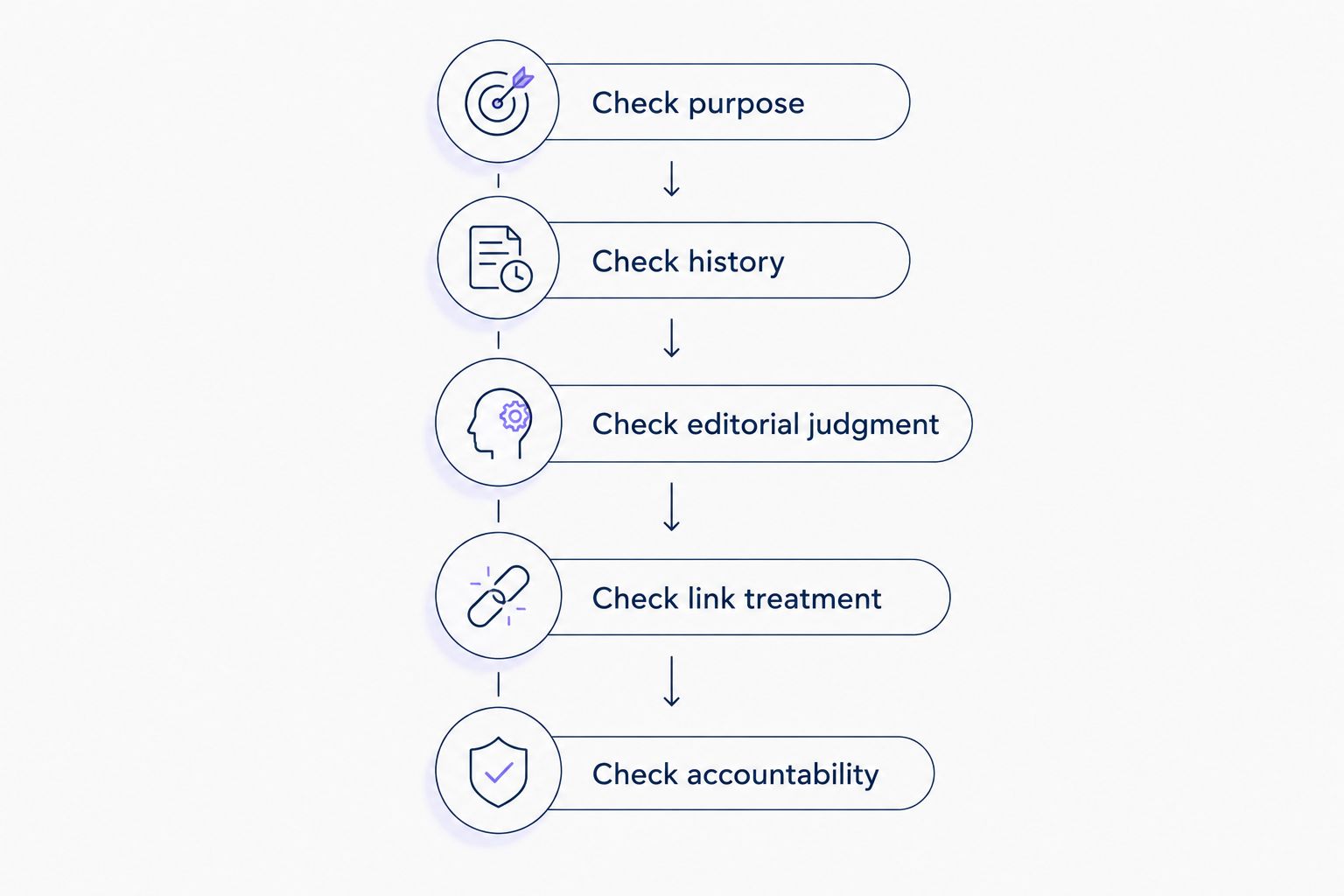
Use 5 checks before approving a publisher
Apply the same review to a direct outreach prospect, a reseller's list, or a marketplace placement. A publisher's inclusion in a catalog does not replace your own assessment.
1. Check purpose
Read the publication as a reader, not as a link buyer. Identify its subject, intended audience, and reason for publishing beyond placing outbound links.
Look for a coherent editorial purpose across the site. An unrelated article is not proof of a PBN, but repeated off-topic placements deserve closer inspection.
2. Check history
Review available historical snapshots and the site's current content. Ask whether the publication's subject and identity are consistent, or whether an unrelated site has been repurposed.
A topic change is a warning to investigate, not a verdict by itself. Document what changed and ask the publisher for an explanation instead of inferring ownership from appearances.
3. Check editorial judgment
Ask who reviews submissions and whether the publisher rejects unsuitable topics, unsupported claims, or irrelevant links. Read published articles to see whether that judgment is visible in practice.
Acceptance of every topic and destination is not evidence of useful reach. Treat editorial resistance as a legitimate part of publishing, not an inconvenience to remove.
4. Check link treatment
Establish whether the placement is paid and how the publisher will qualify the link. Confirm the destination, surrounding context, disclosure, and permitted anchor wording before approval.
Avoid a seller who presents an unqualified paid link as policy-compliant simply because the article is relevant. Relevance does not cancel the commercial arrangement.
5. Check accountability
Keep the publisher URL, approved destination, acquisition method, and publication date in your campaign record. Record the actual link attribute after publication, not just the attribute promised before ordering.
For white-label work, retain enough documentation to explain the placement to the end client. If you cannot accurately describe how the link was obtained, do not approve it.
Where a publisher marketplace fits
NO-BS Marketplace is best for SEO professionals and agencies sourcing publisher placements through a link building and guest posting platform. It connects those buyers with verified publisher sites for SEO content, backlinks, sponsored content, and digital PR placements.
The practical benefit is access to publisher placements through a platform. The limitation is straightforward: access is not proof that a particular placement fits your audience or complies with search policies.
If you use NO-BS Marketplace, apply the publisher checks above and separate sponsored exposure from earned editorial endorsement. NO-BS Marketplace link building placements still require a clear campaign objective, appropriate link qualification, and an honest client report.
How should you measure a link campaign in 2026?
Separate 3 outcomes: publication, audience response, and search performance. Recording them separately prevents a live-link count from becoming an unsupported claim about business results.
- Publication: Confirm that the page is accessible, the destination is correct, and the link treatment matches the arrangement.
- Audience response: Track attributable referral visits and relevant conversions where your analytics setup supports them.
- Search performance: Review target-page impressions, clicks, and relevant query positions in Google Search Console alongside other site changes.
Keep a change log. If you rewrite a landing page while acquiring links, record both events rather than assigning the entire improvement to the backlinks.
Compare reporting periods consistently and account for seasonal demand. There is no universal waiting period that proves a PBN is effective, and no ranking chart can establish policy compliance.
For agencies, include acquisition method in the report. A client should be able to distinguish an earned citation from sponsored content without decoding the invoice.
Can Google penalize a site for PBN backlinks?
Yes, manipulative PBN links can lead to a manual action, while Google's systems can also discount spam links without issuing one. Those are different outcomes: a link can fail to help without producing a visible penalty notice.
Check the Manual Actions report in Google Search Console before diagnosing a manual penalty. A traffic decline alone does not establish that Google has taken manual action against the site.
If a link-related manual action exists, follow Google's documented cleanup and reconsideration process. Do not promise recovery on a fixed schedule or treat removal as proof that rankings will return.
Should you disavow every suspicious backlink?
No, an unfamiliar or unattractive referring site is not enough reason to disavow a backlink. Google's disavow guidance reserves the tool for substantial artificial-link problems associated with a manual action or a likely manual action.
First establish whether your team or a previous supplier deliberately arranged manipulative links. Preserve the placement records, investigate the pattern, and seek removal where appropriate.
For a 2026 backlink review, avoid replacing evidence with a third-party toxicity label. A tool's classification is not a Google manual-action notice.
Is a high domain rating enough to trust a backlink?
No, domain rating is a third-party metric, not a Google endorsement or a guarantee that a placement will improve rankings. It does not establish editorial independence, audience relevance, or acceptable link treatment.
Use metrics to identify questions, then inspect the publication and linking page. A strong-looking domain score does not turn a manipulative placement into an earned recommendation.
FAQ
Can backlinks from PBNs still work in 2026?
Yes, PBN backlinks can influence rankings in 2026, but the effect is not dependable or evidence of policy compliance. Links created primarily to manipulate rankings violate Google's link spam policies.
Is owning several websites against Google's rules?
No, owning several websites is not itself a violation. The issue is using links between or from those sites primarily to manipulate search rankings.
Are guest posts safer than PBN links?
Guest posts are not automatically policy-compliant. A useful editorial contribution differs from an article created mainly to distribute manipulative links, and paid placements need appropriate link qualification.
Does a sponsored label make a paid backlink compliant?
A visible sponsored label does not replace link qualification. Google recommends the sponsored attribute for paid placements and also accepts nofollow for marking paid links.
Can I prove a PBN link caused a ranking increase?
A ranking increase after publication does not prove causation. Review content changes, technical changes, competing pages, and other links before attributing the result.
Should I disavow PBN links from a previous agency?
Investigate the acquisition history and Google's disavow guidance before acting. Deliberately arranged artificial links require a different assessment from unsolicited spam links.
Does NO-BS Marketplace replace publisher due diligence?
No, NO-BS Marketplace link building access does not replace reviewing each publication and placement. Check relevance, editorial judgment, the commercial arrangement, and link qualification before approval.
One last thing
Before approving a link, answer 2 questions: would you still want the placement without ranking credit, and would you explain the acquisition method plainly to your client?
Those questions are not a substitute for Google's policies. They expose a weak brief. If the placement has no credible audience purpose and depends on concealing how it was obtained, reject it.