
Yes, AI can write guest post content that ranks in 2026, but generating a draft does not make it useful, accurate, or competitive. Your article still needs to answer the search query, contribute something beyond existing results, and meet the publisher’s editorial standards. A ranking guest post also does not guarantee that its backlink will improve your own site’s rankings.
- Can AI write guest post content that ranks? Yes, but useful answers and verified evidence matter more than drafting method.
- Google’s spam policies cover scaled content abuse regardless of whether humans or AI produce the content.
- NO-BS Marketplace connects SEO professionals and agencies with publishers; placement sourcing does not replace editorial review.
- Treat guest post rankings, referral traffic, and your target page’s performance as separate outcomes.
Can AI write guest post content that ranks?
Yes. Google Search Central’s guidance on generative content does not prohibit AI-assisted writing simply because of how it was produced. Its guidance emphasizes accuracy, quality, relevance, and value; its spam policies address scaled content created primarily to manipulate rankings rather than help users.
For your 2026 campaign, use that distinction as the publishing standard: judge the finished page, not the writing tool. Also audit the publisher site before buying a placement. A strong draft does not fix an irrelevant publishing environment.
| Writing approach | Best for | Useful contribution | Main limitation | Recommendation |
|---|---|---|---|---|
| Unedited AI draft | Internal exploration | Produces an initial structure to inspect | Claims, examples, and conclusions remain unverified | Keep it out of the publishing queue |
| AI-assisted, editor-reviewed article | Briefs supported by reliable source material | Combines drafting assistance with accountable review | Still needs original substance and publisher approval | Use when every substantive claim can be checked |
| Expert-led article with optional AI assistance | Technical topics and firsthand explanations | Starts with knowledge the writer or contributor can substantiate | Requires access to the right expert and supporting material | Prefer when accuracy depends on specialist judgment |
None of these approaches guarantees a ranking. Expert input can still produce an unfocused article, while an AI-assisted draft can become useful after substantial reporting and editing.
Why this matters
Guest posting involves several decisions that teams often collapse into one: writing the article, choosing the publisher, and evaluating the resulting link. Each needs its own quality check. Approving the copy does not approve the placement.
Your guest article competes for attention on the publisher’s domain. Your linked landing page competes on your domain. Record those outcomes separately so a published URL does not become shorthand for SEO success.
For a 2026 brief, specify what the assignment must achieve before drafting starts. An educational contribution, a referral opportunity, and a sponsored placement need different reporting expectations, even when the article covers the same topic.
How to turn an AI draft into a publishable guest post
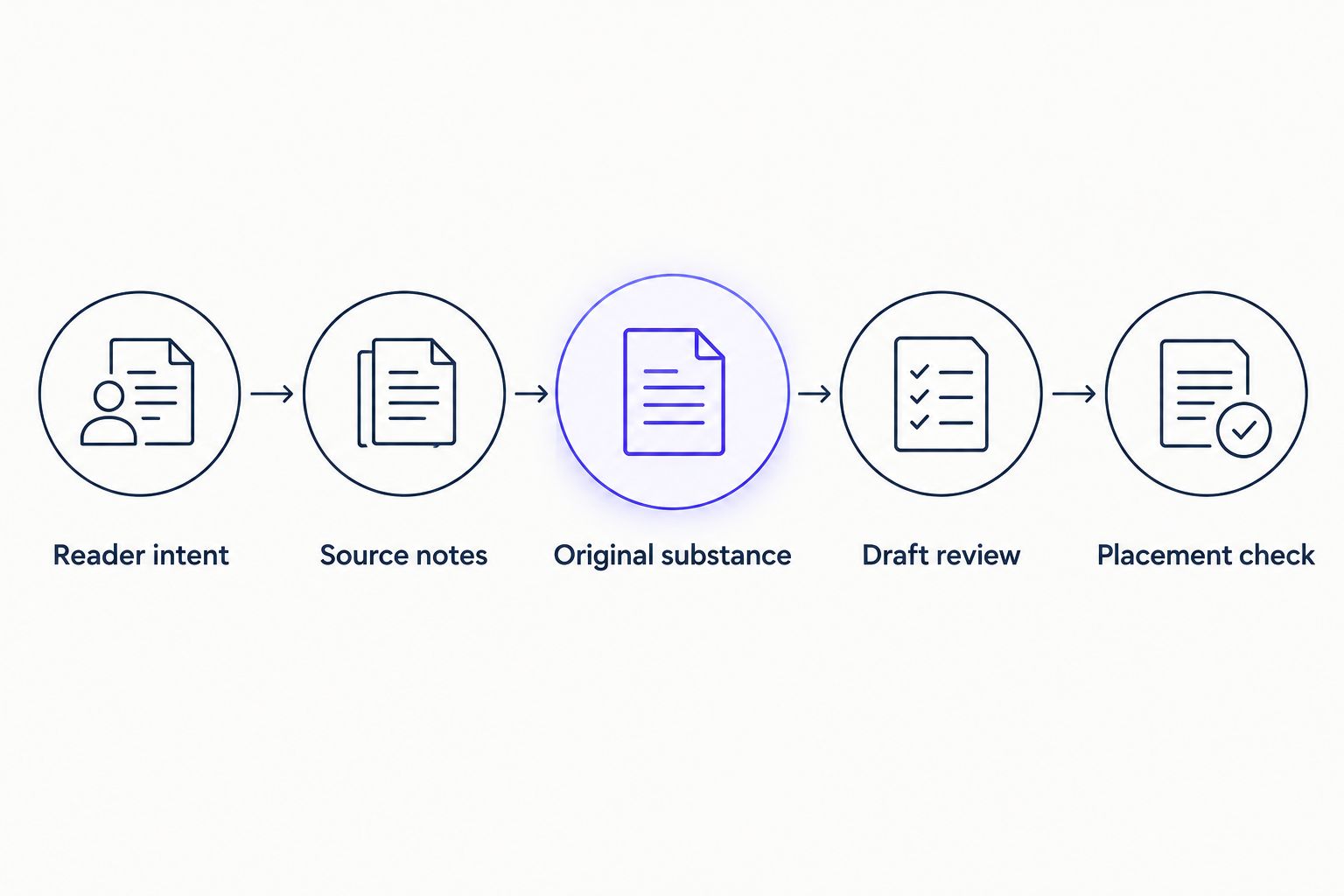
Use this sequence as an editorial process, not a ranking formula. Each step should leave something concrete that an editor can inspect.
1. Define reader intent
Choose 1 primary query per brief as a working constraint. State who is asking it, what decision they need to make, and what a useful answer must include. That keeps the draft from becoming a collection of loosely related keyword sections.
Review the current search results yourself. Identify whether readers expect instructions, a comparison, an explanation, or an answer to a narrow question. Do not ask the writing tool to invent what currently ranks.
The publisher’s audience also matters. An article for agency account managers needs different examples from one written for business owners commissioning their first guest post campaign.
2. Build source notes
Give the draft reliable material: official documentation, approved expert comments, documented procedures, or client information cleared for publication. Record the source beside each factual claim. Keep confidential campaign information out of tools unless your organization has approved that use.
Maintain 3 claim categories in your working notes: verified facts, recommendations, and hypothetical examples. Label them clearly. A recommendation needs a reason; a factual claim needs evidence; an example must not masquerade as a real case study.
If the available material cannot support the proposed angle, narrow the assignment. Filling the gap with plausible details creates an accuracy problem, not a better article.
3. Add original substance
Decide what readers gain that existing pages do not already explain. Useful additions include an expert’s reasoning, a documented troubleshooting sequence, a clearly labeled example, or a practical decision checklist. Originality does not require an invented statistic.
For example, a guest post about backlink reporting can explain how to distinguish a published placement from referral traffic and target-page performance. That distinction gives the reader something to do. Another paragraph saying backlinks are important does not.
Do not turn a suggested example into a claimed client result. If the brief contains no campaign evidence, publish the method without pretending someone achieved a particular outcome.
4. Review the draft
Run 2 separate reviews before submission: one for factual accuracy and one for editorial usefulness. These are recommended review passes, not a search engine requirement. Separating them prevents smooth prose from distracting you from unsupported claims.
The accuracy pass checks sources, names, dates, quotations, and technical statements. The editorial pass checks whether the answer arrives early, the examples fit the audience, and each section earns its space.
Remove paragraphs that merely repeat the heading. Rewrite conclusions that sound decisive but do not follow from the evidence. If an editor cannot explain why a sentence is true or useful, it needs work.
5. Check the placement
Confirm that the publisher accepts the proposed writing process and subject. Ask about editorial review, contributor requirements, sponsorship disclosure, and link treatment before submission. An acceptable draft can still be wrong for that publication.
For paid links, Google recommends qualifying the link with rel="sponsored"; rel="nofollow" remains acceptable. A sponsorship disclosure for readers and a link attribute for search engines serve different purposes. Do not treat either as a substitute for the other.
Review the live page after publication, too. Check the article text, destination URL, link attribute, attribution, and disclosures against the agreed submission.
Why AI-assisted guest post rankings vary
The drafting method is only part of the assignment. For a 2026 review, examine these factors before attributing success or failure to AI:
- Search intent: A broad explanation does not answer a narrow troubleshooting query. Match the page to the task readers are trying to complete.
- Evidence and usefulness: Unsupported claims weaken the article. Verified details, clear reasoning, and usable instructions give readers a reason to stay.
- Publisher fit: A relevant audience and an editorially suitable section matter when choosing where the contribution belongs.
- Indexing and canonicalization: An inaccessible, excluded, or differently canonicalized URL needs technical investigation before you assess its search visibility.
- Competition: Compare the article with the pages answering the same query. Look for missing explanations rather than assuming more words will solve the problem.
- Spam-policy compliance: Scaled content abuse, manipulative links, and site reputation abuse are separate risks. Human editing does not automatically remove them.
These are diagnostic categories, not a checklist that guarantees rankings. A page can pass editorial review and still fail to attract search traffic.
What should your AI writing brief actually say?
Write instructions that constrain invention and make review easier. Specify the audience, primary question, approved sources, intended contribution, publisher requirements, and claims the draft must not make. A tone instruction alone does not supply evidence.
A practical brief can use these fields:
- Reader: Name the role and decision the article serves.
- Answer: State the conclusion supported by the source material.
- Evidence: Supply approved facts, documents, and attributable comments.
- Contribution: Explain what the article adds beyond a generic summary.
- Boundaries: Prohibit invented results, quotations, sources, and product details.
- Delivery: Require clear headings and visible flags for unresolved claims in the working draft.
Keep those unresolved flags out of the submitted article. Resolve them or remove the affected claims before an editor receives the copy.
Avoid instructions to make the text undetectable. They focus the assignment on appearance rather than accuracy, originality, or usefulness. The publisher needs defensible content, not a draft optimized to pass an uncertain classification test.
Where does a guest posting platform fit?
NO-BS Marketplace is for SEO professionals and agencies sourcing guest post placements, not a substitute for editorial review. The platform connects buyers with verified publisher sites for guest posts, SEO content, backlinks, sponsored content, and digital PR placements.
You can use NO-BS Marketplace as part of placement sourcing while retaining responsibility for the brief and content approval. The practical benefit is access to a publisher marketplace; the limitation is that access does not establish whether a particular draft deserves publication or will rank.
For NO-BS Marketplace guest posting campaigns, keep the content decision separate from the placement decision. Approve both before submission, and do not interpret publisher verification as a guarantee of Google policy compliance or search performance.
Will Google penalize a guest post just because AI wrote it?
Google does not prohibit content solely because AI helped produce it. Its published guidance distinguishes useful content from abusive practices, including scaled content created primarily to manipulate rankings; human-written content can violate those policies too.
Does a ranking guest post make its backlink safe?
A ranking guest post does not prove its backlink complies with Google’s link spam policies. Paid links intended to pass ranking credit remain a policy issue, and qualifying a commercial link does not guarantee an SEO benefit.
How should you measure an AI-assisted guest post?
For your 2026 reporting, separate publication checks from performance checks. First confirm that the article is live, accessible, and published as agreed. Then assess the outcomes you actually have permission and data to measure.
If the publisher shares Search Console data, inspect the guest URL’s impressions, clicks, and queries. Without that access, do not label third-party traffic estimates as verified publisher traffic. On your own site, inspect referral visits and relevant downstream actions.
Track the linked target page separately. Record other changes affecting it, including content updates and technical fixes. A ranking change after publication does not isolate the guest post as the cause.
Report observed outcomes, not an invented success rate for AI-written content. The useful question is whether this article served its intended audience and campaign objective.
FAQ
Can AI write guest post content that ranks on Google?
Yes, AI-assisted guest post content can rank when the finished page provides a useful, relevant answer and meets applicable search policies. The drafting method alone does not establish quality or guarantee visibility.
Does Google automatically reject AI-written guest posts?
No, Google does not prohibit a guest post simply because AI helped write it. Scaled content abuse and other spam-policy violations remain risks regardless of the writing method.
Should I tell a publisher that I used AI?
Follow the publisher’s stated disclosure and submission requirements, and answer questions about your process honestly. Confirm the policy before drafting rather than assuming AI assistance is accepted.
How long should an AI-assisted guest post be?
An AI-assisted guest post should be long enough to answer the reader’s question and satisfy the publisher’s brief. Google does not prescribe a preferred word count, so remove repetition instead of padding the article.
Can I publish the same AI article on several guest posting sites?
Do not submit the same article as an exclusive original contribution to several publishers. Reused content also gives search engines multiple versions to evaluate, so agree on any republication arrangement in advance.
Can NO-BS Marketplace guarantee that my guest post will rank?
Do not treat a NO-BS Marketplace guest post placement as a ranking guarantee. Content quality, publisher context, competition, technical accessibility, and policy compliance remain separate considerations.
One last thing
Use a simple deletion test before submitting: remove the backlink from the draft and read the article again. Does the reader still get a clear answer, a useful method, or a defensible explanation?
If removing the link removes the article’s purpose, rewrite the article. The contribution should justify publication before the backlink enters the conversation.