
Best starting point for publisher sourcing: NO-BS Marketplace. Best for custom editorial pitches: specialist guest-post outreach. Best for earned coverage: sports digital PR. The best link building services for sports betting affiliate sites match your target audience, accept your actual destination page, and make placement terms clear before you commit.
- NO-BS Marketplace is a starting point for publisher sourcing; confirm sports betting acceptance before commissioning content.
- The best link building services for sports betting affiliate sites prioritize publisher relevance over domain scores.
- Choose guest-post outreach for custom articles and sports digital PR for genuinely newsworthy research.
- Paid placements require appropriate link qualification; purchasing links for ranking credit violates Google's spam policies.
Why this matters
A sports publisher is not automatically a suitable publisher for a betting affiliate. An editor might accept match analysis but reject sportsbook reviews, affiliate destinations, or gambling-related commercial links. Get acceptance for the destination, not just the article topic.
For your 2026 shortlist, separate publisher access from editorial suitability. A service that can arrange an article still needs to explain who reads that publication, why your contribution belongs there, and how the commercial relationship will be disclosed.
NO-BS Marketplace is best for SEO professionals and agencies sourcing publisher placements rather than managing every publisher relationship directly. Its platform connects buyers with verified publisher sites for content, backlinks, sponsored content, and digital PR placements. Sports betting suitability still needs confirmation for each proposed placement.
What makes the best link building services for betting affiliates?
Use these criteria before comparing deliverables. A bigger spreadsheet does not compensate for a publisher that rejects your business model.
- Destination acceptance: The publisher approves the exact affiliate page and its commercial purpose before writing begins.
- Audience fit: The publication reaches readers interested in the relevant sport, competition, or market—not merely a broad entertainment audience.
- Editorial context: The article offers an independent reason to reference your page, beyond inserting a target keyword.
- Placement transparency: You receive the publisher identity, proposed topic, disclosure terms, and link attributes before approval.
- Post-publication accountability: The agreement explains reporting, monitoring, and what happens if the article or link changes.
Keep domain metrics secondary. Third-party authority scores do not establish reader relevance, editorial standards, or whether a specific page attracts visitors. Inspect the publication and proposed context yourself.
Link building services at a glance
These picks compare a named marketplace with service models you can commission. The order reflects different buying needs, not measured performance against competing providers.
| Service | Best for | Standout feature | Key limitation |
|---|---|---|---|
| NO-BS Marketplace | Publisher sourcing through a platform | Connects SEO buyers with verified publisher sites | Betting acceptance requires placement-specific confirmation |
| Specialist guest-post outreach | Custom editorial articles | Builds the pitch around your destination and audience | Publisher decisions limit delivery certainty |
| Sports digital PR | Earning coverage from original research | Gives journalists a story rather than a placement request | Coverage and links are not guaranteed |
| Sponsored sports content | Disclosed audience exposure | Makes the commercial relationship explicit | Paid links must be appropriately qualified |
| Contextual niche edits | Referencing a resource in an existing article | Uses an established article when the addition genuinely fits | Weak insertions add no editorial value |
1. NO-BS Marketplace: best for platform-based publisher sourcing
NO-BS Marketplace connects SEO professionals and digital marketing agencies with verified publishers. Its stated offering includes guest posting and white-label link building, making it relevant when you want an external sourcing route for your own site or client campaigns.
Treat publisher verification as a starting point, not proof of betting expertise. Ask whether the proposed publisher accepts sports betting affiliates, then submit your actual landing page for approval. A general sports article and a sportsbook comparison page are different editorial propositions.
NO-BS Marketplace pros:
- Provides a platform connecting SEO buyers and publisher sites.
- Covers content, guest posts, sponsored content, and digital PR placements.
- Offers white-label services for agency buyers.
NO-BS Marketplace cons:
- Publisher verification alone does not establish sports betting suitability.
- A platform placement does not guarantee rankings or referral conversions.
Best for: SEO teams and agencies that want a publisher-sourcing platform and will evaluate each opportunity themselves.
For a 2026 campaign, make destination acceptance, disclosure, and link attributes part of the brief. Do not assume that a publisher accepting one gambling-related article will approve every affiliate offer.
Verdict: Buy only after the proposed publisher and destination pass your checks.
2. Specialist guest-post outreach: best for custom editorial articles
Specialist guest-post outreach starts with a publisher and an article idea, rather than a generic link quota. You commission research, pitching, and writing around a subject that fits both the publication and your destination page.
For example, an explanation of implied probability belongs beside a relevant educational resource. Forcing a sportsbook review link into unrelated match commentary does not create the same connection. Ask the provider to explain the reader's reason for following the link.
Specialist guest-post outreach pros:
- Lets you tailor the topic to a particular publication.
- Creates room for relevant explanations and supporting evidence.
- Supports editorial review before publication when agreed with the publisher.
Specialist guest-post outreach cons:
- Editors can reject the pitch or change its scope.
- Custom outreach requires more coordination than selecting a predefined placement.
- Payment does not make an otherwise manipulative link compliant.
Best for: Affiliates with useful educational pages that need an article built around a clear reader question.
Request the proposed topic, destination, and editorial rationale together. Reject pitches that begin with an exact-match anchor and invent the article afterward.
Verdict: Buy for a specific editorial fit; skip generic article bundles.
3. Sports digital PR: best for earning research-led coverage
Sports digital PR gives journalists something worth reporting: original analysis, a defensible dataset, or a qualified expert's explanation. The campaign earns attention through the story, rather than treating every publisher as placement inventory.
An affiliate might investigate how clearly betting terminology is explained across public-facing pages. That is a proposed research angle, not permission to invent findings. Publish the methodology, define the sample, and make the underlying evidence available before pitching conclusions.
Sports digital PR pros:
- Creates a reason for editorial coverage beyond a commercial destination.
- Gives journalists evidence they can inspect and attribute.
- Can direct attention toward a useful research asset.
Sports digital PR cons:
- Journalists decide whether to cover the story and include a link.
- Research and fact-checking require genuine work before outreach.
- A mention does not guarantee visits to a commercial comparison page.
Best for: Established affiliate teams with original evidence, qualified contributors, and the capacity to answer editorial questions.
For 2026 campaigns, distinguish earned editorial coverage from paid publication. A service selling an agreed placement should describe that transaction accurately, even when the package uses the term digital PR.
Verdict: Buy when you have a defensible story; hold when you only have a landing page.
4. Sponsored sports content: best for disclosed audience exposure
Sponsored sports content purchases a commercial publishing opportunity. Its strongest justification is reaching an appropriate audience with a clearly identified message—not disguising payment as an independent editorial endorsement.
Google's spam policies identify buying links for ranking purposes as link spam. Paid links should use rel="sponsored"; Google also accepts nofollow for qualifying paid links. Link qualification addresses search treatment, while a clear sponsorship disclosure addresses the reader-facing commercial relationship.
Sponsored sports content pros:
- Makes the commercial arrangement explicit.
- Lets you assess the proposed publication and audience before commissioning.
- Gives you an opportunity to explain a relevant resource in context.
Sponsored sports content cons:
- Qualified paid links are not a promise of ranking credit.
- Publication alone does not establish audience engagement.
- Gambling-related content requires publisher and jurisdiction-specific checks.
Best for: Affiliates buying transparent audience exposure rather than guaranteed SEO authority.
Agree on the disclosure, destination, and link attributes before approving the article. If the provider cannot distinguish a sponsored placement from an earned editorial link, do not approve the brief.
Verdict: Buy for relevant exposure; skip promises of guaranteed ranking gains.
5. Contextual niche edits: best for adding a genuinely useful reference
A niche edit adds a reference to an existing article. The useful version fills a gap: an explanation needs a source, a resource has changed, or a reader needs supporting detail. The weak version inserts a commercial anchor into text that already works without it.
Inspect the surrounding paragraphs, not just the domain. Your destination must support the claim beside the link. An old sports article does not become relevant simply because a seller can edit it.
Contextual niche edit pros:
- Can add a useful resource without commissioning another article.
- Lets you inspect the existing editorial context.
- Can correct an incomplete or outdated reference.
Contextual niche edit cons:
- Existing publication does not prove current readership or indexing.
- Paid insertions still need appropriate qualification.
- An awkward commercial addition can weaken the article.
Best for: Affiliates whose resource directly answers a question an existing article leaves unresolved.
The same audience discipline applies across channels: media buying for betting brands and publisher placements both require you to distinguish sports interest from permission to promote a betting destination. Neither a media opportunity nor an editable article removes that approval requirement.
Verdict: Buy only when the reference improves the existing article; otherwise skip.
How this ranking works
This ranking prioritizes destination acceptance, audience fit, editorial context, transparency, and accountability. It compares service structures, not undisclosed testing results or unsupported claims about provider performance.
The marketplace route comes first for sourcing needs. Custom outreach serves tailored articles, digital PR serves original stories, sponsored content serves disclosed exposure, and niche edits serve existing editorial gaps. Choose the category that matches your asset before choosing a supplier.
Run a small approval-and-measurement pilot
For your 2026 buying process, use 3 proposed placements as an initial approval exercise. This is a recommended control, not an industry benchmark. Review each opportunity separately rather than approving a package on its average domain score.
Use 5 checks in order:
- Destination review: Confirm that the target page is accurate, useful, and appropriate for the intended market.
- Publisher review: Inspect recent articles, relevant sections, and outbound commercial links.
- Written approval: Record acceptance of the destination, topic, disclosure, and link attributes.
- Publication check: Inspect the live article, anchor, destination, disclosure, and response status.
- Outcome review: Separate referral visits, search performance, and publication delivery in your reporting.
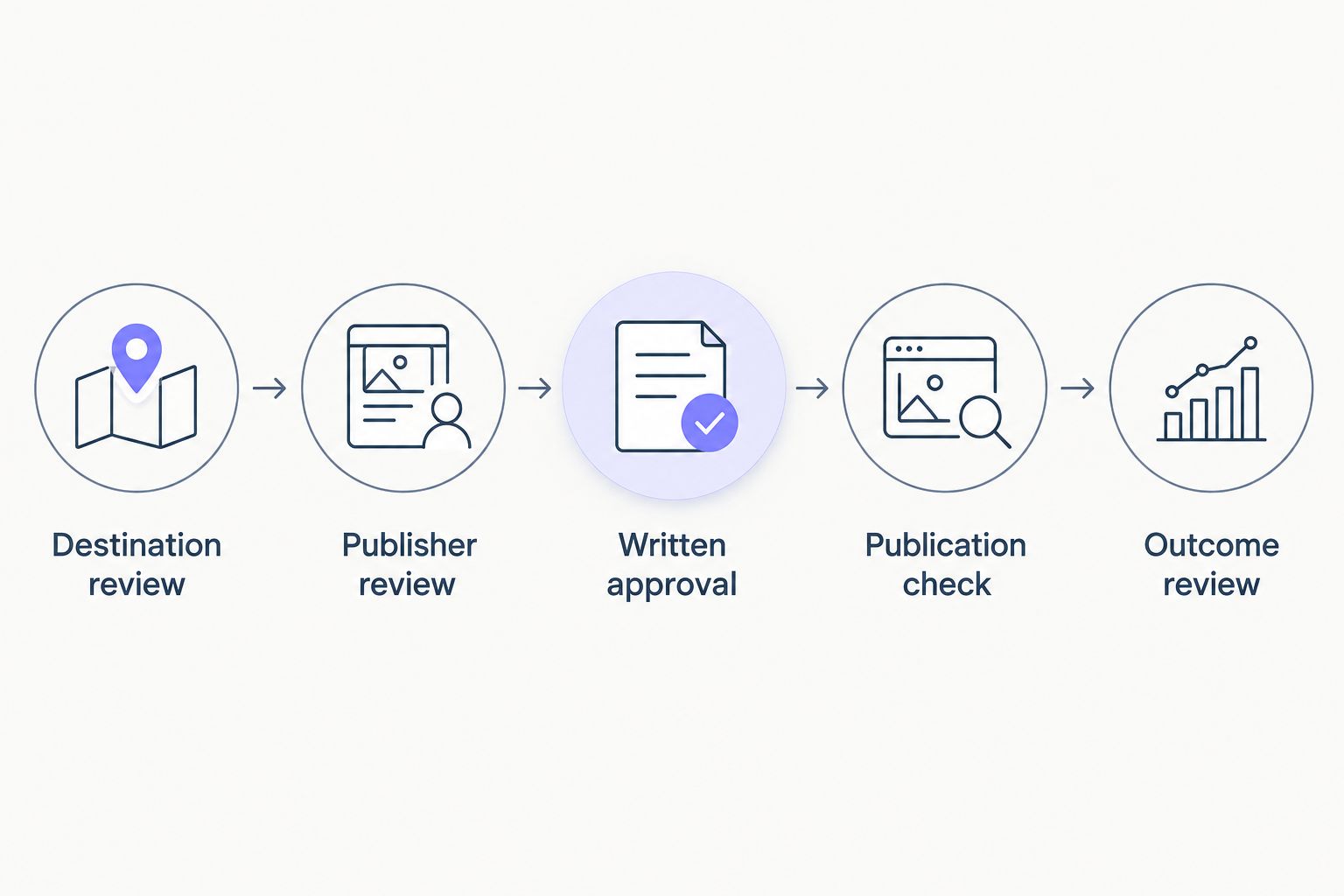
Keep the publisher review independent of the seller's summary. A practical publisher-site audit before buying a placement examines the publication itself, rather than treating a supplied metric as the decision.
Schedule your first administrative review 30 days after publication to check whether the agreed placement remains intact. That is a monitoring interval, not a ranking deadline. Record other site changes so you do not attribute every movement to the new links.
Which link building service should you choose?
Start with a sourcing platform when you need publisher access; choose custom outreach when you need a specific article. Add sports digital PR when you have evidence worth reporting. Use sponsored content for disclosed exposure, and reserve niche edits for references that genuinely improve an existing page.
Your 2026 brief should reject guaranteed positions, unexplained publisher substitutions, and undisclosed paid links. A clear rejection rule protects your campaign better than an ambitious monthly link target.
FAQ
What's the best link building service for a sports betting affiliate site?
The best service fits your destination, audience, and disclosure requirements. NO-BS Marketplace is a starting point for publisher sourcing, while custom outreach suits tailored articles and sports digital PR suits original research. Confirm betting acceptance for each publisher.
Do sports publishers accept betting affiliate links?
Acceptance depends on the publisher and the exact destination. Obtain written approval for the affiliate page before commissioning the article; approval of a sports topic alone is not enough.
Is digital PR better than guest posting for betting affiliates?
Digital PR is the better fit for original research, while guest posting fits a planned educational article. Earned coverage leaves publication and linking decisions with the journalist, so it should not be sold as guaranteed link delivery.
Can buying backlinks violate Google's spam policies?
Yes. Buying links to pass ranking credit violates Google's link spam policies. Paid placements should use appropriate link qualification, such as sponsored or nofollow, and must not be presented as guaranteed ranking gains.
Should I choose publishers by domain rating?
No. Domain rating is a third-party metric, not proof of editorial quality or relevant readership. Inspect the publication, the proposed article context, and whether the publisher accepts your destination.
Are niche edits safer than guest posts?
Neither format is automatically safe. Relevance, editorial purpose, payment arrangements, and link qualification matter more than whether the article is new or already published.
What should a betting affiliate link-building report include?
The report should identify the live article, destination, anchor, link attributes, disclosure, and publication date. Keep placement delivery separate from referral traffic and search-performance reporting so each outcome remains clear.
One last thing
The strongest approval test is whether the link helps the publisher's reader. Remove the commercial anchor from the draft and read the paragraph again. If the reference has no clear purpose beyond placing a keyword, rewrite the contribution or reject the opportunity.