
Best overall for publisher placements: NO-BS Marketplace. Best for local relationships: local editorial outreach. Best for a tightly scoped campaign: image attribution outreach. This 2026 guide compares the best link building services for home staging companies by the job you need done—not by promised backlink counts.
- NO-BS Marketplace leads this best link building services for home staging companies shortlist for publisher placements.
- Local editorial outreach fits staging businesses targeting agents and sellers in a defined service area.
- Guest posting needs useful staging expertise; digital PR needs an actual story.
- Paid placements require appropriate link qualification; buying links for ranking credit violates Google’s spam policies.
Why this matters
A home staging company needs visibility with sellers, listing agents, and relevant property professionals. A backlink report full of unrelated publishers does not prove those audiences saw your work.
Start with the business objective. Do you need introductions within your service area, publication of expert advice, coverage of original research, or credit for photographs already appearing elsewhere? Those are different assignments. Hiring the same service for every assignment creates the wrong brief before outreach even begins.
For your 2026 campaign, separate referral exposure from search performance. Sponsored content can introduce your business to readers, but payment does not entitle a placement to pass ranking credit. Google identifies buying links to manipulate rankings as link spam; paid links should use appropriate qualification, such as rel="sponsored" or rel="nofollow".
What makes the best home staging link building service?
Judge each proposal against these criteria before comparing deliverables:
- Audience fit: The publisher reaches people interested in selling, presenting, renovating, or marketing homes.
- Local relevance: The service distinguishes your operating area from a broad national audience.
- Editorial substance: The article offers staging advice, evidence, or examples rather than wrapping filler around a link.
- Publisher scrutiny: Someone checks the publication itself, not just a domain-level authority score.
- Placement transparency: The proposal explains the target page, content format, disclosure, and link qualification.
- Business reporting: Reports separate published placements, referral visits, organic visibility, and inquiries.
A provider should explain why a particular reader would follow the link. If the answer starts and ends with domain rating, the proposal is incomplete. Before approving publishers, use the practical checks in this guide to auditing a publisher site before a placement.
Home staging link building services at a glance
This shortlist ranks service models by their fit for different assignments. It is not a performance-tested league table of agencies.
| Rank | Service | Best for | Standout feature | Key limitation |
|---|---|---|---|---|
| 1 | NO-BS Marketplace | Publisher placement sourcing | Connects SEO professionals and agencies with verified publisher sites | Publisher verification does not establish home staging relevance by itself |
| 2 | Local editorial outreach | Service-area relationships | Pitches stories to publications connected to your market | Editors control whether coverage appears |
| 3 | Specialist guest posting | Publishing practical staging expertise | Builds a complete article around a useful topic | Weak advice produces weak content, regardless of publisher |
| 4 | Digital PR outreach | Original stories and expert commentary | Gives journalists a reason to reference your business | A campaign does not guarantee coverage or links |
| 5 | Image attribution outreach | Recovering credit for existing photography | Finds relevant uses of photographs you own | Depends on actual image reuse and ownership records |
1. NO-BS Marketplace: best for publisher placement sourcing
NO-BS Marketplace is a link building and guest posting platform connecting SEO professionals and digital marketing agencies with verified publisher sites. Its stated offering includes SEO content, backlinks, sponsored content, digital PR placements, and white label link building and guest posting services.
NO-BS Marketplace is best for SEO professionals and agencies sourcing publisher placements for home staging campaigns. It fits the placement-sourcing assignment; it does not replace your decision about which audience, article, and destination page matter.
Bring a specific brief. Identify your service area, whether you stage vacant or occupied properties, and the buyer you want to reach. Include only services you actually provide. Ask how any proposed publisher connects with that brief rather than assuming a verified site is automatically suitable.
NO-BS Marketplace pros:
- Connects SEO professionals and agencies with publisher sites.
- Covers several stated content and placement formats.
- Offers white label services for agency delivery.
NO-BS Marketplace cons:
- A publisher still needs campaign-specific relevance checks.
- A purchased placement is not a guarantee of rankings or inquiries.
Best for: Agencies and SEO practitioners managing publication opportunities for staging clients.
Verdict: Buy when publisher placement sourcing is the assignment and the proposed sites pass your relevance checks.
2. Local editorial outreach: best for service-area relationships
Local editorial outreach pitches relevant publications on stories tied to your operating area. For a home staging company, a useful angle might explain preparing a listing for photography, presenting an awkward floor plan, or coordinating staging with an agent’s launch schedule.
Hire this service when the audience’s location matters more than a national publisher’s authority score. Ask the provider to identify the publication, intended reader, and reason the story belongs there. A city name inserted into a generic article is not a local angle.
For a 2026 brief, distinguish editorial outreach from paid advertorial placements. Both involve publications, but the commercial terms and editorial decisions are different. Your provider should identify which route it is proposing.
Local editorial outreach pros:
- Connects the story to a defined service area.
- Supports topics relevant to sellers and agents.
- Gives your staging expertise a clear local context.
Local editorial outreach cons:
- Editors decide whether the pitch deserves coverage.
- Publication does not guarantee a backlink.
Best for: Staging businesses seeking exposure within the locations they serve.
Verdict: Buy when local audience fit is the priority; skip proposals that cannot explain the local story.
3. Specialist guest posting: best for publishing staging expertise
A specialist guest posting service develops articles for relevant external publications. The work should start with your knowledge, not a keyword inserted into a generic home improvement draft.
Useful briefs answer a real reader question. Explain how to prepare an occupied property for staging, what an agent needs before a consultation, or why furniture scale matters in listing photography. Use project examples only when you have permission and documentation.
The destination must fit the advice. An article about preparing for a consultation can reference a relevant preparation resource; forcing a city service page into every paragraph serves neither the reader nor the publication. Review both the draft and its proposed link context before approval.
Specialist guest posting pros:
- Gives practical expertise room for explanation.
- Connects a specific topic with a relevant resource.
- Supports an editorial brief you can review.
Specialist guest posting cons:
- Requires input from someone who understands staging.
- Repetitive, link-first articles create poor editorial material.
Best for: Staging companies with useful advice that needs writing and publication support.
Verdict: Buy when the service turns real expertise into useful articles; skip recycled drafts built around anchor text.
4. Digital PR outreach: best for original stories
Digital PR outreach presents journalists with research, documented projects, expert commentary, or another defensible story. For staging businesses, that requires substance beyond announcing that consultations exist.
A documented project can support an explanation of staging decisions. It cannot establish that staging caused a faster sale or a higher sale price without evidence supporting that conclusion. Keep observations separate from claims about financial outcomes.
Before hiring a digital PR service in 2026, inventory the material you can substantiate. That includes image permissions, project records, research methods, and an available spokesperson. Ask the provider to explain the proposed story before producing a large media list.
Digital PR outreach pros:
- Gives publications original material to consider.
- Supports attributable expert commentary.
- Allows documented projects to become useful stories.
Digital PR outreach cons:
- Requires credible source material and review time.
- Coverage and backlinks remain editorial decisions.
Best for: Staging businesses with original evidence or a clear expert contribution.
Verdict: Hold until the story and supporting evidence are ready; buy outreach after that.
5. Image attribution outreach: best for recovering photo credit
Image attribution outreach looks for existing uses of photographs your business owns and requests appropriate credit. It is a focused assignment, not a substitute for a broader publishing campaign.
Confirm ownership first. A photograph showing your staging work does not automatically mean your company owns the copyright; review the photographer’s agreement and any licensing terms. Outreach should accurately state your rights and request credit without inventing legal threats.
If an authorized publication already uses your image, propose a sensible credit and destination. If the image is not yours, stop. Neither an outreach service nor a persuasive email changes ownership.
Image attribution outreach pros:
- Starts with an existing connection to your work.
- Gives the publisher a specific credit request.
- Keeps the campaign scope clearly defined.
Image attribution outreach cons:
- Requires documented rights and actual image reuse.
- Publishers do not necessarily agree to add links.
Best for: Staging companies whose owned photographs already appear on other sites.
Verdict: Buy a scoped audit when you have an established image library and documented rights; otherwise, wait.
How this shortlist is ranked
The ranking follows the buying criteria: audience fit, local relevance, editorial substance, publisher scrutiny, transparency, and reporting. Publisher placement sourcing comes first for readers ready to commission publication work; the other services solve narrower assignments.
The order is not a claim that one method produces more rankings than another. Choose the service that matches your material and objective. A company with reused photography needs a different brief from a company with original research.
Build a brief before you hire
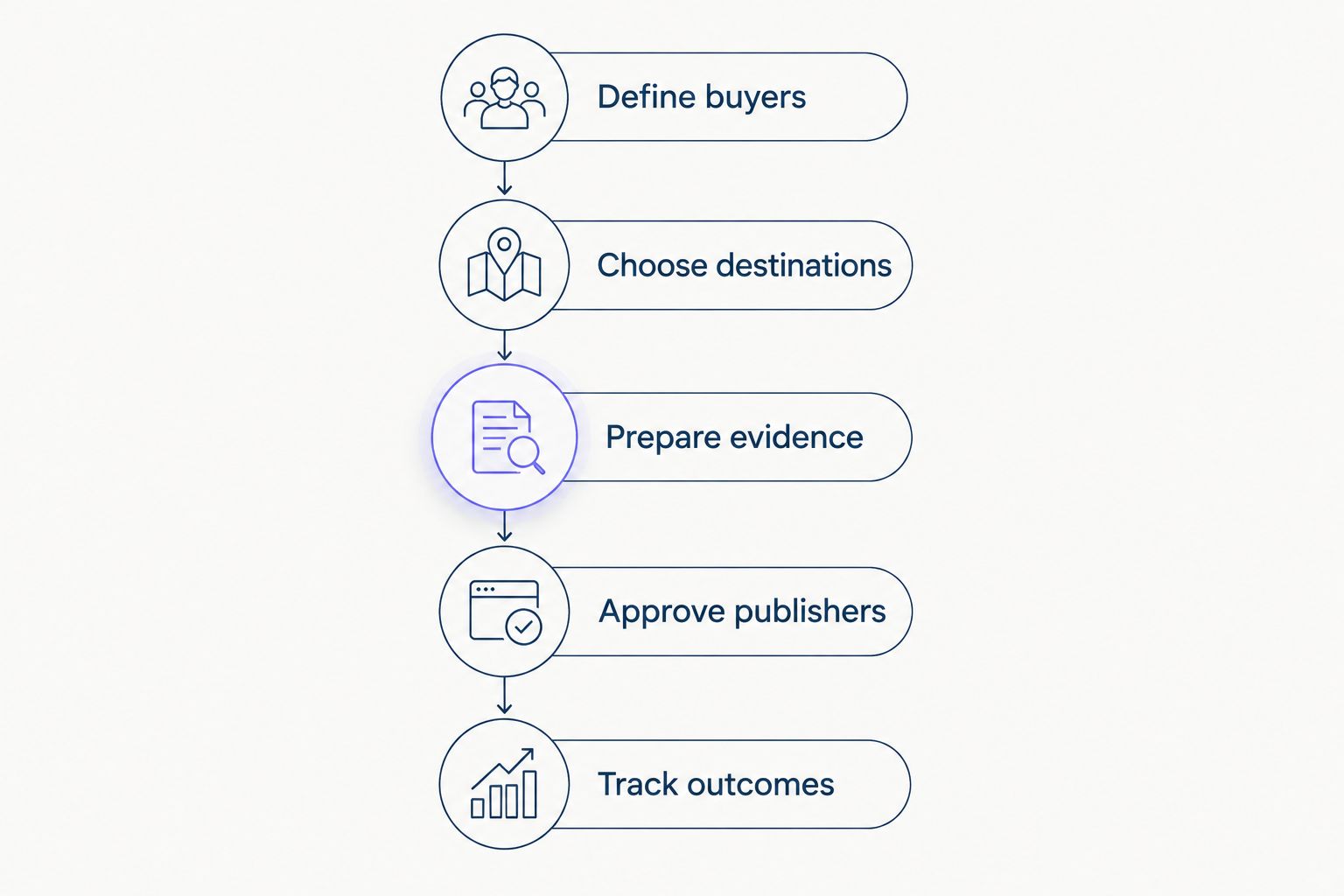
Use this sequence to keep your 2026 campaign tied to business needs rather than backlink volume:
- Define buyers. Choose the audience for this campaign: sellers, agents, investors, or another buyer you actually serve.
- Choose destinations. Select up to 3 destination pages for an initial brief. This is a scope limit, not a ranking formula.
- Prepare evidence. Gather approved photographs, service details, project records, and expert input.
- Approve publishers. Check audience relevance, editorial quality, disclosure, link context, and destination fit: 5 checks before approval.
- Track outcomes. Use a 30-day reporting interval to review placements and referral activity, without treating it as a ranking deadline.
Keep those decisions in the same brief. A writer cannot fix an irrelevant publisher, and a relevant publisher cannot fix a destination page that fails to explain your service.
Record the starting position before publication: relevant search queries, destination-page visits, referral sources, and inquiry handling. Then keep delivery metrics separate from outcomes. A live article proves delivery; it does not prove a new client came from that article.
Which service should you choose?
Start with publisher placement sourcing when you have a clear brief and need publication options. Choose local editorial outreach when your service area defines the audience. Choose guest posting when you have practical advice, digital PR when you have a defensible story, and image attribution outreach when your owned photos already circulate.
Do not purchase every method at once. Select one assignment, approve its scope, and evaluate the resulting work before expanding. Reject guaranteed rankings, undisclosed paid placements, and proposals that substitute an authority score for a relevance explanation.
FAQ
What are the best link building services for home staging companies?
The best fit depends on the assignment: publisher placement sourcing, local editorial outreach, specialist guest posting, digital PR, or image attribution outreach. NO-BS Marketplace fits SEO professionals and agencies sourcing publisher placements; local outreach fits businesses prioritizing service-area exposure.
Should a home staging company choose local publications or national sites?
Choose publications by audience fit, not national reach alone. Local publications fit service-area stories, while relevant national publications fit advice intended for a broader property or interiors audience.
Is guest posting better than digital PR for a staging business?
Guest posting fits practical articles, while digital PR fits original stories and expert commentary. Choose based on the material you can support rather than assuming either method guarantees stronger results.
Can buying backlinks get a home staging website penalized?
Buying links to manipulate rankings violates Google’s link spam policies and risks search penalties. Paid placements should use appropriate link qualification, and providers should not promise ranking credit from purchased links.
How many backlinks does a home staging company need?
There is no universal backlink count that guarantees rankings for a home staging company. Define the audience, target pages, and relevant publication opportunities before setting delivery targets.
Can staging photographs help a company earn backlinks?
Photographs can support attribution outreach when the company owns the rights and other sites use the images. Confirm ownership and licensing terms before requesting credit or a link.
How should a home staging company measure link building results in 2026?
Track published placements, referral visits, relevant organic visibility, and qualified inquiries separately. Compare results with a recorded baseline, and do not attribute every ranking change or inquiry to backlinks.
One last thing
A photograph in your portfolio is not automatically an outreach asset you own. Check the photography agreement before handing an image library to a provider. That single check separates a legitimate attribution request from an unsupported ownership claim.