
Best overall: Ahrefs. Best for agency-wide keyword planning: Semrush. Best for prioritizing existing pages: Google Search Console. These are the best keyword research tools for link building in 2026 because they answer different campaign questions: which pages need support, what content deserves links, and where relevant publishers fit.
- Ahrefs leads the best keyword research tools for link building when keyword decisions depend on competing pages and backlinks.
- Semrush suits agencies combining keyword gaps, content planning, and outreach research.
- Google Search Console identifies existing search visibility; it does not explain competitors’ backlinks.
- NO-BS Marketplace connects SEO teams with publishers after keyword research establishes campaign priorities.
Why this matters
A keyword list is not a link building plan. Search volume tells you about estimated demand, not whether a page deserves outreach or whether a publisher has a relevant audience.
Separate research from placement. NO-BS Marketplace connects SEO professionals and agencies with verified publishers for guest posts, sponsored content, and other placements; it is not a keyword research tool. NO-BS Marketplace is best for SEO teams seeking publisher placements after setting their keyword and content priorities.
Your research should produce a destination page, an editorial angle, and a reason for the publisher’s readers to care. Without those, a bigger keyword export just creates more sorting.
What makes the best keyword research tools for link building?
Choose your 2026 research stack against these criteria, not the length of its feature menu:
- Page-level context: Connect a query to the actual page ranking for it. Domain-wide averages hide differences between individual URLs.
- Backlink context: Check whether competing content attracts relevant referring pages, rather than treating keyword difficulty as a link quota.
- Intent clarity: Separate informational research from searches that need a service page, category page, or product page.
- Editorial usefulness: Find questions, comparisons, and supporting topics that give publishers a credible article angle.
- First-party validation: Check your own impressions and clicks before committing outreach resources to a destination page.
- Workflow fit: Choose tools that produce decisions your team can explain, rather than exports nobody uses.
Keyword research tools at a glance
| Tool | Best for | Standout capability | Key limitation |
|---|---|---|---|
| Ahrefs | Backlink-led keyword decisions | Keyword and competing-page research alongside backlink analysis | Difficulty scores do not establish a required link count |
| Semrush | Agency keyword-gap planning | Keyword Gap alongside keyword and backlink research | Broad exports still need intent and relevance checks |
| Google Search Console | Prioritizing existing destination pages | Your site’s query, page, impression, and click data | No competitor keyword or backlink database |
| Google Keyword Planner | Expanding commercial topic seeds | Keyword suggestions and advertising-oriented demand data | Advertising competition is not organic ranking difficulty |
| AlsoAsked | Developing question-led guest post angles | Related questions drawn from People Also Ask | Questions alone do not validate demand or publisher fit |
| Google Trends | Checking seasonality and topic timing | Relative search interest across time and geography | Relative interest is not absolute search volume |
1. Ahrefs: best keyword research tool for backlink-led decisions
Ahrefs combines keyword discovery, SERP analysis, and backlink research. That combination makes it the default recommendation when your question is not simply what to target, but what competing pages have earned links to.
Start with a destination keyword, inspect the ranking pages, then examine relevant referring pages. Look for an editorial reason behind the link: a useful explanation, original resource, comparison, or reference. Copying a competitor’s referring-domain count misses that distinction.
Ahrefs pros:
- Connects keyword research with page-level backlink investigation.
- Helps identify competing content worth inspecting manually.
- Supports research into topics competitors rank for but your site does not.
Ahrefs cons:
- Estimated metrics are not a substitute for your own search performance.
- Keyword difficulty does not prove that links are the main ranking constraint.
Best for: SEO specialists deciding which content assets warrant a backlink campaign.
Use Ahrefs to shortlist opportunities, then read the linking articles. A link from an unrelated article is not a useful model just because the source domain has an impressive metric.
Verdict: Buy when backlink context drives your keyword decisions.
2. Semrush: best keyword research tool for agency planning
Semrush brings keyword discovery, competitor keyword comparisons, and backlink analysis into a broader SEO suite. Its Keyword Gap feature is useful when an agency needs to identify missing topics across competing sites before assigning campaign work.
Keep ranking competitors separate from business competitors. A publication ranking for an informational query can reveal a content opportunity without being a realistic sales competitor or an appropriate outreach target.
Semrush pros:
- Supports keyword-gap comparisons across domains.
- Offers keyword expansion and intent information for planning.
- Combines keyword and backlink research within the same suite.
Semrush cons:
- A keyword gap does not establish that your client should publish that topic.
- Large exports need pruning before they become useful outreach briefs.
Best for: Agencies coordinating keyword planning across multiple client campaigns.
Assign each approved cluster to a destination page before researching publishers. Otherwise, separate team members can commission overlapping articles while assuming every missing keyword needs its own URL.
Verdict: Buy when shared planning matters more than a narrowly focused research workflow.
3. Google Search Console: best for existing page opportunities
Google Search Console reports how your site appears in Google Search, including queries, pages, impressions, and clicks. It is the strongest starting point when you already have content and need to decide which destination pages deserve closer investigation.
Filter to a relevant page and inspect its queries. Check whether the page answers the intent behind those searches before assuming more backlinks are the next move. Average position is context, not proof of a link deficit.
Google Search Console pros:
- Uses performance data from your own property.
- Connects search queries with destination pages.
- Supports comparisons between reporting periods.
Google Search Console cons:
- Does not show competitors’ keyword portfolios or referring domains.
- Its query reporting does not expose every individual search query.
Best for: Teams prioritizing existing assets before launching new content.
For a 2026 campaign, record a consistent baseline before outreach. Keep branded and nonbranded queries separate so increased brand searches do not get mistaken for improved visibility across your target topic.
Verdict: Hold Google Search Console as your baseline; add competitor research rather than replacing it.
4. Google Keyword Planner: best for commercial seed expansion
Google Keyword Planner generates keyword ideas and provides search-demand information for advertising planning. It helps expand a short commercial seed list into related services, products, problems, and modifiers.
Use those ideas to understand the market’s vocabulary, not to select anchor text automatically. A term that makes sense in an advertising account can sound forced inside an editorial article.
Google Keyword Planner pros:
- Expands initial topics into related keyword ideas.
- Supports location-focused research.
- Helps identify commercial language for further organic analysis.
Google Keyword Planner cons:
- Advertising competition does not measure organic SERP difficulty.
- Does not explain why a publisher would link to your content.
Best for: Teams developing topic seeds for commercial or location-specific campaigns.
Move promising terms into a SERP review. If the results mainly serve people ready to purchase, a broad educational guest post is not automatically the right destination or the right format.
Verdict: Hold as a seed generator, not a standalone link building research system.
5. AlsoAsked: best for question-led guest post angles
AlsoAsked maps related questions from Google’s People Also Ask results. It helps turn a broad topic into the specific questions an editor’s audience needs answered.
The useful output is an angle, not a mandate to write every question as a separate article. Group questions that share an answer, then identify where your destination resource adds something the proposed guest post cannot cover fully.
AlsoAsked pros:
- Makes related reader questions easier to inspect together.
- Helps develop supporting sections and editorial briefs.
- Exposes wording that differs from a commercial seed keyword.
AlsoAsked cons:
- A surfaced question does not establish meaningful search demand.
- Question coverage alone does not make a pitch distinctive.
Best for: Content teams developing useful guest post pitches around an established topic.
Reject an angle when the only reason for including it is to accommodate your link. The destination should support the answer, not interrupt it.
Verdict: Buy when question discovery is a recurring editorial task.
6. Google Trends: best for seasonal campaign timing
Google Trends shows relative search interest over time and across locations. Use it to check whether a promising topic follows a seasonal pattern or reflects a temporary surge.
Compare terms within a consistent geography and time range. Trends normalizes its data, so a stronger-looking chart is not an absolute count of searches or a forecast of referral traffic.
Google Trends pros:
- Helps inspect seasonality before scheduling content.
- Supports comparisons between related search terms or topics.
- Adds geographic context to editorial planning.
Google Trends cons:
- Does not replace keyword-volume or backlink research.
- A temporary spike does not establish lasting editorial value.
Best for: Teams scheduling seasonal content and timely outreach angles.
Use the timing signal to decide when to pitch, then validate the publication’s audience separately. Search interest and an editor’s publishing calendar are different things.
Verdict: Hold as a timing check, not your primary keyword tool.
How the tools are ranked
This 2026 shortlist prioritizes page-level decisions, backlink context, intent, editorial usefulness, and first-party validation. Ahrefs takes the default slot because the task is link building research; Semrush takes the agency-planning slot because keyword gaps support broader campaign coordination.
The remaining tools solve narrower problems. NO-BS Marketplace belongs after this research stage, when the campaign has an approved destination and a publisher brief—not as a substitute for keyword analysis.
Turn keyword research into a publisher brief
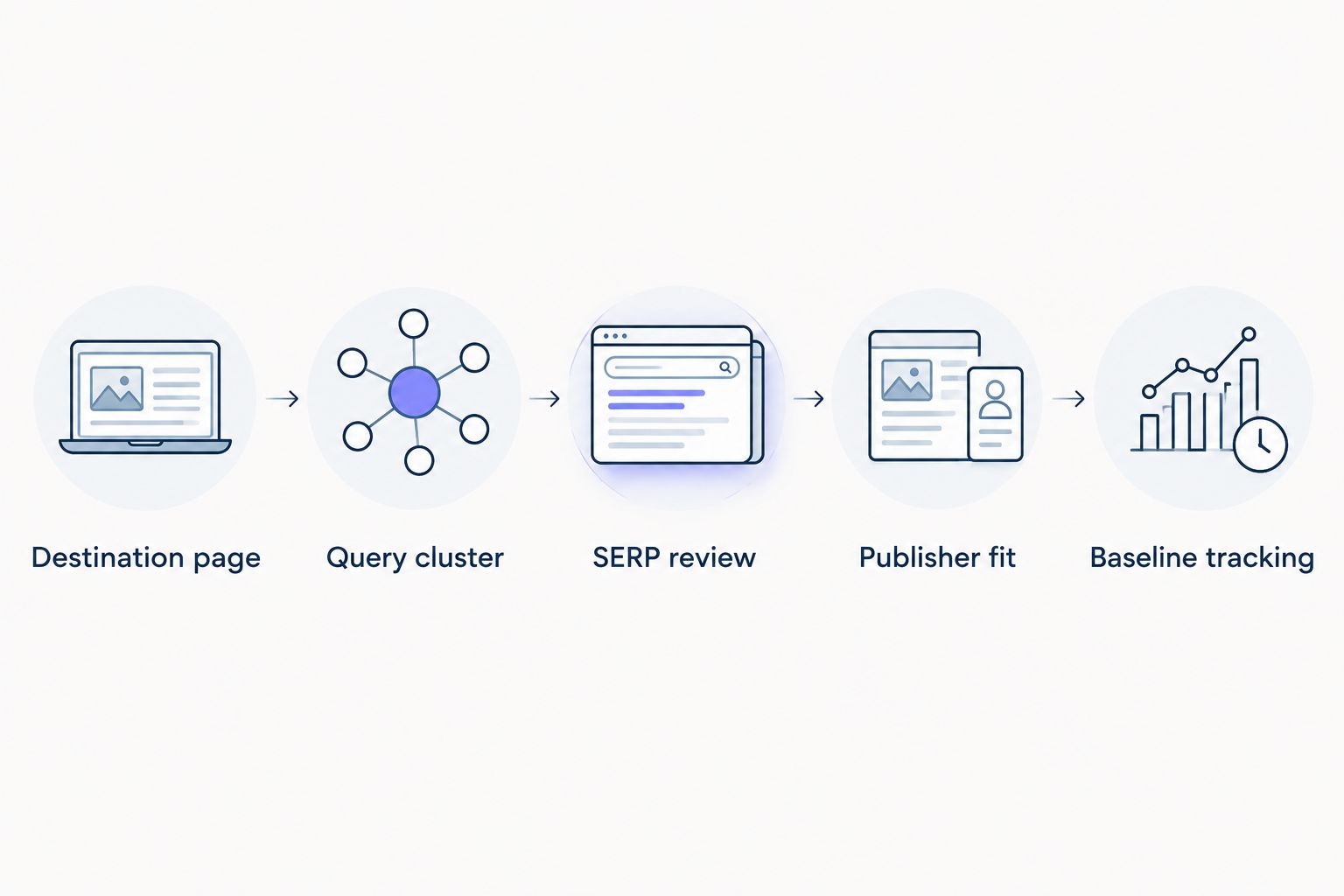
Use this sequence for a 2026 campaign. The quantities below are suggested working limits, not performance benchmarks.
- Destination page: Select one URL that answers a defined search intent. Fix content mismatches before assigning outreach.
- Query cluster: Review 10 queries around that destination. Group them by the answer the reader needs, not just shared words.
- SERP review: Inspect 3 competing URLs. Note their format, useful evidence, and the context of relevant incoming links.
- Publisher fit: Define the audience and article angle. Explain why the destination belongs in that discussion.
- Baseline tracking: Record clicks and impressions over 30 days before launch. Use a comparable reporting window afterward without attributing every change to links.
Keep anchor selection separate from keyword selection. Your primary keyword describes the search opportunity; it does not need to become the repeated anchor across every placement. Use the guide to choosing anchor text when buying backlinks to build that part of the brief.
Paid placement also requires a policy check. Google treats paid links that pass ranking credit as link spam; qualify paid links with appropriate attributes such as rel="sponsored" or nofollow. Keyword relevance does not remove that obligation.
Which keyword research tool should you choose?
Choose Ahrefs if you need one default for backlink-led research. Choose Semrush instead when keyword-gap planning across client accounts is the central job. Keep Google Search Console alongside either choice to check your own page performance.
Add Keyword Planner, AlsoAsked, or Google Trends only when you have a specific unanswered question. For your 2026 workflow, duplicate subscriptions are less useful than a clear handoff from keyword evidence to content and publisher selection.
FAQ
What's the best keyword research tool for link building?
Ahrefs is the default recommendation for backlink-led keyword research because it combines keyword, competing-page, and backlink analysis. Semrush is the alternative when agency-wide keyword-gap planning is the main task.
Is Ahrefs better than Semrush for link building keyword research?
Ahrefs is the recommended starting point when page-level backlink investigation drives your decisions. Semrush fits teams that prioritize keyword-gap planning alongside broader SEO campaign work.
Can I use Google Search Console alone for link building research?
Google Search Console alone does not cover competitor or backlink research. Use it to prioritize your existing pages, then investigate competing content and relevant referring pages separately.
Should I target the keyword with the highest search volume?
No, search volume alone does not determine the best campaign target. Prioritize a relevant destination page, matching intent, and an editorial reason for another site to reference it.
Does keyword difficulty tell me how many backlinks I need?
No, keyword difficulty does not establish a required backlink count. Inspect the ranking pages, their content, and relevant referring pages before deciding whether link acquisition addresses the actual problem.
Should every guest post use my primary keyword as its anchor?
No, the primary keyword should not automatically become every guest post's anchor. Choose wording that accurately describes the destination and fits the surrounding editorial sentence.
Where does NO-BS Marketplace fit into keyword research?
NO-BS Marketplace fits after keyword and destination-page selection. It connects SEO professionals and agencies with verified publisher sites for placements, rather than providing keyword discovery data.
One last thing
Save the linking sentence before you approve the article angle. Write the sentence that would naturally introduce your destination resource, without forcing an exact-match keyword into it. If that sentence adds nothing for the publisher’s reader, revise the destination or the pitch before committing to the placement.