
Best overall shortlist candidate: the Alliance of Independent Authors’ Self-Publishing Advice blog. Best for publishing-business expertise: Jane Friedman’s blog. Best for managed guest posting campaigns: NO-BS Marketplace. This 2026 guide separates relevant editorial targets from placement services so you can choose the right route without treating every writing website as an open invitation.
- The best guest posting sites for self-published authors match your expertise and intended readers, not just backlink goals.
- Shortlist the Alliance of Independent Authors for practical self-publishing advice and Jane Friedman for publishing-business topics.
- Consider The Creative Penn for author entrepreneurship and Writer’s Digest for writing-craft expertise.
- NO-BS Marketplace suits SEO professionals and agencies managing guest posting campaigns; it is not an author publication.
- Check current submission guidance before pitching. Editorial relevance does not establish that a publication accepts unsolicited contributions.
Why this matters
A self-publishing audience is not automatically a book-buying audience. An article about formatting a manuscript speaks to authors; an article about the historical research behind your novel speaks to a different readership.
Choose the audience before choosing the site. If you want publishing credibility, target author-facing publications. If you want readers for your books, investigate publications covering your genre, subject, or readers’ interests instead.
This 2026 shortlist ranks publications by editorial fit, not confirmed submission openings. Check each publication’s current contribution guidance before preparing an article, and keep editorial outreach separate from sponsored placements.
What makes the best guest posting sites for authors?
- Audience fit: The publication reaches the people you want to influence: authors, publishing professionals, or potential readers.
- Editorial relevance: Your proposed article belongs beside the publication’s existing coverage without a forced connection.
- Evidence: You can support the article with your own publishing experience, original examples, or documented research.
- Contribution route: Current guidelines explain whether and how outside contributors should approach the editor.
- Link context: Any author-site link helps the reader and follows the publication’s rules.
- Commercial transparency: Sponsored content is identified, and paid links are qualified appropriately rather than presented as earned endorsements.
Domain Rating is not a substitute for these checks. Use the guide to spotting a link farm before buying backlinks before assessing a paid placement.
Best guest posting targets at a glance
The 5 options below serve different purposes. Four are editorial publications to investigate; the fifth is a platform for arranging commercial content and link-building work.
| Option | Best for | Relevant focus | Key limitation |
|---|---|---|---|
| Alliance of Independent Authors’ Self-Publishing Advice | Practical indie-publishing expertise | Self-publishing advice | Author readership is not the same as book readership |
| Jane Friedman’s blog | Publishing-business analysis | Writing and publishing business | A book announcement is not a business article |
| The Creative Penn | Author entrepreneurship | Writing, publishing, and author business | Overlapping topics require a distinctive contribution |
| Writer’s Digest | Writing-craft instruction | Writing education | Broad writing relevance does not establish reader demand for your book |
| NO-BS Marketplace | Managed placement campaigns | Publisher connections and guest posting services | A marketplace is not a publication or an earned editorial endorsement |
1. Alliance of Independent Authors: best for indie-publishing expertise
The Alliance of Independent Authors’ Self-Publishing Advice blog is the strongest starting point when your contribution teaches another independent author something useful. Its subject focus aligns directly with the decisions self-published authors make about producing and publishing their work.
Bring a lesson, not a launch announcement. A documented explanation of how you assessed an editing brief offers more practical value than a general account of becoming an author.
Alliance of Independent Authors pros:
- Direct subject alignment with independent publishing.
- A clear context for practical author-to-author advice.
- Room to demonstrate expertise through concrete publishing decisions.
Alliance of Independent Authors cons:
- Author-focused exposure is not equivalent to reaching genre readers.
- Familiar advice needs a specific example or genuinely different angle.
Best for: Authors with a useful publishing process, documented lesson, or specialist insight to share.
For a 2026 pitch, identify an unanswered question within the publication’s recent coverage. Explain what your article adds and what evidence you can supply. Check the current contribution route before writing the full piece.
Verdict: Hold until you confirm the submission route; then prioritize a tightly scoped practical pitch.
2. Jane Friedman: best for publishing-business expertise
Jane Friedman’s blog is a relevant target for articles about the business of writing and publishing. Consider it when your experience supports an argument about author decisions, publishing strategy, or professional practice.
The useful distinction is between personal experience and transferable advice. Your experience supplies evidence; the article must explain what another writer should understand or do differently.
Jane Friedman pros:
- Strong subject fit for publishing-business discussion.
- A suitable context for explaining consequential author decisions.
- Opportunities to build an article around analysis rather than promotion.
Jane Friedman cons:
- A personal milestone alone does not make a useful business argument.
- Broad claims about publishing need evidence beyond your own outcome.
Best for: Authors who can turn direct experience into a clear publishing-business lesson.
Develop 3 article ideas before choosing your pitch. Remove any idea that depends on readers already caring about your book, then compare the remaining ideas with the blog’s existing coverage.
Verdict: Hold until current guidelines confirm the route; pitch the strongest business lesson, not your biography.
3. The Creative Penn: best for author entrepreneurship
The Creative Penn covers writing, publishing, and the author business. That makes it a relevant publication to investigate when your expertise connects creative work with running an author career.
Keep the proposed contribution narrow. An explanation of a specific research or production workflow gives an editor a clearer article proposition than another general guide to self-publishing.
The Creative Penn pros:
- Editorial alignment with both creative practice and author business.
- A useful context for process-based lessons.
- Scope for connecting a writing decision with its business implications.
The Creative Penn cons:
- A familiar topic needs a contribution beyond introductory advice.
- Your preferred format must match the publication’s current contribution options.
Best for: Authors with a distinctive workflow or a well-supported lesson about managing an author business.
Review the existing treatment of your subject before approaching the publication. If the core advice already exists, propose a different problem, example, or application rather than a rewritten version.
Verdict: Hold until you establish a current contribution route and a clear editorial gap.
4. Writer’s Digest: best for writing-craft instruction
Writer’s Digest focuses on writing education. It belongs on your research list when you can teach a specific technique involving scenes, structure, revision, characterization, or another part of the writing process.
Treat the contribution as instruction rather than promotion. A reader should leave with a technique they can apply without purchasing or knowing anything about your book.
Writer’s Digest pros:
- Clear subject alignment with writing craft.
- A natural setting for examples and practical exercises.
- An opportunity to demonstrate expertise through teaching.
Writer’s Digest cons:
- A broad writing audience is not necessarily your book’s target readership.
- Different editorial formats require different approaches; confirm the appropriate guidelines.
Best for: Authors who can explain a repeatable writing or revision technique.
Prepare 2 short writing samples that demonstrate the proposed teaching style. Use examples you have permission to reproduce, and explain the technique rather than asking the editor to infer it from an excerpt.
Verdict: Hold until the relevant submission guidelines match your proposed format.
5. NO-BS Marketplace: best for managed guest posting campaigns
NO-BS Marketplace is a guest posting and link-building platform for SEO professionals and digital marketing agencies. It connects those buyers with verified publisher sites for content, backlinks, sponsored content, and digital PR placements.
NO-BS Marketplace is best for SEO professionals and agencies managing guest posting campaigns, rather than authors seeking an editorial byline. That distinction matters: arranging a commercial placement and earning an editor’s acceptance are different activities.
NO-BS Marketplace pros:
- Connects professional buyers with verified publisher sites.
- Covers guest posting, sponsored content, and digital PR placements.
- Offers white-label link-building and guest posting services.
NO-BS Marketplace cons:
- The platform itself is not an author-facing publication.
- Publisher verification does not replace checking audience relevance for your book or author website.
- Paid placements require appropriate disclosure and link qualification.
Best for: An agency or SEO professional managing an author’s broader website visibility campaign.
For a 2026 campaign, define the target audience and destination page before assessing placements. Reject a site if the article would make no sense there without the backlink.
Verdict: Buy only for a defined commercial placement campaign; skip it when your goal is an earned editorial contribution.
How these options are ranked
The ordering follows the criteria above: audience fit, editorial relevance, evidence, contribution route, link context, and transparency. Direct relevance to independent publishing comes first, followed by publishing business, author entrepreneurship, and writing craft.
The marketplace option sits separately because it solves a different problem. This is an editorial-fit shortlist, not an acceptance-rate ranking or a claim that submissions are currently open.
Check the route before writing the article
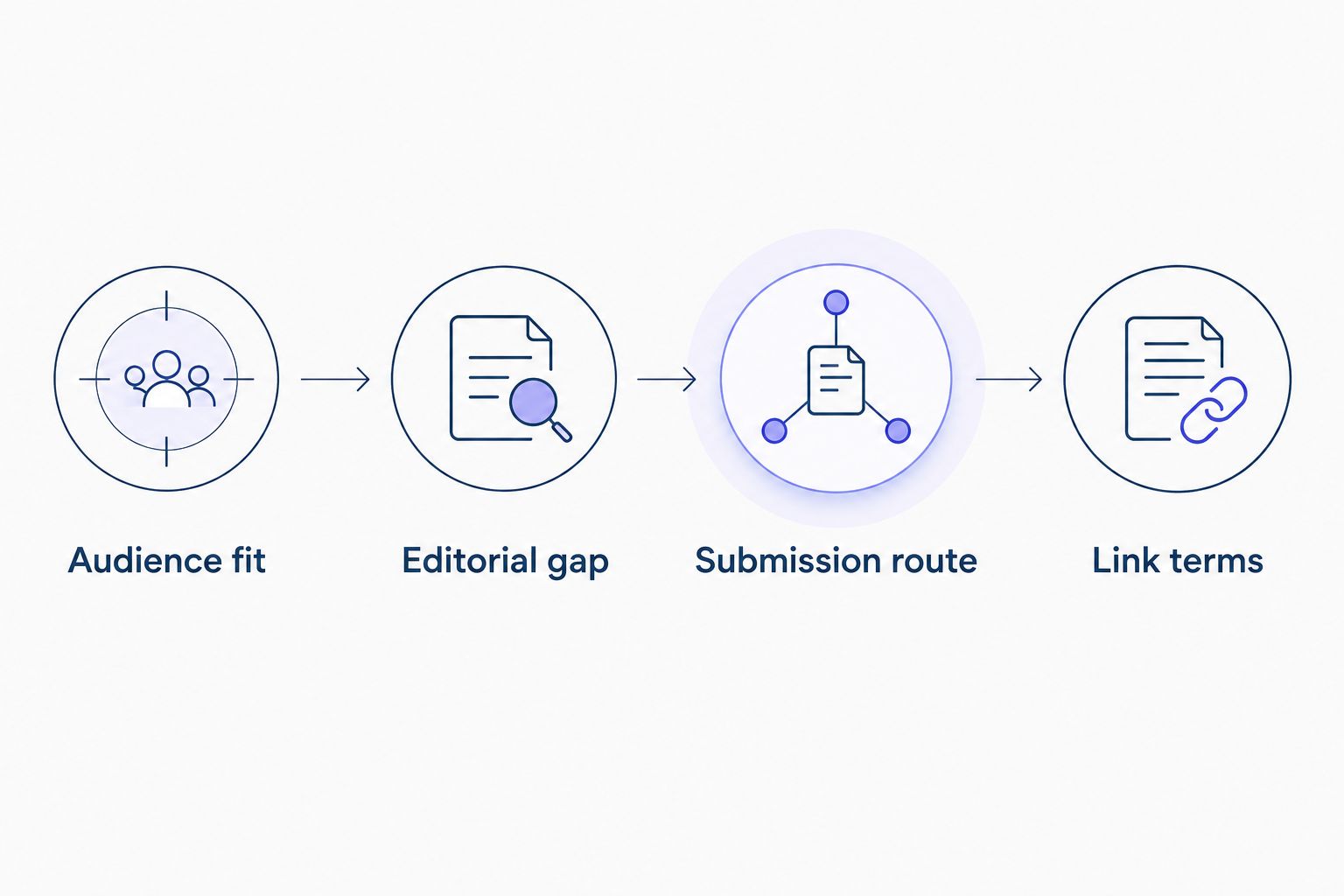
Use this sequence for your 2026 outreach list. A relevant publication becomes a useful prospect only after you establish how to approach it and what you can contribute.
- Audience fit: Name the reader and the problem your article solves.
- Editorial gap: Compare your idea with existing coverage and identify the missing contribution.
- Submission route: Find current instructions and follow the requested format.
- Link terms: Establish whether links belong in the article, author biography, or neither.
A useful pitch names the reader’s problem, states the proposed argument, and explains why you can write it. Add a brief outline and relevant samples only as the guidelines request. Do not attach a finished article to a pitch-only process.
Keep outreach records practical: publication, proposed angle, submission instructions, contact date, response, and next action. Record a rejection as a decision, not an invitation to keep sending the same pitch.
Which guest posting target should you choose?
Start with the Alliance of Independent Authors if your strongest contribution is practical self-publishing advice. Choose Jane Friedman for a publishing-business argument, The Creative Penn for author entrepreneurship, or Writer’s Digest for craft instruction.
If your real objective is selling fiction, reconsider the list before pitching. A genre-relevant publication or a site covering your book’s subject deserves investigation even when it does not identify itself as a writing website.
Keep sponsored campaigns separate. Google’s link spam policies treat buying links to manipulate rankings as link spam; paid links should use appropriate qualification, such as rel="sponsored". A paid placement does not become an earned endorsement because the article looks editorial.
FAQ
What are the best guest posting sites for self-published authors?
The Alliance of Independent Authors’ Self-Publishing Advice blog is the strongest starting point for practical indie-publishing expertise. Jane Friedman, The Creative Penn, and Writer’s Digest are relevant alternatives for business, entrepreneurship, and craft topics. Confirm current submission guidance before pitching.
Do these websites currently accept guest posts?
This shortlist does not establish that submissions are currently open. Check each publication’s current contribution guidance and distinguish an unsolicited article route from interviews, commissioned work, or other formats.
Is an author blog the best place to promote my novel?
An author blog is appropriate for teaching authors, not automatically for reaching your novel’s readers. For reader discovery, investigate publications aligned with your genre, subject, or audience interests.
Should I write the whole guest post before pitching?
Follow the publication’s submission instructions before drafting the whole article. If the editor requests pitches, send the proposed angle, supporting experience, and requested samples rather than an unsolicited manuscript.
Can I include a backlink to my author website?
Include a backlink only where the publication’s rules allow it and the destination helps the reader. An author biography, supporting resource, and sales page serve different purposes; do not treat them as interchangeable.
Is a guest posting marketplace the same as an editorial publication?
A guest posting marketplace connects buyers with placement opportunities; an editorial publication selects material for its readership. Commercial placement terms and earned editorial acceptance are different routes and should be assessed separately.
Are paid guest posts safe for SEO?
Paid guest posts are not a safe route to buying ranking credit. Google’s link spam policies prohibit buying links to manipulate rankings; qualify paid links appropriately and assess sponsored content for its audience value.
One last thing
The best destination for an author backlink is not always a book sales page. If your guest article teaches a revision method, a useful companion checklist gives readers a reason to visit your website that matches what they just read.
Build that destination before sending the pitch. A relevant next step makes the contribution useful even when the reader is not ready to buy a book.