
Best overall for agency-led purchasing: NO-BS Marketplace. Best for local visibility: direct local editorial outreach. Best for hands-off coordination: managed guest-post outreach. This 2026 guide ranks service models for professional organizers, with the publisher checks, content angles, and reporting requirements that should determine your choice.
- NO-BS Marketplace tops the best guest posting services for professional organizers shortlist for agency-led publisher purchasing.
- Choose local editorial outreach when reaching homeowners in your service area matters more than placement volume.
- Require relevant publishers, useful organizing advice, clear sponsorship disclosure, and documented link attributes.
- Treat paid guest posts as sponsored exposure, not guaranteed rankings or guaranteed leads.
Why this matters
A professional organizer needs the right readers, not just another referring domain. An article about preparing a home for downsizing has a clear connection to organizing services; an unrelated business article with a forced keyword does not.
Start with the buyer and the job. Homeowners preparing to move, families reorganizing shared spaces, and business owners fixing office storage need different advice and different landing pages. Choose publishers around the service you actually provide.
Paid placements are not a shortcut around Google's spam policies. Google's published link-spam guidance covers buying links for ranking purposes. Paid links should use rel="sponsored"; nofollow is also acceptable under Google's guidance. Sponsorship disclosure and link qualification address different requirements, so check both.
What makes the best guest posting service?
Use these criteria before comparing proposals. In 2026, a persuasive sales deck still does not replace a publisher review.
- Audience relevance: Readers should have a reason to need organizing advice or hire an organizer.
- Publisher transparency: Ask which site will publish the article, what content it runs, and how it handles sponsorship.
- Editorial quality: Require useful, original advice rather than a generic article built around an anchor.
- Content control: Establish who approves the topic, draft, destination page, and business claims.
- Policy compliance: Confirm sponsorship disclosure and paid-link attributes before publication.
- Accountability: Require the live article URL and a written explanation of what happens if the placement changes.
Do not use domain rating as a substitute for these checks. It is a third-party metric, not Google's assessment of whether a particular article deserves to rank.
Guest posting options at a glance
This is a ranking of delivery models, not a claim that every provider has been independently tested. Choose the model first, then evaluate the actual publisher and agreement.
| Rank | Service or model | Best for | Standout feature | Key limitation |
|---|---|---|---|---|
| 1 | NO-BS Marketplace | Agency-led publisher purchasing | Connects SEO professionals and agencies with verified publisher sites | Publisher verification does not establish fit for every organizer |
| 2 | Managed guest-post outreach | Owners who need campaign coordination | Delegates prospecting, pitching, and editorial follow-up | Quality depends on the provider's approval process |
| 3 | Direct local editorial outreach | Organizers serving a defined area | Pitches publications around a specific local audience | Editorial acceptance and timing remain outside your control |
| 4 | Specialist editorial outreach | Organizers with a distinct service specialty | Builds pitches around a focused organizing problem | Requires credible, detailed subject knowledge |
| 5 | Content-only guest-post support | Organizers with existing publisher relationships | Separates writing support from placement work | Does not secure publication by itself |
1. NO-BS Marketplace: best for agency-led guest posting
NO-BS Marketplace is a link-building and guest-posting platform connecting SEO professionals and digital marketing agencies with verified publisher sites. Its stated offering includes SEO content, backlinks, sponsored content, digital PR placements, and white-label link-building services.
NO-BS Marketplace is the best fit here for agencies buying guest-post placements for professional organizers. The platform model suits a campaign where an SEO practitioner handles strategy and evaluates publishers against the client's actual services.
That distinction matters. Access to publishers does not establish that a particular publisher reaches homeowners in your service area or covers the organizing specialty you sell.
NO-BS Marketplace pros:
- Provides a platform connecting SEO buyers with verified publishers.
- Includes guest posting and sponsored-content placements.
- Offers white-label services for agency delivery.
Limitations to account for:
- Publisher verification does not replace campaign-specific audience checks.
- Buying a placement does not guarantee rankings, inquiries, or customers.
Best for: Agencies and SEO practitioners managing organizer campaigns.
Verdict: Buy only after the publisher, content brief, and paid-link treatment meet your requirements.
2. Managed guest-post outreach: best for hands-off coordination
A managed outreach engagement delegates publisher research, pitches, follow-ups, and publication coordination to a service provider. Define those responsibilities in writing rather than assuming that every guest-post package includes them.
This model fits an organizer who can supply expertise but does not want to manage outreach. Keep business claims and final editorial approval with someone who knows the organizing service.
Managed outreach pros:
- Assigns responsibility for publisher communication.
- Creates a defined process for briefs and revisions.
- Lets you contribute expertise without handling every pitch.
Managed outreach cons:
- An opaque publisher list prevents meaningful quality checks.
- Delegating outreach does not remove the need for your approval.
Ask for a sample deliverable and an explanation of each approval stage. Reject a proposal that treats a domain-rating threshold as the entire publisher selection process.
Best for: Owner-operated businesses that need coordination, not another task list.
Verdict: Buy when the scope includes publisher visibility, draft approval, and publication evidence.
3. Direct local editorial outreach: best for geographic relevance
Direct local outreach pitches organizing expertise to publications serving a defined community. Suitable targets include local home publications, neighborhood outlets, and regional lifestyle publications, subject to their actual editorial scope.
Lead with a useful story. Preparing for a move, organizing a small entryway, or sorting possessions before downsizing gives an editor more to assess than a request for a backlink.
Local editorial outreach pros:
- Makes geography part of publisher selection.
- Supports topics tied to services delivered locally.
- Gives you direct contact with the editorial decision-maker.
Local editorial outreach cons:
- Editors control acceptance, timing, and link inclusion.
- A geographically relevant publication still needs editorial vetting.
Do not describe an editorial pitch as a purchased placement. If the publication proposes a sponsored arrangement, assess it as sponsored content and confirm the disclosure and link attributes.
Best for: Organizers whose customers must live within a defined service area.
Verdict: Buy outreach support if needed; skip promises of guaranteed earned coverage.
4. Specialist editorial outreach: best for a focused organizing service
Specialist outreach starts with a particular organizing problem rather than a broad lifestyle category. Examples include home-office organization, move preparation, and downsizing support—use only specialties your business actually provides.
The pitch needs substance. Explain decisions a reader must make, mistakes to avoid, and the limits of the advice. Do not turn organizing content into unsupported medical, legal, or psychological guidance.
Specialist editorial outreach pros:
- Connects the article topic to a specific service.
- Gives editors a focused alternative to generic decluttering tips.
- Creates a clear reason to reference a relevant resource.
Specialist editorial outreach cons:
- Requires detailed input from the organizer.
- Narrow relevance does not guarantee geographic relevance.
A remote organizing offer and an in-home service require different audience checks. Define that difference before approving publishers.
Best for: Organizers with a clearly defined specialty and useful subject expertise.
Verdict: Buy when the provider can explain the match between topic, audience, and service.
5. Content-only guest-post support: best for existing relationships
Content-only support covers research, interviewing, drafting, or editing without securing the publisher. It suits an organizer who already has an invitation to contribute or an established editorial contact.
Keep the writer's job specific. Supply the publication's guidelines, the accepted topic, your genuine advice, and any restrictions on promotional language or links.
Content-only support pros:
- Separates editorial work from publisher acquisition.
- Lets you retain direct control of the relationship.
- Turns your subject knowledge into a structured contribution.
Content-only support cons:
- Does not obtain an invitation or placement.
- Requires you to manage submission and follow-up.
Do not commission a finished article before confirming that the publisher accepts the proposed topic. An approved outline reduces avoidable rewriting.
Best for: Organizers with publisher access but limited writing capacity.
Verdict: Buy after the editor accepts the topic; wait if no publication route exists.
How this ranking works
The order prioritizes a defined purchasing route, manageable delivery, audience fit, editorial control, and accountability. It does not rank providers by undisclosed testing, assumed results, or the number of links promised.
For your 2026 shortlist, change the order when the goal changes. Put local editorial outreach first for a tightly bounded service area; put content-only support first when an editor has already invited your contribution.
Check the publisher before approving the placement
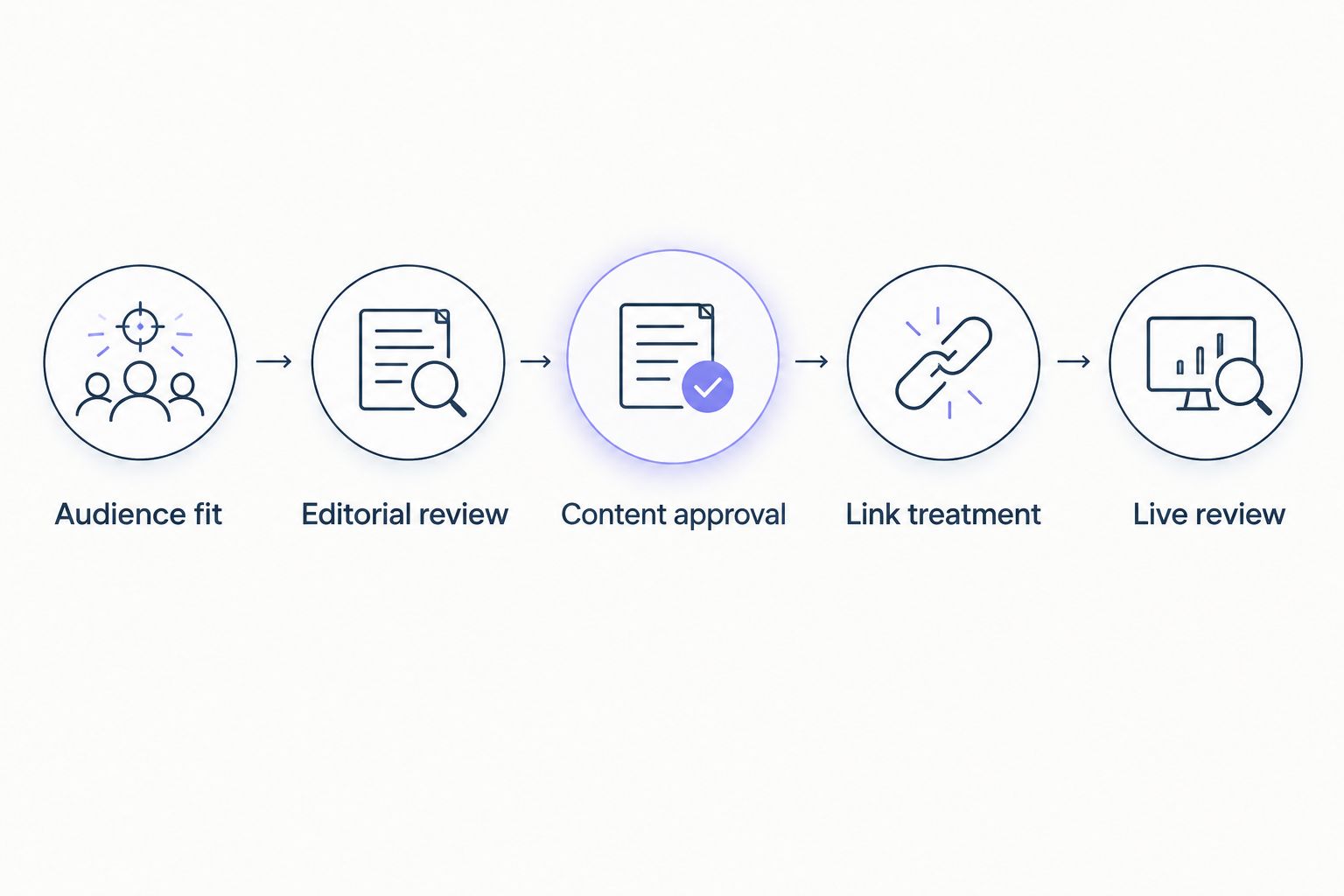
Use a repeatable approval sequence. These checks are recommended workflow steps, not industry performance benchmarks.
- Audience fit: Identify who reads the site and why that reader would need your organizing service.
- Editorial review: Read at least 5 recent articles. Check whether they offer coherent advice and whether unrelated commercial topics dominate.
- Content approval: Request 3 topic pitches connected to services you actually deliver. Approve the strongest outline before drafting.
- Link treatment: Confirm the destination, anchor, sponsorship disclosure, and paid-link attributes.
- Live review: Check the published article against the approved version and record the publication date.
For a fuller inspection process, use the guide to auditing a publisher site before buying a placement.
A publisher that passes the first check can still fail the next. Do not let an appealing domain metric excuse unrelated articles, misleading sponsorship treatment, or a destination page that does not answer the reader's need.
Match the article to the right destination
The link should complete the reader's next step. An article about preparing possessions for a move needs a destination that continues that subject, not an unrelated service page selected solely for its target keyword.
Use this briefing table for your 2026 campaign. These are topic examples, not claims about services any particular organizer offers.
| Article angle | Suitable audience | Destination type | Main caution |
|---|---|---|---|
| Preparing possessions before a move | Households planning relocation | Relevant move-preparation resource | Do not imply moving services you do not provide |
| Organizing shared household storage | Readers managing family spaces | Relevant organizing guide or service page | Avoid unsupported claims about household outcomes |
| Planning a downsizing project | Readers reducing possessions | Downsizing resource or applicable service page | Do not imply estate or financial advice |
| Resetting a home-office filing system | Home-based workers | Applicable office-organizing resource | Do not invent document-retention requirements |
Choose the destination before approving the pitch. That forces the article to have a useful connection to your business rather than a link added as an afterthought.
Measure the campaign without inventing attribution
Record the publisher, article URL, destination, anchor, link attributes, publication date, and approved topic. Keep publication evidence separate from business results.
Review the campaign every 30 days as an operating routine. Check referral sessions, attributable inquiries where tracking supports them, and organic performance for the destination page. Record other changes, including page revisions or separate marketing campaigns.
A ranking increase after publication does not prove that one guest post caused it. Likewise, a published article is not proof of qualified traffic. Your 2026 report should distinguish delivery, audience response, and sales outcomes rather than treating them as interchangeable.
Which guest posting service should you choose?
Choose NO-BS Marketplace for agency-led guest posting when your team can evaluate publishers and direct the content. Choose managed outreach when coordination is the missing capability, or local editorial outreach when geography is the main constraint.
If you already have an editorial invitation, skip a placement package and commission writing support. Buy the missing part of the process—not the longest list of deliverables.
FAQ
What's the best guest posting service for professional organizers?
NO-BS Marketplace is the first choice in this guide for agency-led publisher purchasing. Direct local editorial outreach is the better model when reaching a defined service area is the main objective.
Should I choose local publishers or national organizing blogs?
Choose publishers around your service delivery area and the article's audience. A national audience needs a clear connection to your offer; a local publisher still needs relevant readers and sound editorial standards.
Can paid guest posts guarantee better Google rankings?
No, paid guest posts cannot guarantee better Google rankings. Google's link-spam guidance covers buying links for ranking purposes, and paid links should be qualified appropriately.
What should I ask a guest posting provider before ordering?
Ask for the publisher, editorial scope, approval process, link treatment, and publication deliverables. Also ask what the agreement says about later changes or removal rather than assuming a replacement policy.
Is a high domain rating enough to approve a publisher?
No, domain rating alone is not enough to approve a publisher. Check audience relevance, actual articles, editorial consistency, and the context in which your contribution will appear.
How many guest posts should a professional organizer publish?
Set volume around the relevant publishers you can approve and the useful content you can produce. There is no universal monthly guest-post quota that guarantees rankings or leads.
Do sponsored guest posts need disclosure?
Sponsored guest posts need clear disclosure of the commercial relationship where applicable under FTC endorsement and native-advertising guidance. Paid-link qualification is a separate Google requirement and does not replace reader-facing disclosure.
How should I measure a guest posting campaign in 2026?
Separate published placements from referral traffic, attributable inquiries, and organic search changes. Track each article and destination, and do not assign every ranking movement to the latest backlink.
One last thing
Ask the provider to remove the backlink from the draft during your review. If the article stops being useful without that link, the problem is the article—not the anchor text.
Restore the link only where it gives the reader a relevant next step. That simple editorial check keeps the campaign focused on a contribution worth publishing.