
Best for agencies sourcing publisher placements: NO-BS Marketplace. Best for technical marine content: specialist outreach. Best for local dealership visibility: regional sponsored editorials. Best for outsourced client delivery: white-label guest posting. This 2026 guide ranks service models by dealership needs, not unsupported promises about rankings.
- NO-BS Marketplace is best for agencies sourcing guest posting placements through a platform connecting buyers with verified publishers.
- The best guest posting services for boat and marine dealers prioritize marine relevance, editorial quality, and useful destination pages.
- Choose specialist outreach for technical topics and regional editorials for local dealership visibility.
- Require clear sponsorship disclosures and appropriate link attributes; paid placements are not guaranteed ranking gains.
Why this matters
A boat dealer needs more than a backlink report. You need articles that reach relevant readers, explain something useful, and send visitors to pages that help them take the next step.
A fishing publication, a regional waterfront magazine, and a general business blog serve different audiences. Treating those placements as interchangeable makes the campaign harder to judge. Start with the buyer and the purpose of the article, then assess the publisher.
For a 2026 campaign, Google's link-spam policies are a hard boundary: buying links to manipulate rankings violates those policies. Paid advertising and sponsorship links should use appropriate attributes, with rel="sponsored" preferred by Google and nofollow also acceptable. A provider promising paid followed links as a safe ranking shortcut is the wrong choice.
What makes the best marine guest posting service?
Use these criteria before comparing proposals. A provider should explain how each proposed placement meets your brief, rather than substituting a domain score for an editorial assessment.
- Audience fit: The publication covers boating, fishing, watersports, marine ownership, or a relevant geographic market.
- Publisher transparency: You can assess the proposed publication, recent articles, authorship, and editorial focus before approving the placement.
- Technical accuracy: The workflow includes review of boating terminology, model references, maintenance claims, and safety statements.
- Destination fit: The linked page answers the question raised in the article and remains useful after individual boats sell.
- Disclosure standards: Commercial relationships are disclosed clearly, and paid links receive appropriate attributes.
- Delivery evidence: Reporting identifies the published article, destination URL, anchor text, link attributes, and publication date.
There is no universal domain-rating cutoff that makes a marine placement good. Third-party authority metrics do not establish audience fit, editorial standards, or business value. Use them as supporting evidence, not the decision.
Guest posting options at a glance
The comparison below separates purchasing and delivery models. It does not claim that an unnamed specialist has been tested or that every publisher in a marketplace fits marine dealers.
| Option | Best for | Standout characteristic | Key limitation |
|---|---|---|---|
| NO-BS Marketplace | Agencies sourcing publisher placements | Platform connecting buyers with verified publisher sites | Marine relevance still needs placement-level assessment |
| Marine-specialist outreach | Technical buyer education | Brief built around boating knowledge and editorial relevance | Requires subject-matter input from your dealership |
| Regional sponsored editorials | Local dealership visibility | Geographic connection between publisher and dealership | Local readership does not automatically mean boating intent |
| White-label guest posting | Outsourced client delivery | Service delivered for an agency's client campaign | Agency remains accountable for quality and claims |
1. NO-BS Marketplace: best for agency placement sourcing
NO-BS Marketplace is a link building and guest posting platform connecting SEO professionals and digital marketing agencies with verified publisher sites. Its stated services include SEO content, backlinks, sponsored content, digital PR placements, and white-label link building.
That makes the platform a relevant option when your agency needs a route to publisher placements. It does not establish that a particular publication reaches boat buyers; assess each proposed site against the dealership's audience, location, and topic.
NO-BS Marketplace pros:
- Connects SEO professionals and agencies with verified publisher sites.
- Covers guest posting and sponsored content within its stated offering.
- Offers white-label link building and guest posting services.
NO-BS Marketplace cons:
- Platform-level publisher verification does not establish marine relevance for an individual placement.
- Publisher sourcing does not replace a dealership's technical review or destination-page preparation.
Best for: Agencies that want publisher sourcing through a platform and can supply a clear dealership brief.
Ask for proposed publications that match an actual content angle, such as choosing a fishing boat or preparing for a dealer visit. Reject a recommendation whose only justification is an authority metric.
Verdict: Buy this service model when agency-led sourcing matches your workflow; approve individual placements on evidence.
2. Marine-specialist outreach: best for technical buyer education
Marine-specialist outreach means commissioning a provider to develop pitches around boating topics and approach relevant editors. The defining requirement is subject knowledge, not simply putting “marine” in an outreach template.
Use this model when the article needs credible explanations of boat types, intended use, ownership considerations, or inspection questions. Your sales or service team should review factual claims before submission; editorial fluency is not a substitute for technical accuracy.
Marine-specialist outreach pros:
- Lets you build the pitch around a specific boating audience.
- Supports articles that answer detailed buyer questions.
- Gives your dealership's subject experts a defined review role.
Marine-specialist outreach cons:
- Requires time from staff who understand the topic.
- Editors control acceptance, revisions, and publication decisions.
Best for: Dealers promoting technically detailed buying guides or explaining differences between boating use cases.
Request 3 recent article samples as a selection exercise. Read them for unsupported claims, repetitive phrasing, and whether the linked resource genuinely helps the reader. Ask the provider to explain its contribution to each sample rather than assuming authorship.
Verdict: Buy specialist outreach when technical substance is the campaign's main requirement.
3. Regional sponsored editorials: best for local dealership visibility
Regional sponsored editorials place clearly identified commercial content with publications serving a relevant location. For a dealership, the connection should be explicit: the publisher serves a market where the dealership actually operates.
A regional angle might explain questions to ask before visiting a boat dealer or considerations for a local boating trip. Keep factual details grounded in information your team can verify, and avoid turning the article into an unsupported local boating guide.
Regional sponsored editorial pros:
- Makes geography part of the publisher-selection criteria.
- Supports practical content tied to a dealership visit.
- Gives sponsorship a clear commercial context when properly disclosed.
Regional sponsored editorial cons:
- Geographic overlap does not prove reader interest in buying a boat.
- Sponsored links should not be treated as purchased ranking authority.
Best for: Dealerships whose immediate objective is visibility among readers in their service area.
Ask which section will carry the article and review comparable content there. A publication's geographic name alone is not enough; the relevant section needs a credible connection to your intended reader.
Verdict: Buy regional editorials for geographic audience fit, not for a local label attached to a generic placement.
4. White-label guest posting: best for outsourced client delivery
White-label guest posting lets an agency commission delivery for its client campaign. Define the arrangement around responsibilities: who selects publishers, writes the brief, checks facts, approves drafts, and reports the published result.
This is the right model to assess when your bottleneck is fulfillment rather than strategy. Outsourcing execution does not outsource accountability for the recommendations and claims your agency presents to the dealership.
White-label guest posting pros:
- Separates fulfillment work from the agency's client-management role.
- Lets the agency define a consistent campaign brief.
- Supports a repeatable approval and reporting process when specified in the agreement.
White-label guest posting cons:
- Adds a handoff between the dealership, agency, and delivery provider.
- Requires clear responsibility for factual corrections and publication checks.
Best for: Agencies that already own the strategy but need outside delivery support.
Before signing, assign an owner to each approval. Do not assume the fulfillment provider will recognize an incorrect model reference, a claim about a dealership's services, or a destination page that no longer works.
Verdict: Buy white-label delivery when your agency has a clear brief and an accountable reviewer.
How these options are ranked
This 2026 ranking prioritizes fit between the service model and the job you need done. Publisher transparency, technical review, destination quality, disclosure, and delivery evidence form the assessment framework.
The platform option fits agency sourcing; specialist outreach fits technical education; regional editorials fit geographic visibility; white-label delivery fits outsourced fulfillment. These are distinct recommendations, not measured performance rankings or claims that one model produces more sales than another.
Turn the shortlist into a usable campaign brief
A useful 2026 brief starts with the reader's question and ends with a defined publication check. Give the provider enough direction to reject irrelevant opportunities without waiting for your team to review every pitch.
Define the audience
Name the person the article should help: a first-time boat buyer, an experienced angler comparing boat types, or an owner researching service questions. Avoid bundling every dealership audience into one article.
Choose destinations
Shortlist 2 destination pages before commissioning content. This is a planning exercise, not a required backlink ratio. Choose pages that match the proposed topics and explain what the reader can do next.
A stable buying guide or relevant category page can remain useful after a specific boat listing disappears. Check the page's content, mobile usability, and enquiry route before sending visitors there.
Vet publishers
Inspect recent articles, topic consistency, authorship, sponsorship treatment, and the proposed placement section. Ask what the provider means by “verified” or “vetted”; those words need a defined scope.
Use the publisher-site audit guide to structure the review. Reject sites whose unrelated commercial articles overwhelm any clear editorial purpose.
Review drafts
Have a knowledgeable reviewer check claims about boats, ownership, maintenance, and the dealership. Remove statements the team cannot substantiate. Agree on anchor text in context rather than demanding the same commercial phrase across placements.
Verify publication
Check the live article against the approved draft. Record the destination, anchor, disclosure, link attributes, and publication date, then confirm that the destination works.
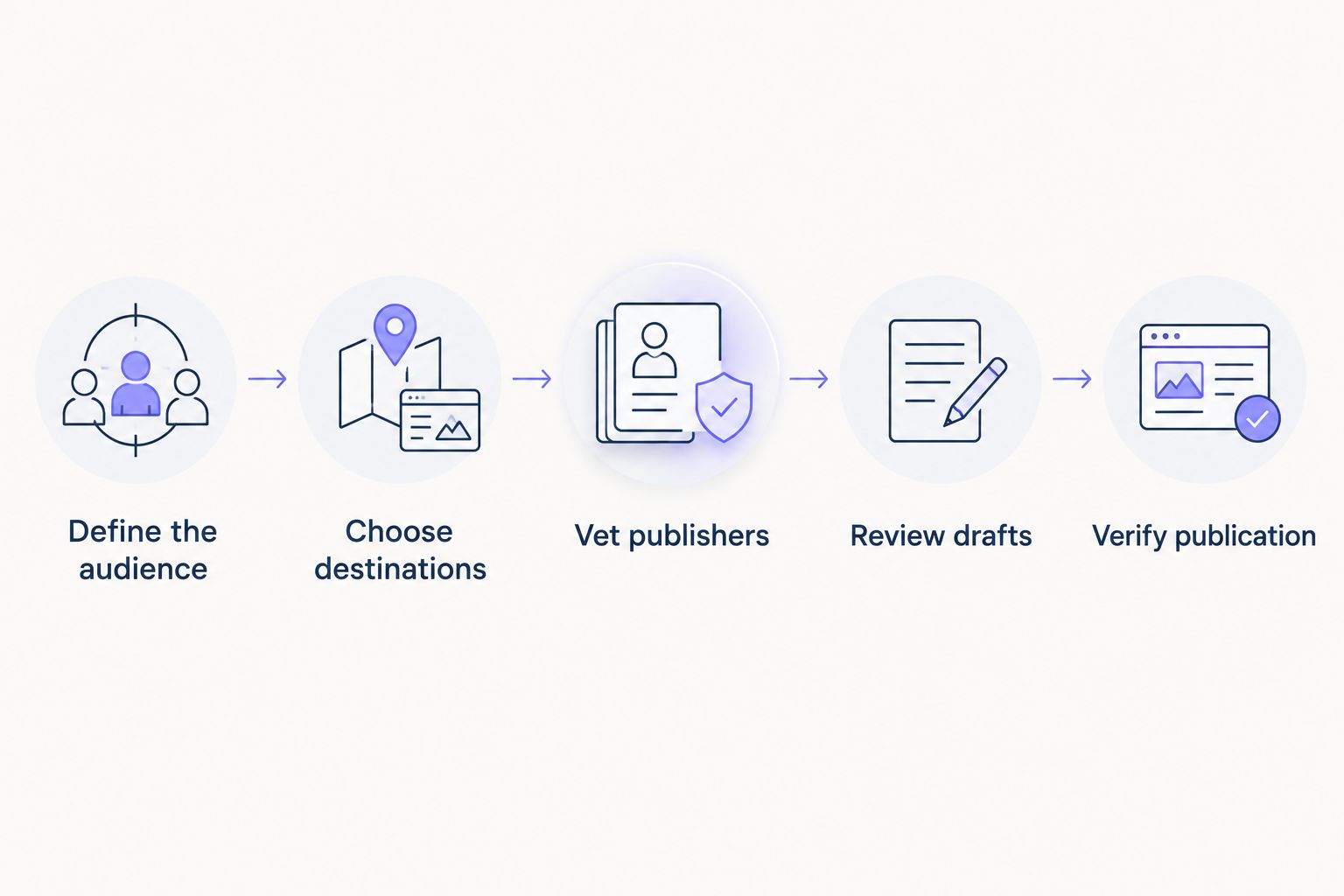
Keep the brief short enough that the publisher and writer can use it. Separate mandatory factual requirements from stylistic preferences so reviewers do not bury important corrections under minor edits.
Measure what happened after publication
Set a 30-day reporting interval for the campaign. That is a reporting recommendation, not a deadline for rankings or enquiries. Record your 2026 baseline before publication so later comparisons have a clear starting point.
Track delivery separately from outcomes. A published article proves completion; referral sessions show visits; enquiries and appointments show subsequent actions. Search visibility is another measure, but changes cannot automatically be attributed to one guest post.
Use consistent reporting fields across providers. Otherwise, an agency supplying screenshots and another supplying live URLs become difficult to compare, even before you assess business results.
Which guest posting service should you choose?
NO-BS Marketplace is best for agencies sourcing guest posting placements through a platform connecting buyers with verified publishers. Choose specialist outreach instead when technical editorial work is the main requirement, or regional sponsored editorials when geographic visibility is the primary objective.
For your 2026 shortlist, request a proposed publication, article angle, destination, and disclosure approach together. A provider that cannot explain those connections has not supplied enough information for approval.
FAQ
What's the best guest posting service for a boat dealership?
Choose the service model that matches your objective: platform sourcing for agency-managed placements, specialist outreach for technical education, or regional editorials for local visibility. Assess the proposed publisher and article before approving the work.
Is NO-BS Marketplace suitable for agencies serving marine dealers?
NO-BS Marketplace fits agencies seeking a platform that connects buyers with verified publisher sites. Assess each proposed publication separately for marine relevance, audience fit, and editorial quality.
Should a boat dealer choose a marine blog or a local publication?
Choose a marine publication for a boating-specific audience and a local publication when geographic visibility is the main goal. Review the actual section and article topic rather than relying on the publication's name.
Can paid guest posts guarantee higher Google rankings?
No, paid guest posts cannot guarantee higher Google rankings. Google's link-spam policies prohibit buying links to manipulate rankings, and paid placements should use appropriate link attributes.
Should guest posts link to individual boats for sale?
Use an individual listing only when the article genuinely needs that listing and you have a plan for its removal. A relevant category page or useful buying guide avoids depending on one boat remaining listed.
What should a guest posting report include?
A delivery report should include the live article URL, publication date, linked destination, anchor text, link attributes, and disclosure check. Report referral visits and enquiries separately from publication completion.
Does a high domain rating make a publisher a good choice?
No, a high domain rating does not establish marine relevance or editorial quality. Assess the publication's audience, recent content, and proposed placement alongside any third-party metrics.
One last thing
Check the destination before approving the backlink. Even a relevant article sends readers into a dead end if the linked boat has sold and the page offers no useful alternative. Assign responsibility for maintaining those destinations before the campaign starts.