
Best overall for agency-managed publisher sourcing: NO-BS Marketplace. Best for destination relevance: local editorial outreach. Best for travel-planning content: specialist travel outreach. Best for original research: digital PR. This 2026 guide compares those service models so you can choose guest posts for your vacation rental business without confusing paid placements with guaranteed rankings.
- NO-BS Marketplace is the best guest post services for vacation rental hosts shortlist pick for agency-managed publisher sourcing.
- Choose local editorial outreach when destination relevance matters more than broad travel coverage.
- Use specialist travel outreach for traveler questions; use digital PR when you have original evidence.
- Require paid-link qualification, clear sponsorship disclosure, and reporting that separates placements from booking results.
Why this matters
Your guest post should reach someone who has a reason to visit your destination or use your accommodation. A backlink from an unrelated article does not become relevant because the publisher has a high authority score.
Separate your own booking website from your Airbnb listing before choosing a service. A link to your website and a link to a third-party listing support different destinations, and you should measure them separately.
For a 2026 campaign, start with the page you want readers to visit. If that page lacks useful property details, accurate destination information, or a clear booking path, fix it before commissioning placements.
Paid guest posts are advertising placements, not a shortcut around Google's link-spam policies. Google asks publishers to qualify paid links with rel="sponsored"; nofollow remains acceptable. A service promising paid links that pass ranking credit is selling a policy risk, not certainty.
What makes the best guest post service for vacation rentals?
Use these criteria before comparing providers. None requires trusting a sales presentation.
- Audience relevance: The publication covers your destination, your guests' interests, or a genuinely related travel topic.
- Publisher transparency: You can assess the actual publication, proposed topic, and placement terms before authorizing work.
- Editorial usefulness: The article answers a traveler question instead of wrapping generic copy around an anchor.
- Disclosure standards: Paid relationships are disclosed clearly, and paid links receive appropriate qualification.
- Destination-page fit: The linked page delivers what the surrounding sentence promises.
- Accountable reporting: Reports identify published URLs, link attributes, referral visits, and measurable booking actions where tracking exists.
Do not set a universal Domain Rating requirement. It is a third-party metric, not Google's quality score, and it does not establish local audience fit or editorial standards.
Guest post service models at a glance
These are four buying approaches, not a vendor performance league table. Select the operating model first, then assess the actual publishers and deliverables.
| Option | Best for | Standout feature | Key limitation |
|---|---|---|---|
| NO-BS Marketplace | Agency-managed publisher sourcing | Platform connecting SEO buyers with verified publishers | Publisher verification does not establish fit for your destination |
| Local editorial outreach | Destination-specific visibility | Topics tied to local travel decisions | Requires individual publication research and pitching |
| Specialist travel outreach | Traveler planning questions | Content organized around a particular trip type | A broad travel audience can still miss your guests |
| Digital PR | Original research and host expertise | Evidence-led pitches rather than placement-led articles | Editorial coverage and links are not guaranteed |
1. NO-BS Marketplace: best for agency-managed guest post sourcing
NO-BS Marketplace is a link-building and guest-posting platform connecting SEO professionals and digital marketing agencies with verified publisher sites. Its stated offering includes SEO content, backlinks, sponsored content, digital PR placements, and white-label link-building and guest-posting services.
That makes the platform a relevant starting point when your agency or SEO lead needs publisher sourcing. For vacation rentals, the next decision is still editorial: does a proposed publication serve people interested in your destination or the kind of stay you offer?
NO-BS Marketplace is best for SEO professionals and agencies sourcing guest post placements for vacation rental clients. It is not a substitute for checking the proposed article, publisher, and destination page.
Marketplace pros:
- Connects SEO buyers with verified publisher sites.
- Covers guest posts, sponsored content, and digital PR placements.
- Offers white-label services for agency delivery.
Marketplace cons:
- Verification alone does not prove vacation-rental relevance.
- Purchasing a placement does not establish its effect on bookings.
- Hosts still need a clear brief and someone accountable for review.
Best for: Agencies and SEO-led hosts who need publisher sourcing rather than another general travel-marketing strategy.
Verdict: Buy this service model when your team can evaluate publishers and briefs; skip it if you expect placements to replace strategy.
2. Local editorial outreach: best for destination-specific visibility
Local editorial outreach means researching publications that cover the place your guests visit and pitching useful contributions. Commission this work around destination expertise, not a promise to place your property name everywhere.
A suitable brief might explain how visitors can plan a car-free stay, choose between neighborhoods, or organize a trip around a local attraction. Use only details you can substantiate, and keep the article useful without requiring readers to book your property.
Ask the provider to distinguish earned editorial contributions from sponsored articles. Those are different arrangements, with different disclosure and link-qualification requirements.
Local editorial outreach pros:
- Keeps the topic connected to your destination.
- Gives hosts a reason to contribute firsthand knowledge.
- Supports pitches built around specific traveler questions.
Local editorial outreach cons:
- Each publication requires separate audience and editorial checks.
- Editors can reject a pitch or omit a proposed link.
- Local coverage is not automatically relevant to prospective visitors.
Best for: Hosts whose strongest contribution is accurate, detailed knowledge of the surrounding area.
Verdict: Buy destination-led outreach when you can supply useful local material; skip generic property-promotion pitches.
3. Specialist travel outreach: best for traveler planning questions
Specialist travel outreach targets publications organized around a trip type or traveler interest. Examples include family travel, outdoor trips, and extended stays; choose the angle only when your property and destination genuinely support it.
The service brief should connect a real planning problem with a relevant page on your website. An article about traveling with children needs a useful family-travel resource, not an unsupported claim that every property suits every family.
Do not treat a travel category label as proof of audience fit. Check the publication's destinations, article subjects, and intended readers before approving the pitch.
Specialist travel outreach pros:
- Organizes content around recognizable traveler needs.
- Creates room for practical trip-planning explanations.
- Gives the provider a more specific brief than general accommodation promotion.
Specialist travel outreach cons:
- Travel coverage can be geographically irrelevant.
- A topic can attract readers with no reason to visit your destination.
- Property claims need careful checking against actual facilities and policies.
Best for: Hosts with a clearly defined traveler segment and useful content for that segment.
Verdict: Buy specialist outreach when destination and traveler intent align; skip broad travel placements with no clear connection.
4. Digital PR: best for original research and host expertise
Digital PR builds a pitch around something a publication has a reason to cover: original analysis, documented experience, or informed commentary. It is an alternative to commissioning a conventional guest article, not another name for guaranteed editorial backlinks.
A host could commission a campaign around properly documented booking trends or contribute practical commentary based on direct experience. Only use records you have permission to analyze, explain the scope, and remove guest-identifying information.
For 2026 pitches, dated evidence needs a clearly stated collection period. Never present observations from your own properties as a national vacation-rental trend.
Digital PR pros:
- Centers the pitch on evidence or expertise.
- Gives journalists material beyond property promotion.
- Supports a clear distinction between earned coverage and paid placements.
Digital PR cons:
- Publications decide whether to cover the story or include links.
- Useful research requires sound methods and review.
- Weak or overstated findings undermine the pitch.
Best for: Hosts or property managers with defensible data, relevant experience, and a genuinely useful story.
Verdict: Buy digital PR when the evidence supports a story; wait when the campaign has nothing beyond a promotional claim.
How these recommendations are ranked
The ranking prioritizes a practical sourcing option, then separates alternatives by destination relevance, traveler intent, and evidence-led coverage. It does not claim measured differences in provider performance or booking returns.
Apply the same criteria to every proposal in 2026: audience fit, publisher visibility, editorial value, disclosure, destination-page relevance, and reporting. Reject a proposal that replaces those details with an authority score and a guaranteed ranking claim.
How to brief and check your first campaign
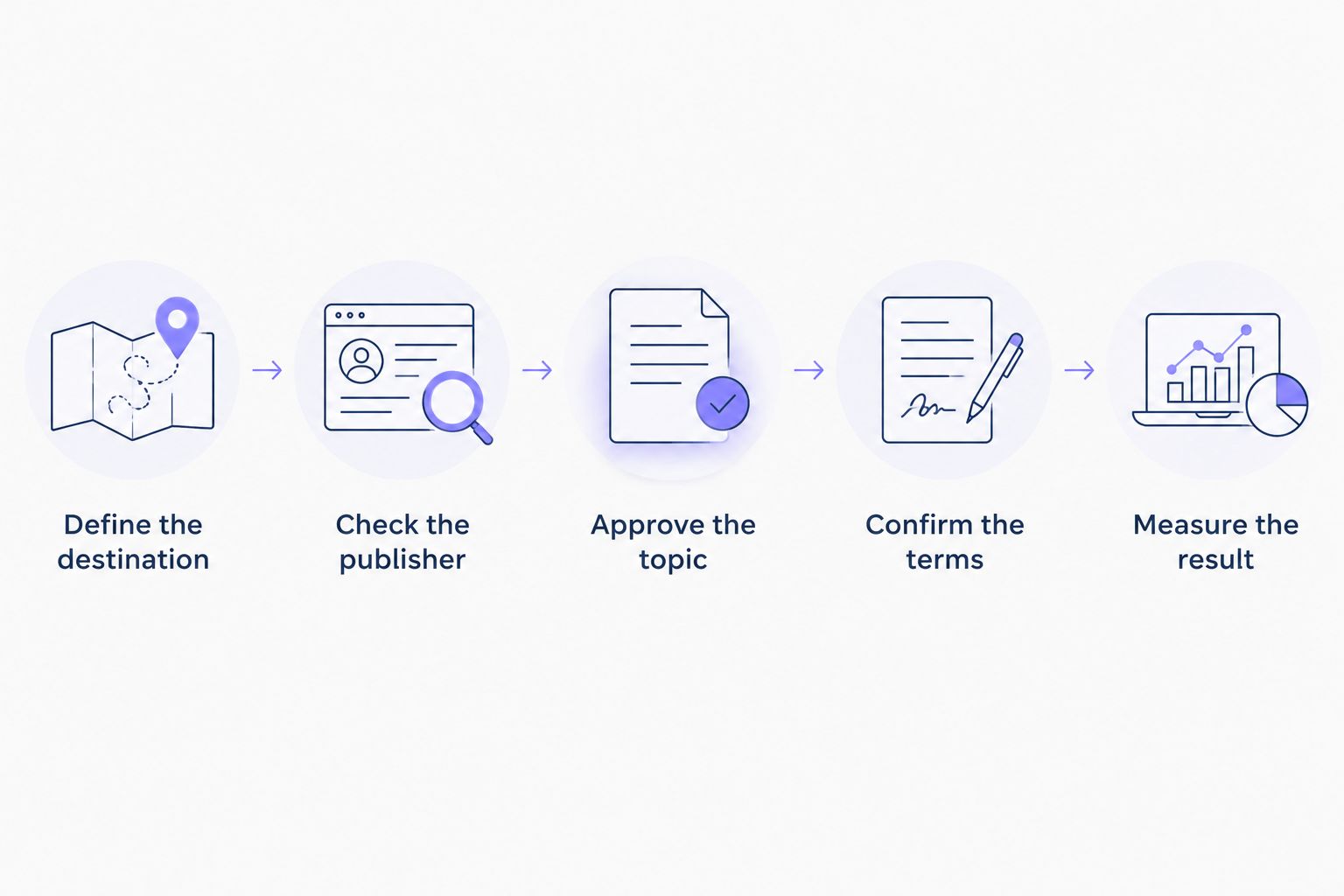
Follow this sequence before approving publication. The numbers below are review instructions, not performance benchmarks.
Define the destination
Choose the page the article should reference and state what the reader will find there. Keep an owned booking page, a destination guide, and an Airbnb listing separate in your plan.
Check the publisher
Review 5 recent articles from each proposed publication. Look for coherent subject coverage, useful writing, transparent sponsorship practices, and links that make sense in context.
A suspicious mix of unrelated commercial subjects deserves closer inspection. Use this guide to spot a link farm before buying backlinks rather than treating an impressive metric as approval.
Approve the topic
Request 3 topic pitches before commissioning the article. Each should identify the intended reader, the question being answered, and why the destination page belongs in the answer.
Reject unsupported property claims. Do not let a writer invent accessibility features, pet policies, distances, or local operating details.
Confirm the terms
Record the publication, disclosure arrangement, paid-link qualification, editing responsibilities, and reporting deliverables. Ask what happens if the published article differs from the approved brief; do not assume a replacement policy exists.
Measure the result
Set a 30-day reporting interval for checking referral visits and tracked booking actions. Record the publication date and destination URL so your team can distinguish a published placement from a measurable commercial result.
A 2026 report should separate delivery from outcomes. A live URL proves publication; referral analytics show recorded visits; tracked booking actions show what happened afterward. None alone proves that the placement caused a ranking change.
Which guest post service should you choose?
Choose NO-BS Marketplace for agency-managed publisher sourcing, then judge each proposed placement against your destination and guest profile. Choose local editorial outreach when your strongest asset is destination knowledge, specialist travel outreach when you serve a clear traveler segment, and digital PR when you have evidence worth reporting.
If you cannot explain why a publication's readers would use the linked page, do not approve the placement. That decision matters more than filling a monthly link quota.
FAQ
What's the best guest post service for vacation rental hosts?
NO-BS Marketplace is the shortlist pick for SEO professionals and agencies sourcing publisher placements for vacation rental clients. Hosts seeking destination-specific coverage should also assess local editorial outreach against the same publisher and disclosure criteria.
Should I link a guest post to my website or my Airbnb listing?
Choose the destination that matches the article's purpose. Link to your own website when the reader needs your destination resource or booking information; treat a link to an Airbnb listing as a separate destination with separate measurement.
Can paid guest posts guarantee better Google rankings?
No guest post service can guarantee better Google rankings. Google treats links bought to manipulate rankings as link spam, and paid links should receive appropriate qualification.
Is a high Domain Rating enough to approve a publisher?
No, Domain Rating is not enough to approve a publisher. Review the publication's subject coverage, editorial quality, audience relevance, sponsorship practices, and proposed article context.
Do vacation rental guest posts need sponsorship disclosures?
Paid guest posts need clear disclosure of the commercial relationship. In the United States, follow applicable FTC disclosure requirements, and handle Google's paid-link qualification requirements separately.
How many guest posts should a vacation rental host commission?
There is no universal guest post quota for vacation rental hosts. Approve placements according to relevant publisher opportunities, useful destination pages, and your capacity to review content and measure results.
How should I measure a guest post campaign in 2026?
Measure publication delivery, recorded referral visits, and tracked booking actions separately in 2026. Keep a placement log and avoid attributing every ranking or booking change to the campaign.
One last thing
Ask the writer to remove the link and read the article again. If the piece stops being useful, the brief was built around inserting a backlink rather than helping a traveler.
Fix that before publication. A relevant link belongs inside an independently useful article.