
Generation Beta (or Gen Beta, for short) is the newest cohort to enter our wild and wacky world. And depending on how the next few years go, these people will either be lauded for their efforts or be blamed for ruining everything.
According to social researcher Mark McCrindle (also credited for coining its predecessor, Gen Alpha), this generation covers those born between 2025 and 2039. He explained that these people would live in a world shaped by digital technology, particularly AI. Given all that’s happened in the AI space so far, it isn’t a stretch.
Granted, a lot of them are still infants or inside their mothers’ wombs as we speak. That’s not stopping some companies from developing marketing strategies centered around this new demographic. With this generation still busy learning how this world works, now is the perfect time to prepare for when they grow older.
Gen Beta’s Likely Traits
McCrindle predicts that Gen Beta won’t start making a dent in the global population until 2035, when it’s estimated to comprise 16%. As for the global workforce population, that’s to come much later, as Gen Z is expected to remain the dominant group and millennials (or Gen Y) at a close second (31% vs. 29%, respectively).
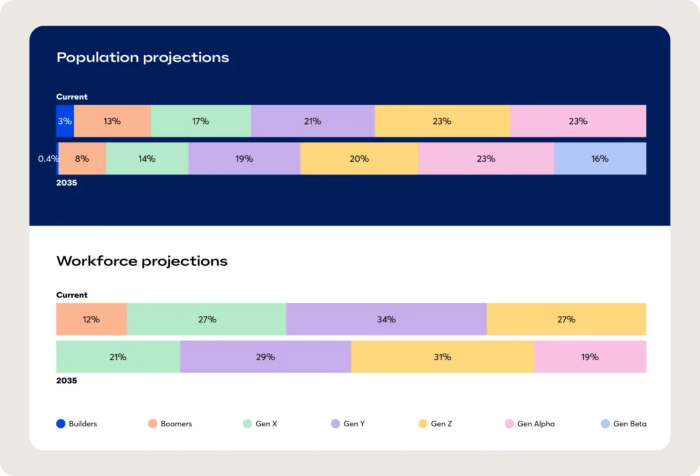
Source: McCrindle
That said, experts have looked into the possible attitudes and preferences of the upcoming generation. They agree that the most prevalent is treating AI as the norm.
Vibhas Ratanjee, Senior Practice Expert on Leadership Development at Gallup, wrote in a piece for Forbes that Gen Beta is more likely to favor online communication. Advances like social media and AI tools make it easier for them to talk to people from across the globe. Meanwhile, in-person interactions might become less common.
Whereas previous generations reaped the benefits of AI, they were mostly experimental. Gen Beta, McCrindle stated, would likely experience these tools nearly or fully integrated into daily life, from wearables to automated transport systems.
As much as witnessing how far AI has come is a cause for celebration, it’s also a cause for concern. The UN Environment Programme reported how much stuff goes into maintaining a data center, including rare earth metals, which are frequently mined using unsustainable methods. Not to mention that the International Energy Agency reported that processing a ChatGPT request uses 10 times as much electricity as a Google search. (1)
Older people might not bat an eye at such issues, but that’s less likely for Gen Beta. This is because most, if not all, would be raised by parents who understand the ramifications of a ruined environment. This’ll likely reflect on their choice of product or service (when they earn direct buying power), or influence adults around them of theirs.
Speaking of parents, they’re likely to become aware of the dangers of exposing their Gen Beta kids to too much technology. McCrindle says that you can expect them to prioritize nurturing authentic relationships and developing human skills.
Implications on Marketing
Before continuing, we probably should address the elephant in the room.
It’s important to note that all this is just conjecture for now. Only time will tell whether Gen Beta follows this trend or defies expectations. And with a couple of years before this new wave of youths can make any meaningful difference in consumer trends, experts caution against falling into the trap they call “generational marketing.”
Jay Topham, co-founder and creative director of London-based brand design firm Unfound Studio, said in an interview with Creative Boom: (2)
“Consumer behaviour is not defined solely by age. Today, regardless of their generation, people align themselves with cultural movements, communities, niche groups or interests that transcend their birth year.”
While now’s not yet the time to fully devote to Gen Beta marketing, it’s enough to be aware of it. In the meantime, recent research states that their Gen Alpha counterparts hold more sway regarding their parents’ purchases.
That’s what research firm ACC and the USC Annenberg School of Communications and Journalism arrived at, according to a joint report released in September last year. Apart from almost all of Gen Alpha calling the shots on family purchases, this also makes the generation the first to wield such power. (3)
Will this trend persist with the first wave of Gen Beta consumers? Again, it’s too early to be certain of anything about Gen Beta. But again, understanding this may as well be the first step when it finally joins the pool of consumers.
Impact on Content
Naturally, the nature of content will change with each generation’s entry. For Gen Beta, it’s predicted that content tailored to it must have a powerful first impression for two reasons.
First, the average attention span has shrunk over generations. One study discovered that it had gone down from 2.5 minutes in 2003 to 75 seconds in 2012. Six years later, it dropped again to 47 seconds. Contrary to another study that pissed off the scientific community at the time, we don’t have the attention span of a goldfish. (4)

As technology is a major contributor, researchers concur that future generations may have shorter attention spans. At the rate it’s decreasing, though, having that of a goldfish might not be as far-fetched as it was several years ago.
Second, as mentioned earlier, is the trend among parents to protect their kids from excess digital exposure. The latter would likely grow in households that would impose strict limits on gadget use. McCrindle states that the trend is more likely among Gen Z parents, granted it’s the most tech-savvy of the cohorts.
To that end, expect a narrower window to reach out to Gen Beta. Short-form content (e.g., video shorts) is already popular with the current generation, and that’ll hardly change with the next one. This doesn’t mean long-form content is on its way out, as one goal of short-form content is to get people hooked enough to check out the long form.
Additionally, considering that AI is expected to be the norm by the time the first of Gen Beta emerges, AI mentions will become more crucial. Not optimizing for AI-assisted search puts content at risk of being forgotten.
Don’t Act Yet, But Start Thinking
It may be too early to jump into Gen Beta marketing, but it’s best to start thinking about it. Knowing what to expect in the next several years helps put your brand in an ideal position for when it’s really time to act.
References
1. “AI has an environmental problem. Here’s what the world can do about that,” Source: https://www.unep.org/news-and-stories/story/ai-has-environmental-problem-heres-what-world-can-do-about
2. “Should creatives be thinking about Gen Beta already?” Source: https://www.creativeboom.com/insight/should-creatives-be-thinking-about-gen-beta-already-/
3. “From Playdates to Power Brokers: Why 11-Year-Olds Are Now Calling the Shots,” Source: https://www.prnewswire.com/news-releases/from-playdates-to-power-brokers-why-11-year-olds-are-now-calling-the-shots-302550085.html
4. “Speaking of Psychology: Why our attention spans are shrinking, with Gloria Mark, PhD,” Source: https://www.apa.org/news/podcasts/speaking-of-psychology/attention-spans