
I began my career in SEO with zero knowledge about SEO. Back then, search engines were nothing more than modern conveniences that I often took for granted. It didn’t occur to me that businesses were vying for the top rankings in search results (AI-generated summaries weren’t a thing yet), trying every trick in the book and then some.
Fifteen years later, it feels like I haven’t gotten any better at it.
As explained in previous posts, the rules of SEO change too fast for anyone to realistically keep up. When the Panda and Penguin updates rolled out, the industry struggled to move on from the practices that had just been branded as black hats. When E-A-T (and later E-E-A-T) was included in the guidelines, people scratched their heads on how to achieve it.
And now that AI is all but inevitable in search, we’ll all be busy unlearning the old—which we’re still learning—to make room for the new. It’s no wonder professionals and website admins alike can’t help but be frustrated or, worse, claim that SEO is a scam…or dead.
So, is it accurate to say that SEO has gotten harder today? Here’s the whole 411 on that.
SEO Before Google
SEO is heavily associated with Google, but by no means did it pioneer the practice. One story claimed that it started with a very angry phone call from the then-manager of the rock band Jefferson Starship. According to the book Net Results: Web Marketing That Works:
The scene is the Heyman home, the summer of 1995, 3:00 a.m. on a Monday morning. The phone rings. Bob, senior vice president of audience development at Cybernautics, grabs the receiver and mumbles, “Hello?”
“Why the #$%$ don’t we come up before page 4 on this damned thing? Page #$%$ 4, you #$%$ morons” the voice on the other end shouts.
Examining the alarm clock and smiling meekly at his wife, Bob asks, “Huh?”
Okay, so “very angry” may be an understatement.
The people at the other end of the call, including the co-author Bob Heyman, checked out the problem. They learned that search rankings back then depended on how frequently the keyword appeared on a page. The solution: spam the keyword “Jefferson Starship” in small print on the band’s website’s black background—and it worked.
Google eventually prohibited this practice, later called keyword stuffing. But back then, it was the most effective way to rank at the top of search results. Search engines at the time worked more like directories and less like the rich content experience they offer today.
Speaking of directories, some search engines like AltaVista and Yahoo! require manually submitting websites to start ranking. Then, a team of human editors reviews the content to ensure everything checks out. Bot crawlers didn’t come until later with WebCrawler.
As for tracking performance, it was also manual. People had to run searches on individual keywords to see where their content ranked for the day. That said, the first analytical tools also came out around this time, such as WebPosition.
Revolution or Ruin?
Google entered the market in 1998, emerging from its BackRub origins with the mission of becoming the world’s largest repository of knowledge. But to achieve this, plenty of things would have to change, starting with the state of SEO.
You see, Google had a different idea about what content deserves to rank at the top. The system rewarded keyword density, which was easier to track, but Google argued that it didn’t necessarily add value for the visitor. Would you, as a visitor, find something that’s remotely helpful in this example from Google’s guidelines below?

Instead, it wanted the focus to shift from keywords to user behavior. If people are sharing or referring your website to others, you must have something that gets them doing so. For that, it found the perfect medium: links.
PageRank was one of many game-changing technologies Google would introduce to its search engine. According to this archived Google page, this system gauges a website or page’s importance by measuring the number and quality of links to it. It’s still a game of numbers; the higher the number of quality links, the higher the chance of ranking high.
PageRank was revolutionary for its time, yet not everyone was a fan. Google later found itself in a perpetual game of whack-a-mole, further tweaking the system in response to incidents that got past the net. One of these was JCPenney’s controversial SEO strategy that I cited a couple of times in this blog.
The first several years were tough because, well, people are highly resistant to change. Keyword stuffing and even content farming were deep-seated in the SEO institution, so sweeping changes like PageRank were—at least, initially—not welcome.
Sadly, it was the start of a vicious cycle that persists today.
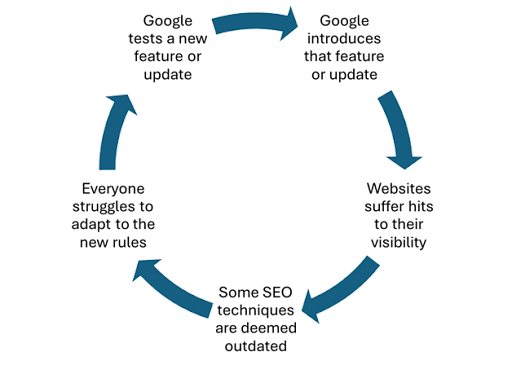
At least let us make sense of your last update first, Google.
It doesn’t help that, unlike most industries, SEO doesn’t have a regulatory body. Well, it does in the form of the SEO Professional Services Association (SEOPSA). But if it’s your first time hearing about SEOPSA, I can’t blame you.
Because of this, SEO is still stuck with the “Wild West” reputation. It’s an industry where scrupulous individuals or groups operate with near impunity, and the legitimate ones are left cleaning up the mess. And all the while, those bad experiences lead clients to see the industry in a negative light.
Did AI Make It Worse?
Fast forward to today: AI-powered search is the norm. Publishers are facing a new wave of concerns, from decreasing inbound traffic to copyright infringement. And while the tech is designed for the user’s convenience, the public is rather divided.
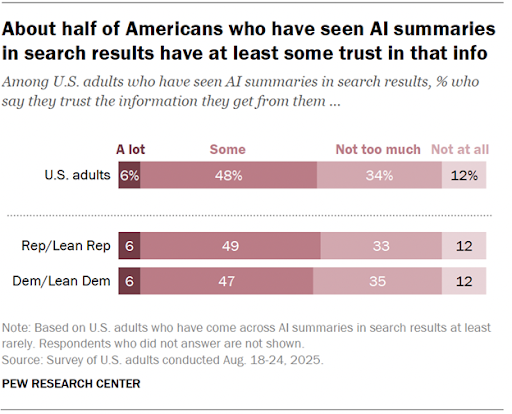
Source: Pew Research Center
AI is arguably the most disruptive driver of change in search since PageRank, mainly in the form of AI-generated summaries. Superseding even the top organic result, this AI-powered feature lets search engines return direct answers within seconds. While far from perfect, it turned search engines into answer engines.
However, it poses a new problem for publishers. How can they make their content trusted enough for AI to cite or mention it? Unlike in the era of keyword stuffing, the criteria for AI citations and mentions aren’t as clear-cut. The best we have is a continued focus on high-quality content, one that follows Google’s E-E-A-T criteria (which itself is vague).
Also, if you think that securing a high rank is enough, know that AI doesn’t care much for rankings. As long as it finds the content ideal to answer a prompt, even those beyond the first or second page can still have a chance.
This may be Google’s way of telling people to stop their unhealthy obsession with rankings. However, because of the divided sentiment toward AI summaries, the so-called “ten blue links” remain important in modern SEO for now. For publishers, though, they should know that more rivals are vying to get cited or mentioned.
The Verdict
So, is doing SEO today more difficult than decades ago?
Well, that goes without saying.
SEO has always been in a tough position, solving old problems only for new ones to come up. But as much as we admit that SEO has become harder than before, our duty to put it in layman’s terms remains. Remember that we do all this so they don’t have to, and every bit of trust we earn through our actions builds trust in the industry as a whole.