
Google Officially Kills FAQ Rich Results
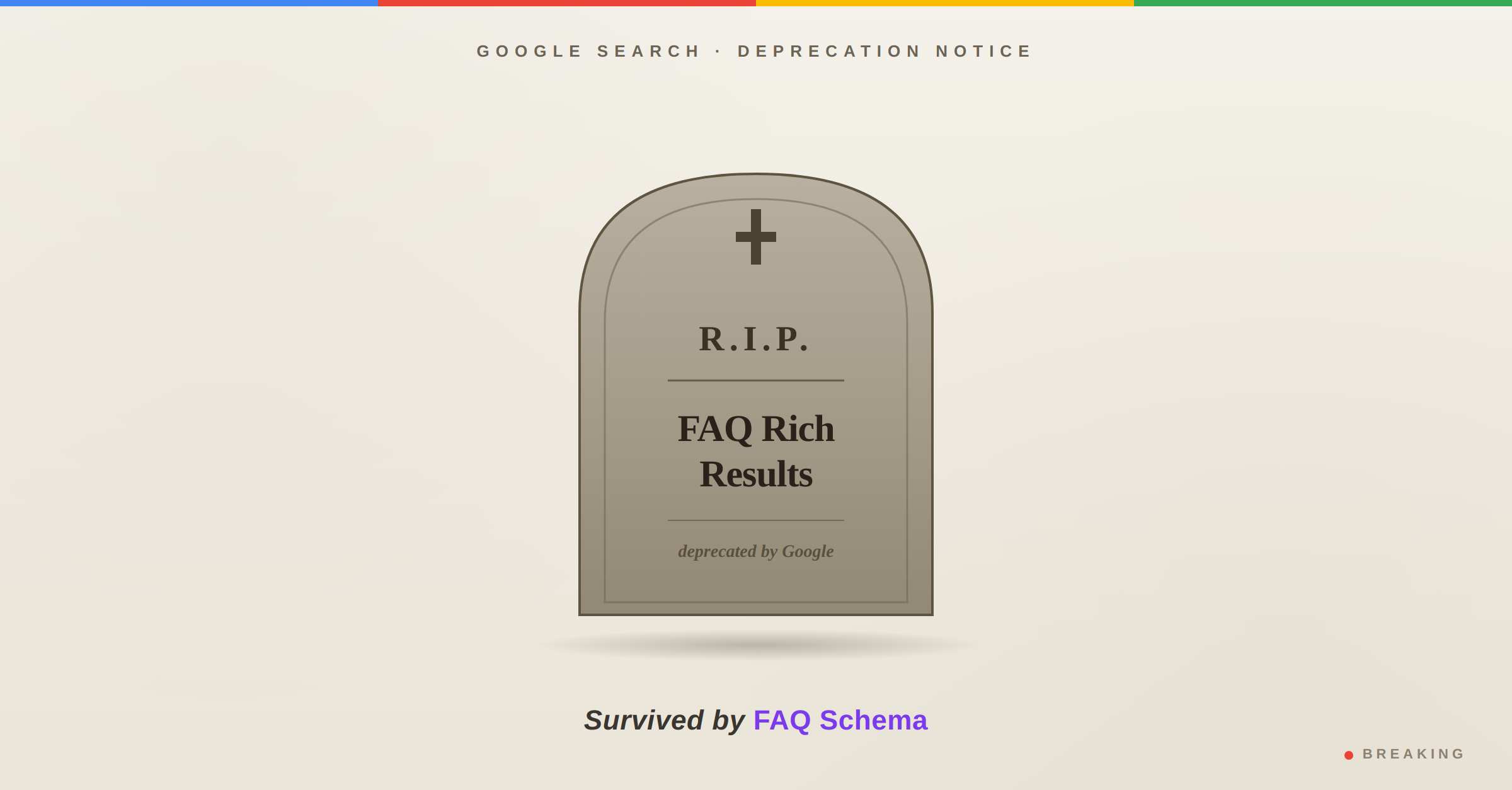
Google updated its Search Central documentation on May 7, 2026, with a deprecation notice for FAQ rich results. The update appears at the top of the FAQ structured data page and announces that as of that date, FAQ rich results are no longer appearing in Google Search. The notice also lays out what gets removed when, ending with a single line that changes how the announcement should be read: Google will continue to use FAQ structured data to better understand pages, even though the rich result feature is gone.
The deprecation completes a process that started in August 2023, when Google first restricted FAQ rich results to well-known authoritative government and health websites. For most of the web, FAQ rich results have already been gone for nearly three years. The May 2026 announcement removes them for everyone, including the sites that retained them after the 2023 restriction.
The deprecation rolls out across three months
The notice spells out a removal timeline that runs from May through August 2026.
The first change is already live. As of May 7, FAQ rich results no longer appear in Google Search. Sites that previously qualified for the feature, including the government and health domains that kept it after 2023, no longer see their FAQ markup rendered as expandable dropdowns in search results. The visual SERP feature is gone.
In June 2026, Google will remove FAQ-related reporting from Search Console. The rich result status report for FAQ markup, which let site owners track how many of their FAQ-marked pages were eligible for the feature, will be retired. The Rich Results Test, the tool developers use to validate structured data, will also stop supporting FAQ markup at that point.
In August 2026, Google will remove FAQ rich result support from the Search Console API. The three-month gap between the Search Console UI removal and the API removal gives developers time to adjust any automated reporting or monitoring that relies on FAQ rich result data.
The full timeline removes every visible trace of FAQ rich results from Google’s product surfaces. Search appearance, dashboards, testing tools, and API access all get retired in sequence.
From restriction in 2023 to full retirement now
The May 2026 announcement is not a sudden change. The deprecation completes a process that began in August 2023, when John Mueller, a Search Advocate at Google, posted on the Google Search Central blog that FAQ rich results would only appear for well-known authoritative government and health websites going forward. The 2023 update was framed as a search appearance change, not a ranking change, and it was rolled out globally within a week of the announcement.
The 2023 restriction was a response to widespread abuse of FAQ schema. Sites had been adding artificial FAQ sections to inflate their SERP real estate, often with questions that did not match user intent or answers that existed only to occupy more pixels. Restricting the feature to government and health sites, where the questions and answers tend to address genuine public information needs, was Google’s way of cleaning up the SERP without removing the feature entirely.
Between 2023 and 2026, the restricted version remained available to qualifying sites. The May 2026 announcement removes it for those sites too. The reasoning is not spelled out in the documentation, but the practical effect is clear: FAQ rich results are no longer a Google Search feature for any category of website.
Google’s commitment to keep using the data
The deprecation notice includes a line that easily gets lost in coverage of the news but appears to be the most consequential part of the update. Google states that it will continue to use FAQ structured data to better understand pages, even though it will no longer display the rich result.
The line confirms what some SEO professionals have argued since the 2023 restriction: structured data and rich results are two different things. Schema markup tells Google what a page is about in machine-readable form. Rich results are a display feature that uses some structured data to render visual SERP elements. Google can choose to stop showing the visual feature without abandoning the data that informed it.
For FAQ markup specifically, the data describes a page as containing question-and-answer pairs, with each question and its corresponding answer clearly delineated. That structure is useful to Google’s understanding of the page regardless of whether the SERP includes a visual FAQ block. The model used to generate AI Overviews, the system that decides which pages to retrieve for a given query, and the algorithms that match pages to user intent all benefit from clearer signals about page content. FAQ markup contributes to those signals.
Whether the practical impact of FAQ markup on rankings or AI Overview citation probability is large or small is a separate question, and one Google has not directly addressed. What the documentation does say is that the schema continues to function as a comprehension signal, which is a different statement than “remove your FAQ markup because the rich result is gone.”
Sites with FAQ markup face a clear decision
For any site currently using FAQ structured data, the May 2026 announcement raises a practical question: keep the markup or remove it.
The argument for removing it is the simplest one. The rich result that originally motivated the markup is no longer available, and the Search Console reports that helped track its performance are being retired. From a pure SERP-feature ROI standpoint, the markup no longer earns its keep.
The argument for keeping it follows directly from Google’s own statement. The data still informs how Google understands the page. Removing the markup removes a signal that Google has explicitly committed to continuing to use. For a site where the FAQ markup accurately reflects on-page content, the cost of keeping it is minimal (a small amount of additional code in the page) and the upside is preserving a comprehension signal that may or may not show up in rankings or AI Overview citations.
The decision should also account for content quality. Google’s content guidelines for FAQ markup require that the questions and answers on the page actually exist as visible content, that the questions are written by the site rather than user-submitted, and that the answers are not promotional or repetitive. Sites with FAQ markup that does not meet those guidelines, or that was added purely to chase the rich result, may want to clean up the markup or remove it. Sites with genuine FAQ content that follows the guidelines are better off keeping the markup, since Google has committed to continuing to use the data.
FAQ schema as a comprehension signal beyond rich results
The most useful framing of the announcement is probably not “Google is removing FAQ” but “Google is removing the visible feature while keeping the underlying data signal.” That distinction has implications for how to think about structured data more broadly.
Schema markup serves multiple functions. The most visible one is enabling rich results, the visual SERP features that capture extra real estate and click-through rate. The less visible function is helping search engines understand page content, classify it correctly, and match it to relevant queries. Rich results are the visible payoff. Comprehension is the underlying value.
When Google removes a rich result feature, the visible payoff disappears. The underlying value does not necessarily disappear with it. Google’s explicit statement that FAQ data will continue to inform page understanding makes this distinction concrete for FAQ specifically, and it is a useful frame for thinking about other structured data types whose rich result features may be deprecated in the future.
For brands building AI visibility through SEO, link building, and editorial coverage, the comprehension layer matters. Pages that Google understands clearly are pages that get retrieved for relevant queries, that get cited in AI Overviews, and that contribute to the entity recognition signals that AI retrieval systems use across the broader ecosystem. Structured data, including FAQ markup that follows Google’s content guidelines, contributes to that comprehension layer.
The May 2026 announcement is the end of FAQ rich results. It is not the end of FAQ structured data as a useful signal. The two have always been distinct, and Google’s deprecation notice makes that distinction explicit by spelling out what gets removed (the visible feature) and what continues (the comprehension function). For sites with genuine FAQ content and properly implemented markup, the schema is still doing work behind the scenes, even when there is nothing visible on the SERP to show for it.