
This post is an updated guide on our post about dofollow and nofollow backlinks. Whether much has changed or not, it’s important to keep your SEO knowledge up to date.
Backlinks come in various forms, from those earned by inspiring the audience to those that are paid for through link building. But no matter the form, they’re generally classified in one of two types: dofollow and nofollow backlinks.
You probably hear this a lot in SEO circles or anytime you talk to an SEO professional. This is because distinguishing the two is a fundamental skill in this line of work. Trust me, it’s a lot simpler than how the terms look.
What Are Dofollow Backlinks?
Dofollow (or follow) backlinks are the default form of backlinks. It passes link equity, which we in the industry call “link juice,” to the target link. In coding, these links appear as regular hypertext reference (href) attributes.

For duplicate content, a dofollow link is slapped with a canonical attribute. This lets Google know that the page or site it’s on is “canon” or the accepted version of the duplicates. Also, the code syntax used is different.

Search engines read this as a link endorsing the target page or website. Assuming it doesn’t violate the guidelines, they’ll pass the juice to it without incident. That gives the target page or website a merit in search results, especially if the source is reputable.
Dofollow links were the foundation of ranking high in search results, and they still are in the age of AI. Features like Google’s AI Overviews still depend on backlinks to create accurate summaries. While we have yet to get an idea of exactly how it does this, we’re aware that AI cares less for rankings when choosing its sources.
What Are Nofollow Backlinks?
Nofollow backlinks are the opposite—links that don’t pass link equity. This is shown in the code as href attributes but with the addition of the relationship (rel) attribute. In their basic form, the links are tagged with “rel=nofollow” in the code.

Nofollow was introduced in 2005 as Google’s means of fighting against comment spam. By flagging certain links with this attribute, search engines can be instructed not to pass value to the target page. At least, that used to be the case—but more on that in a bit.
In 2019, Google expanded the nofollow system by adding two specific values: sponsored and user-generated content (UGC). The sponsored tag is used for sponsored content and other similar pages, while the UGC tag is for links in comments and forum posts. The code syntax is mostly the same, just replace the rel value with the appropriate tag.
Has Anything Changed?
Dofollow and nofollow links still work the same way as when they were introduced. Despite AI changing SEO, search engines still require websites to tag their backlinks as dofollow or nofollow to maintain a good search experience. Labeling one as the other when it isn’t can be grounds for link devaluation, if not a penalty.
And don’t think that Google isn’t watching.
Remember when Google added more rel values in 2019? Well, that was also the time it changed how it treated nofollow links. Once ignored, they’re now considered “hints” for including or excluding certain backlinks. This shift helps it understand unnatural linking patterns, better rewarding good content and penalizing bad ones.
Long story short, nofollow links now work like dofollow ones—to some extent.
But with traditional SEO in its final years, we need to consider how these links will help with AI visibility. AI hardly cares for rankings as long as the content is relevant. Would this reflect on how it treats dofollow and nofollow?
Kevin Indig, author of Growth Memo, seems to think this is the case.
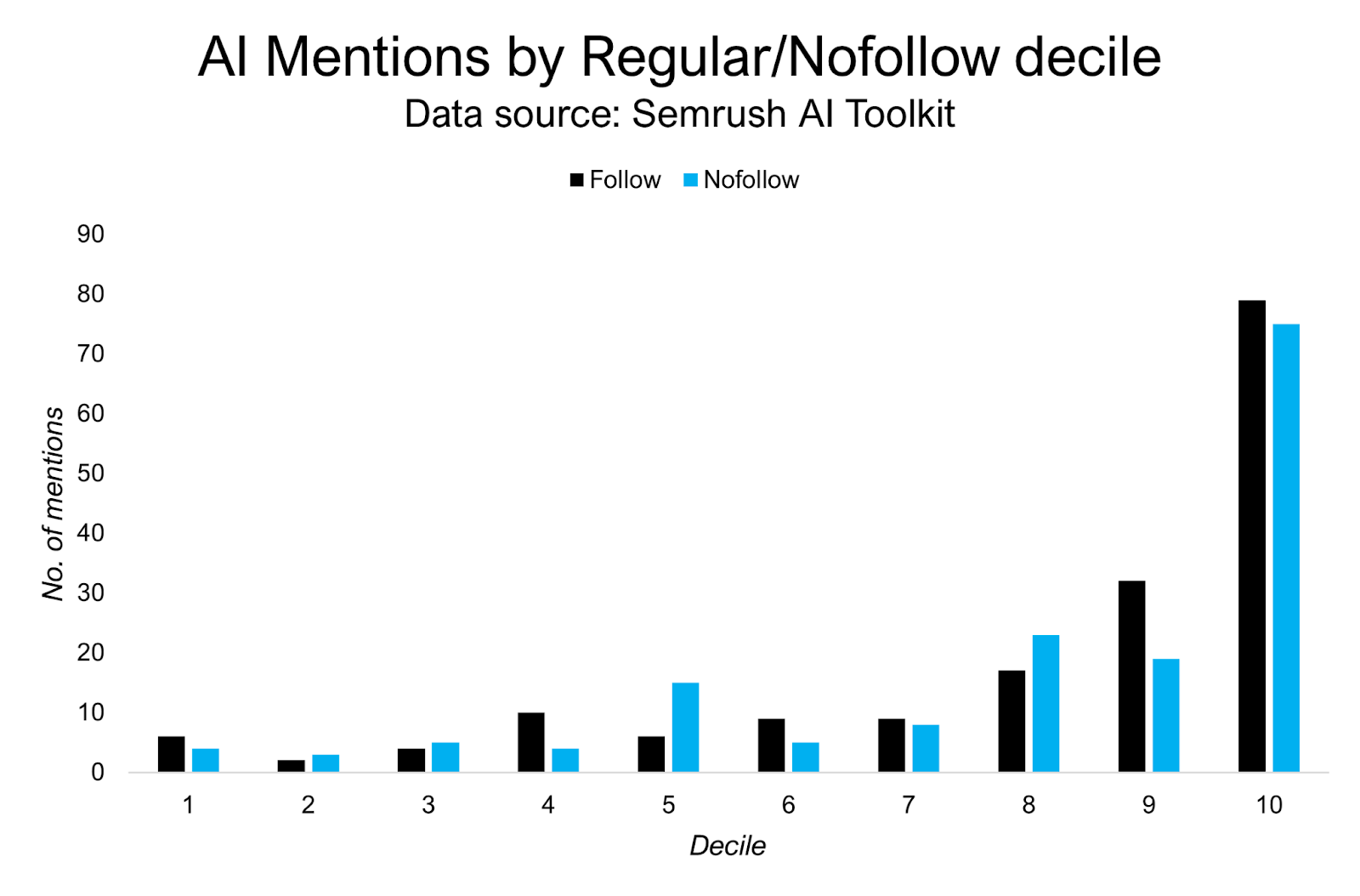
Source: Growth Memo
In his study of 1,000 randomly selected websites, Indig discovered that AI gives as much of a [bleep] for dofollow or nofollow links as for rankings. As the data above shows, there’s no clear winner between the two in terms of the frequency of AI mentions. The results support the fact that AI cares more about the content’s context.
He also stated that AI models favor dofollow or nofollow differently. Even Google is split: AI Overviews favor the former, and Gemini the latter (despite both using the same model).
With that, nofollow links found a new lease of life. Instead of affecting search rankings, they can now influence AI visibility through brand mentions. AI models love it when they’re given a clear citation, namely crediting a statement to a business or an in-house expert. This is why digital PR, which uses nofollow links a lot, has grown in importance in SEO as of late.
Nevertheless, search engines still want to see natural link profiles, and going fully nofollow isn’t a good way to build one. A balance between dofollow and nofollow links is necessary. Too much of one thing is a good way to be penalized.
Still Different, Still Necessary
Dofollow links still pass value, whereas nofollow links pass some value. Both are very much still needed in AI search, given that AI models ignore them in favor of contextual relevance. However, search engine guidelines still exist and must be followed (no pun intended).