
SISTRIX published an analysis of over 100 million keywords in the German search market and found that AI Overviews reduce the click-through rate at position one from 27% to 11%. That’s a 59% relative drop for the most valuable position in organic search, and the dataset is large enough to break the impact down by category, by site, and by absolute click volume.
The numbers land roughly one year after AI Overviews became broadly active in Germany. The findings document losses that vary dramatically by industry, with certain health and information publishers absorbing click reductions that dwarf the average, while transactional and ecommerce sites barely feel the impact.
How Many Keywords Are Affected
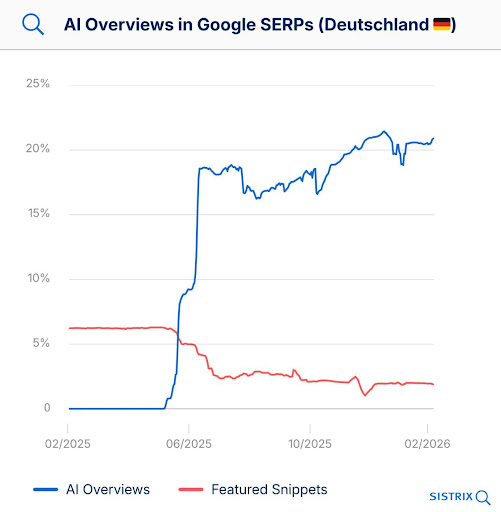
AI Overviews currently appear on about 20% of all keywords in German search results. That’s up from 17% when SISTRIX measured in August 2025, so the growth rate has slowed, but the feature’s presence continues expanding.
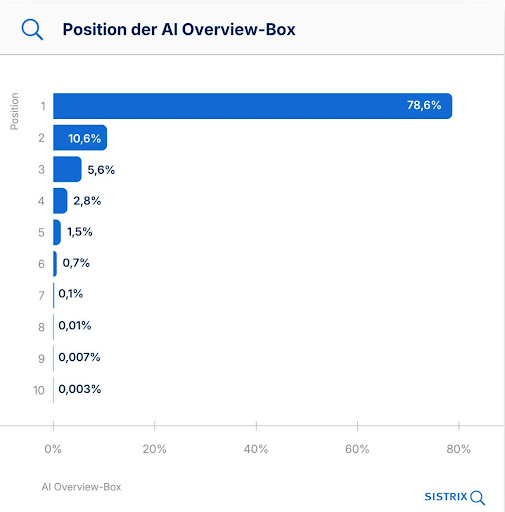
Of the roughly 20 million keywords where AI Overviews appear, 78.6% display them at the very top of the results page, above all organic listings. When an AI Overview sits at the top and directly answers the query, the incentive to scroll down and click a blue link drops significantly.
Across all 100 million keywords in the dataset (including the 80% where no AI Overview appears), the overall click loss comes to 6.6%. That might sound manageable as an average, but the distribution is heavily skewed. Some categories barely register a change. Others lose a quarter of their organic clicks.
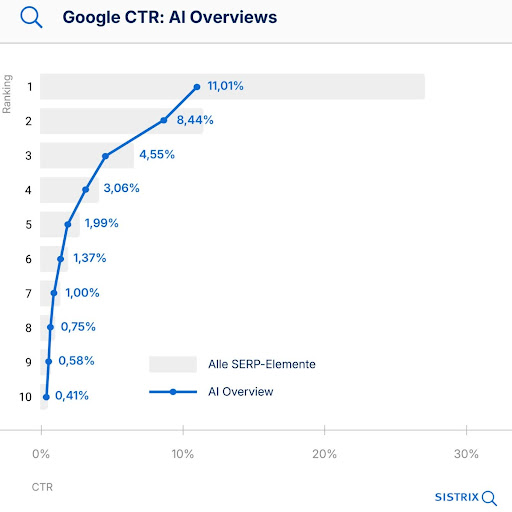
SISTRIX’s calculations show that AI Overviews cost the German market approximately 265 million organic clicks per month. That figure represents clicks that would have gone to websites if the AI Overview hadn’t been present to answer the query directly on the results page.
To put that in context: 265 million monthly clicks being absorbed by AI-generated summaries instead of reaching publisher websites is a structural shift in how traffic flows through German search. The clicks aren’t going to a competitor. They’re not going anywhere. The user gets the answer on Google and the search session ends.
Category Breakdown: From 1% to Over 24%
The SISTRIX data breaks the impact down by category, and the gap between the most affected and least affected is enormous.
Parenting and baby content sits at the top of the loss chart with over 24% of organic clicks lost. Health content and home improvement follow with losses well above the average. These are classic informational categories where the queries tend to be question-based (“what are symptoms of,” “how to fix,” “when should you”), and those are exactly the types of queries AI Overviews are designed to answer directly.
At the other end of the spectrum, recipe sites like Chefkoch lost about 1%. News and media sites lost 7.37%, below the average. Shopping and travel booking sites were barely affected.
The pattern is consistent with what other studies have found across markets: informational queries get hit hardest because AI Overviews can satisfy the intent without a click. Transactional queries, where the user needs to do something an AI summary can’t replace (buy a product, book a trip, sign up for a service), are mostly spared.
For sites in the 1-7% loss range, the impact is real but unlikely to fundamentally change operations. For sites in the 20%+ range, a quarter of organic traffic disappearing represents a material business problem.
The Biggest Losers by Site
Wikipedia leads the absolute loss chart with an estimated 31.6 million clicks per month lost to AI Overviews in Germany alone. SISTRIX estimates that represents about 5% of Wikipedia’s total Google traffic in the German market.
The next tier includes DocCheck (4.8 million lost clicks), AOK (4 million), ADAC (3.1 million), and Pons (3.1 million). These are large German-language reference and information sites that rank well for high-volume informational queries, which are exactly the queries where AI Overviews appear most frequently.
By percentage rather than absolute numbers, specialized health portals take the biggest hit. Lumedis.de lost 30% of its organic clicks, ratgeber-herzinsuffizienz.de lost 29%, and herzstiftung.de lost 29%. These are niche health information sites where virtually all traffic comes from informational health queries that AI Overviews now answer directly.
The sites with the smallest percentage losses include wetter.com (0.18%), Booking.com (0.46%), Idealo (0.85%), and Amazon (1.73%). Weather, travel booking, price comparison, and ecommerce queries require actions that an AI summary can’t complete, so the click continues to flow through to the site.
How the German Numbers Compare to Other Markets
The 59% CTR reduction at position one in Germany is steeper than what other studies have found in other markets, though direct comparisons are limited by different methodologies and keyword sets.
A Pew Research Center study of US searches found that users clicked 8% of the time when an AI Overview was present, compared to 15% without one, roughly a 47% relative reduction. A GrowthSRC analysis found a 32% drop at position one in the US. Ahrefs’ February 2026 data showed AI Overviews reducing clicks by 58% globally.
Whether the German numbers are genuinely steeper or just measured differently isn’t clear from the available data. But the direction is consistent across every study and every market: AI Overviews reduce organic CTR, the reduction is largest for informational queries, and position one absorbs the biggest relative loss because it previously captured the most clicks.
What the Data Means for Search Volume as a Metric
SISTRIX’s founder Johannes Beus makes a methodological argument alongside the click data that’s worth pulling forward: search volume as a standalone metric for evaluating keywords is becoming insufficient.
A keyword with 10,000 monthly searches and no AI Overview delivers fundamentally different traffic potential than a keyword with 10,000 monthly searches and an AI Overview sitting at the top of the results. The search volume is the same. The clicks reaching websites are not. Any keyword analysis that doesn’t factor in whether an AI Overview is present (and how it affects CTR in that specific category) is working with an incomplete picture.
For link-building and digital PR strategy, the implication is about where to focus effort. Earning links and coverage for pages targeting keywords where AI Overviews absorb most of the clicks delivers less return than the same effort directed at keywords where the click still flows through to websites. The keyword’s search volume might look identical, but the traffic outcome is now very different depending on whether an AI Overview is in the way.
The Practical Response
The SISTRIX data doesn’t suggest that organic search is dying. 80% of German keywords don’t have AI Overviews at all. Even on the 20% that do, 11% CTR at position one still delivers clicks. And transactional, commercial, and navigational queries remain largely unaffected.
The practical response is about adjusting where effort goes and how performance gets measured.
Keyword research needs an AI Overview layer. Evaluating keywords by search volume alone misses the CTR impact. Checking whether an AI Overview appears for a target keyword, and whether it appears at the top of results, should be part of the standard evaluation before committing content or outreach resources.
Informational content strategy needs recalibration. For categories in the 20%+ loss range (health, parenting, home improvement), purely informational content that answers a single question is the most vulnerable format. Content that provides depth, tools, interactivity, or perspectives that an AI summary can’t replicate has a better chance of earning the click even when an AI Overview is present.
Tracking needs to account for the split. Search Console data shows impressions and clicks together, but doesn’t separate AI Overview impressions from standard organic impressions. If CTR is dropping on informational queries, the cause may be AI Overviews rather than a ranking or content problem. Understanding the distinction prevents misdiagnosing the issue and wasting effort on fixes that won’t help.
And for sites in the least-affected categories (ecommerce, travel, weather, price comparison), the data is actually reassuring. Transactional intent is still protected, and the click continues to reach the destination. The crisis is concentrated in informational publishing, not across the board.
SISTRIX study: https://www.sistrix.de/news/ai-overviews-in-deutschland-so-stark-sinken-die-klickraten-wirklich/