
On September 11, SEOwner, who identifies himself as “SEO with superpowers,” posted on X that a key URL parameter was no longer working. Users suddenly couldn’t view 100 search results, even with the hack he’s been using for a year.
The post hardly went viral, but Barry Schwartz of Search Engine Land caught wind of it and replicated the results. Initially, the parameter still functioned when used outside of his Google account. However, a follow-up story three days later confirmed that it affected both sign-in and sign-out. The &num=100 (which I’ll refer to as Num 100 for brevity) was gone.
And now, the SEO community is, for lack of a better term, up in arms about Google’s latest decision. Some think it’s good news because it means AI tools like ChatGPT won’t be able to scrape search data, giving traditional SEO the edge. Others are concerned, as its removal has reportedly broken many third-party SEO tools, such as Ahrefs.
There’s no way of telling whether it was intentional or just a glitch. Google hasn’t issued an official statement as I write this, so much of the information available is still based on speculation. That hasn’t stopped people from wondering how SEO tracking (and SEO, to an extent) will work without a parameter they’ve relied on for years.
The Parameter at a Glance
Users can type Num 100 in their browser’s URL bar to prompt Google to return 100 search results per page instead of the standard 10. It benefited users by providing more results to choose from without having to navigate to the next page. Although it’s common knowledge that the top 10 results get the most clicks, Num 100 gives content beyond the first page exposure.
However, it’s more commonly used among SEO professionals, namely in tracking. You see, bots in SEO tools like Ahrefs and Google Search Console also crawl search results, just as bots in Google Search do. That’s how they generate valuable search data that the tools’ users use to make decisions about the right kind of content.
Generating 100 results was more convenient for users because they could assess search data in large batches. Without it, tools would be forced to limit their results to 20 at most. Instead of one page, users would have to go through five.
How Are The Tools Coping?
A few, like seoClarity escaped unscathed. In an official statement, Chief Architect Mitul Gandhi assured clients that it’s business as usual, thanks to its tool being designed with change in mind. That said, he also admits that retrieving SERP data will be more challenging. (1)
Most tools were hit, including prominent ones such as Ahrefs and SEMrush. However, the two mentioned that they’re working on solutions as we speak.
It’s also worth noting that Google’s own tool, Google Search Console (GSC), didn’t escape the carnage. SEO consultant Tyler Gargula evaluated over 300 GSC properties in the wake of Num 100’s removal. Between the before and after periods: (2)
● 87.7% of properties reported a decrease in impressions
● 77.6% of properties reported a decrease in query count
● Of the impression drops, 46.1% involved short-tail keywords
● Of the impression drops, 40% involved mid-tail keywords
● Keywords ranking on pages three and over had their rankings dropped by 13.1%
But here’s where it gets interesting: Gargula suggests that these drops aren’t as bad as they look. For all the convenience the parameter provides, industry experts state that it tends to inflate figures. Removing these artificial inflations, he says, can lead to improved data quality and more accurate statistics. (3)
Joe Friedlein, founder of UK-based marketing firm Browser Media, welcomes the change. However, he added that it can make comparing campaign performance more frustrating. Without accurate year-on-year data, marketers may struggle to assess the impact of a past campaign relative to a recent or current one. (4)
Fighting Against AI Scraping?
Some experts can’t help but feel the timing of the removal was rather impeccable. It came at a time when concerns about web scraping by AI tools are getting, well, more concerning. Sites have become more protective of their content, and honestly, who can blame them?
Then again, it doesn’t seem to stop scraping. SerpApi, a platform widely used by AI tools to collect search data, has released a workaround called the Google Fast Light API that enables users to generate 100 search results on a single page. Together with its regular Google Search API, it reduces the number of searches to just two. (5)
SerpApi is reportedly how ChatGPT returns answers derived from Google Search, though OpenAI CEO Sam Altman has denied it. SerpApi’s website no longer mentions OpenAI as one of its clients, but it does mention another AI tool: Perplexity.

Screenshot from SerpApi’s homepage (as of September 2025)
To confirm this, our team ran searches on both Perplexity and Google Search. Our first test in early September found that, apart from a difference in rankings, the search results were nearly 1:1 in both platforms.

Search term: “SEO in Miami” | Left: Perplexity, Right: Google Search

Search term: “SEO in Brooklyn” | Left: Perplexity, Right: Google Search
That said, I wouldn’t be surprised if Perplexity had rolled out changes to its algorithm since then. To compensate for this, we decided to run another test a month later. The results are largely the same.
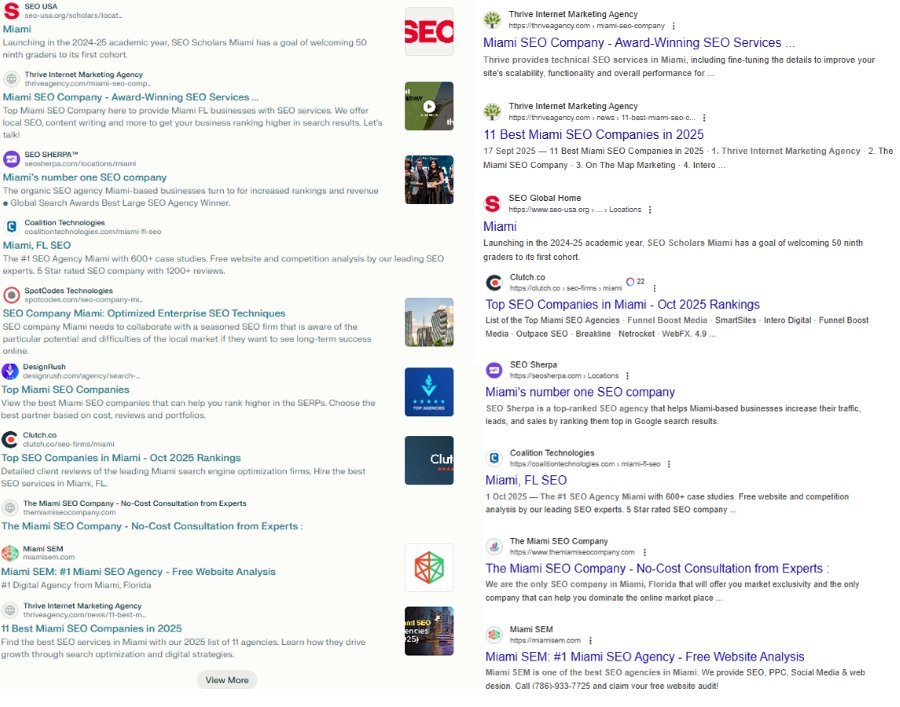
Search term: “SEO Miami” | Left: Perplexity, Right: Google Search
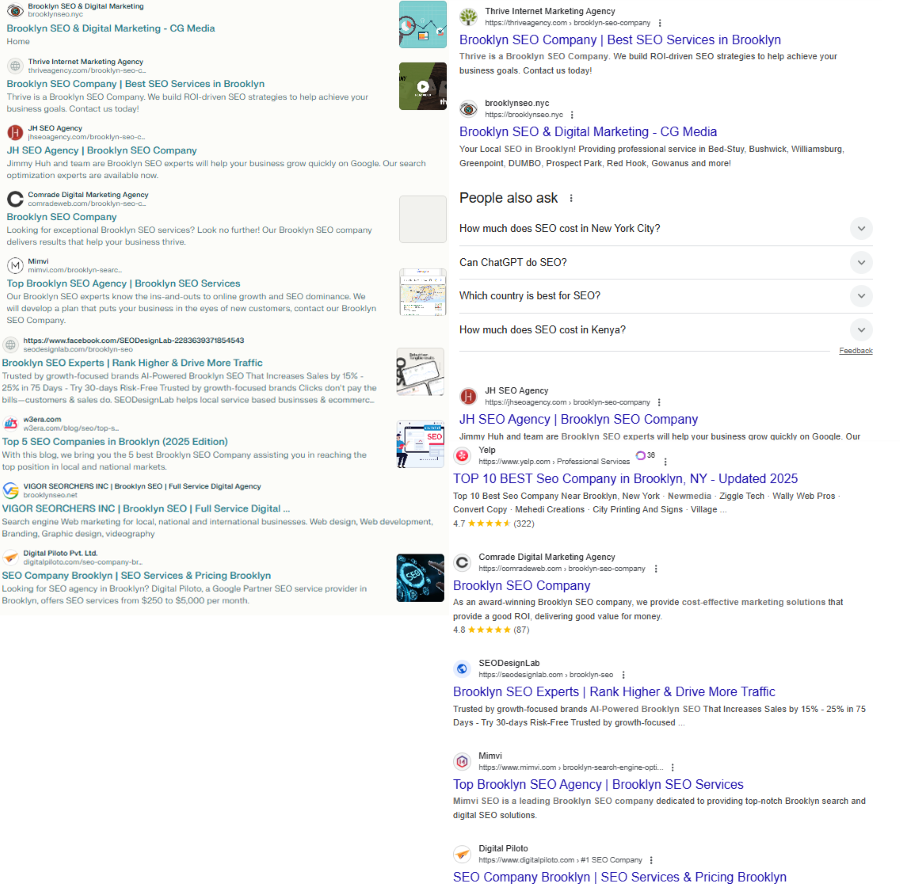
Search term: “SEO Brooklyn” | Left: Perplexity, Right: Google Search
Do You Really Need 100 Results?
Num 100’s removal also raised a question among SEO circles. Does SEO monitoring really need 100 search results to help us make better decisions?
Tim Soulo, Ahrefs Chief Marketing Officer, wondered about the sense behind using results beyond the top 20 for SEO analytics. In his post on X, he stated that content outside of the top 20 only indicates that Google has indexed that content. He couldn’t recall any practical application for such data, given that this isn’t where you want to rank, anyway.
It also raises another question. Why were we using 100 results for our SEO analytics?
For the record, it isn’t as if the industry made this the standard or anything. Google gave us the means to do so with its search settings in the past.
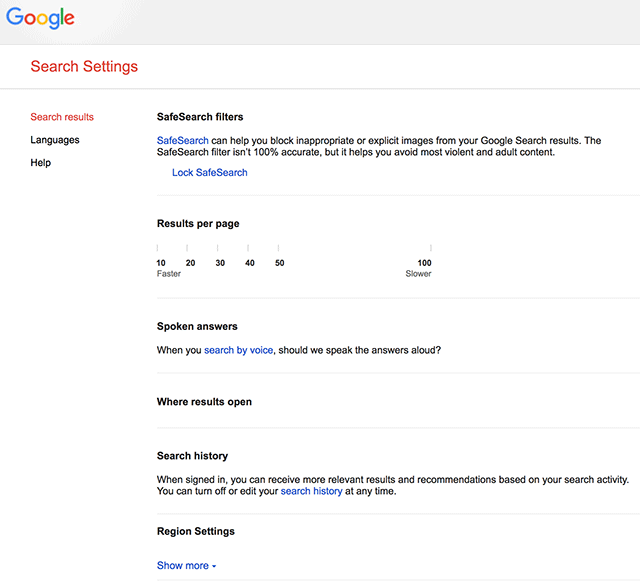
Source: Search Engine Roundtable
Back then, SEO professionals and users could customize the number of results it displays per page up to 100. The downside was a slower processing speed, but people didn’t seem to mind. The feature vanished in an update near the end of August 2018 but returned by the end of the month, citing a glitch as the cause.
Even when it was active, Google said it doesn’t formally support the Num 100 parameter. When asked for specifics, it didn’t provide any.
Not everyone agrees with Soulo’s perspective on the matter. Some claim that the post-top 20 data was helpful in informing website owners that their content lacked quality backlinks or suffered from other issues. Others say it’s valuable for programmatic SEO.
The End of SEO? Not Really.
The end of Num 100 isn’t as SEO-ending as some might believe, at least when compared to the likes of AI. That said, it’s a huge shift in the way SEO monitoring and analytics are done.
Whether your content appears outside or doesn’t appear within the top 20 indicates that it needs optimizing. If removing the parameter will result in better-quality ranking data, I’d be content with just the top 20.
References
1. “Google's Sept. 2025 SERP Update: Why seoClarity is Built for This Moment,” Source: https://www.seoclarity.net/blog/googles-num100-serp-update-why-seoclarity-is-built-for-this-moment
2. “Analyzing 319 GSC properties against the impact of Google disabling num=100,” Source: https://www.linkedin.com/feed/update/urn:li:activity:7374503350576275456/
3. “Google Removes &num=100 Parameter: What This Means for Your Website,” Source: https://locomotive.agency/blog/google-removes-num100-parameter-what-this-means-for-your-website/
4. “The great &num=100 debacle,” Source: https://browsermedia.agency/blog/the-great-num100-debacle/
5. “Solution to scrape 100 Search Results on Google - Google Fast Light API,” Source:https://serpapi.com/blog/solution-to-scrape-100-search-results-on-google-google-fast-light-api/